How Digital Notarisation Is Simplifying

Documentation for Businesses in India From employee onboarding and vendor agreements to bulk document processing, digital notarisation is helping Indian businesses explore more organised, technology-enabled approaches to eligible corporate documentation.NOIDA, UTTAR PRADESH —

As Indian businesses expand their operations, manage distributed teams and work with vendors across multiple locations, legal documentation has become an increasingly important operational responsibility. Employment-related declarations, vendor agreements, financial documents, corporate affidavits and other formal paperwork may require verification, signatures or notarisation before they can be used. Traditionally, these activities have relied on physical paperwork, in-person appointments and manual coordination. For organisations managing large workforces, multiple vendors or geographically dispersed operations, arranging each step can add administrative effort and interrupt routine business processes. Digital notarisation is one area businesses are examining as they modernise documentation workflows. Depending on the document and applicable legal requirements, a digital process may combine a live interaction with an authorised Notary Public, identity verification, electronic signatures and electronic records. These tools may make coordination more convenient, but they do not remove the need to comply with legal and institutional requirements.

Why Traditional Notarisation Can Be Challenging for Businesses

Corporate documentation often involves several departments, employees, external partners and legal stakeholders. Physical notarisation can become difficult to coordinate when signatories are located in different cities or when many documents need attention within a short period.

· Time-consuming coordination: Employees or authorised representatives may need to travel,

arrange appointments and coordinate document submissions. This can add steps to routine administration.

· Bulk documentation: Organisations with large workforces or vendor networks may need to process

many declarations and agreements. Managing each document separately can make tracking and follow-up more demanding.

· Employee onboarding: Some onboarding processes involve declarations, affidavits or other formal

documents. Where notarisation is required, arranging it can add another coordination step.

· Vendor and partner coordination: Suppliers, contractors and service providers may operate from

different locations, making physical execution inconvenient.

· Document storage and retrieval: Physical records require organised filing and storage. Retrieving

older documents and maintaining consistent records can become harder as organisations grow.

How Digital Notarisation May Support Corporate

Documentation Digital notarisation introduces electronic tools into procedures that have traditionally depended on paper and physical coordination. Depending on the document category and applicable law, the workflow may include a live audio-video interaction with an authorised Notary Public, identity checks, electronic signing and digital document records. For businesses, the potential value lies in making eligible documentation easier to coordinate across locations and departments. Employees, vendors and authorised representatives may be able to participate remotely where the process is legally appropriate and accepted by the receiving institution. Companies should first identify which documents genuinely require notarisation, which can be executed through other legally recognised methods, and what the receiving organisation will accept. This distinction helps prevent digital convenience from being mistaken for automatic legal validity.

Bulk Notarisation: Coordinating Multiple Documents

Bulk document processing is an important operational consideration for organisations that regularly handle employee declarations, vendor agreements, contractual paperwork and other formal records. A digital platform with enterprise-oriented workflows may help centralise requests, coordinate participants and organise document status. Depending on the platform’s capabilities and the legal requirements applicable to each document, businesses may look for:

· Centralised coordination: A common workflow for initiating and monitoring multiple documentation

requests.

· Participant management: Clear steps for identifying the signatories and other people who need to

take part.

· Status visibility: A way for authorised teams to track which documents are pending, completed or

require attention.

· Electronic record access: Organised access to completed documents for authorised users, subject

to privacy, security and retention requirements. These capabilities can support administration, but bulk processing does not change the legal requirements applicable to each individual document or notarial act.

The Role of HR, Legal and Procurement Teams

HR teams may encounter notarisation requirements in specific employee declarations or supporting documents. Legal teams may coordinate affidavits, authorisations and other instruments, while procurement and operations teams may manage vendor-related paperwork. A consistent workflow can help these departments understand who is responsible for each step and where a document stands. Before adopting a digital process, organisations should consult their legal advisers and confirm the requirements of the institution receiving the document. They should also establish internal controls for identity verification, access permissions, document accuracy, retention and auditability.

Legal Recognition and Compliance Remain Essential

India’s legal framework does not make every document suitable for electronic notarisation simply because electronic signatures and digital records are recognised in certain circumstances. The Information Technology Act, 2000 addresses electronic records and electronic signatures, while notarial functions are governed by the Notaries Act, 1952 and the Notaries Rules, 1956. e-signing, e-stamping and notarisation remain distinct processes. A September 2026 development in the Karnataka High Court brought the issue into sharper focus. The Court took on record an electronically notarised affidavit and directed its Registry to bring the possibility of implementing e-notarisation for High Court and District Court filings to the attention of the relevant administrative officials. The direction was to examine the possibility; it does not amount to universal approval of all electronically notarised documents. Separately, the Ministry of Law and Justice stated in an April 2026 Rajya Sabha response that no proposal for a uniform nationwide e-notarisation framework was under consideration. For businesses, this underlines the importance of checking document-specific legal requirements and the acceptance policies of the relevant recipient before relying on a digital process.

What Businesses Should Evaluate Before Adopting a Platform

A business considering digital notarisation should assess more than convenience. It should understand how the platform verifies participants, connects them with an authorised notary, records the notarial process, applies the notary’s signature and official seal where required, and provides the completed document. The organisation should also review privacy safeguards, access controls, storage arrangements, customer support and the ability to retrieve records. Most importantly, the company should confirm whether the intended document can be handled through the proposed process and whether the receiving court, government department, bank, counterparty or other institution will accept it. Legal review should be part of implementation rather than an afterthought. How Digital Platforms Are Entering the Corporate Documentation Space Technology providers are developing services intended to make eligible documentation workflows easier to coordinate. EZNotary, operated by Quereshan Solutions Private Limited, is one such platform. It offers digital notarisation-related workflows, eSigning and eStamping services through an online platform, including a feature that connects users with a live Notary Public through a video call. The company describes enterprise-oriented capabilities for documentation requirements such as bulk notarisation workflows, HR onboarding agreements, vendor contracts and other corporate paperwork. The suitability of any particular document depends on the applicable legal requirements and the policies of the organisation receiving it. EZNotary’s approach reflects a broader shift in how businesses are exploring digital tools for legal and administrative documentation. The platform’s role is best understood as part of an evolving market in which convenience must be balanced with legal compliance, data protection and institutional acceptance.

A More Organised Approach to Business Documentation

As organisations become more geographically distributed, the ability to coordinate documentation across locations is likely to remain an operational priority. Digital tools may help reduce manual follow-up, improve visibility and make eligible processes more accessible to employees and business partners. The long-term value of digital notarisation will depend not simply on moving paperwork online, but on whether the process is legally appropriate, secure and accepted by the relevant institution. Businesses that combine careful legal review with well-managed digital workflows will be better placed to benefit from the changing documentation landscape.

About EZNotary

EZNotary is a digital documentation platform operated by Quereshan Solutions Private Limited. It offers online notarisation-related workflows, eSigning and eStamping services, including live connectivity with a Notary Public. Its enterprise-oriented services are designed to support eligible business documentation workflows. For more information: www.eznotary.in

EDITORIAL FACT-CHECK REFERENCES

The following references support the legal and regulatory context in this article. This reference page is for editorial

verification and may be removed by the publishing desk.

Karnataka High Court development — Bar & Bench, 10 September 2026

Reports that the Court took an electronically notarised affidavit on record and directed the Registry to consider

implementation for court filings.

https://www.barandbench.com/news/litigation/karnataka-hc-calls-for-implementation-of-e-notarisation-in-high-cou

rt-and-district-courts

Karnataka High Court development — LawStreet, 11 September 2026

Provides procedural context and clarifies that the direction concerned examination of possible implementation.

https://lawstreet.co/judiciary/karnataka-hc-asks-registry-to-examine-enotarisation-for-court-filings

Ministry of Law and Justice — Rajya Sabha Unstarred Question No. 4437, answered 2 April 2026

Official response stating that no proposal for a uniform nationwide e-notarisation framework was under

consideration.

https://www.doj.gov.in/static/uploads/2026/04/b7b4da487543be9a9f1d1558d06d76d2.pdf

The Notaries Act, 1952 — India Code

Primary legislation governing notaries in India.

https://www.indiacode.nic.in/bitstream/123456789/17288/1/notaries_act_1952.pdf

Ministry of Law and Justice — Digital Modernisation of Notary Portal, 13 March 2026

Government information on the Notary Portal and its digital administrative functions.

https://www.pib.gov.in/PressReleasePage.aspx?PRID=2239464&lang=1®=6

EZNotary company statement on the Karnataka High Court matter

Company-published account identifying EZNotary's role in the affidavit process; attribute platform-specific details

to the company.

https://eznotary.in/blog/karnataka-high-court-accepts-e-notarised-affidavit-via-eznotary


From California to Khamla to Fireblaze: DrAnup Kelkar Joins Fireblaze AI School as Python Academy Is Acquired

The VNIT and IIIT Nagpur alumnus will lead academics and corporate relations at one ofVidarbha's largest AI and data science institutes

NAGPUR, 4 November 2026: Dr Anup Kelkar, a US-returned technologist with a PhD in AI/

ML, has joined Fireblaze AI School as Director of Academics and Corporate Relations,

following Fireblaze AI School's acquisition of his institute, Anup Kelkar's Python Academy,

Khamla.


Early in his career, Dr Kelkar worked with Tata Consultancy Services (TCS) in California,

USA. He returned to Nagpur to bring global industry practice into the classroom and

founded Python Academy in 2016, making it one of the city's first data analytics academies.

Close to a decade later, Python Academy's courses, alumni network and Khamla operations

move under Fireblaze AI School, a NASSCOM partner institute that has trained more than

20,000 learners across three Nagpur centres.


"I started Python Academy to give Nagpur students the same skills I saw global technology

teams rely on. Fireblaze shares that project-first philosophy, and together we can take that

teaching to many more students, colleges and companies," said Dr Anup Kelkar.


A Teacher, Researcher and Entrepreneur


Dr Kelkar holds B.Tech and M.Tech degrees in Computer Science from VNIT Nagpur and

recently completed a PhD in AI/ML at IIIT Nagpur. He has served as a Technical Trainer with

the IIIT Nagpur Training and Placement Cell, conducted a full-semester IT workshop for IIIT

Nagpur, and led more than 20 faculty development seminars on Python and R under NIT

Warangal (HRD Ministry) and IIIT Nagpur programmes. He has presented research in

Singapore on predicting the NIFTY Auto Index using Twitter sentiment, and regularly

conducts sessions at engineering colleges across Nagpur.


He is also Founder and CEO of SpringBoard and Senior Technical Advisor at TechQuadra

Software Solutions. Python Academy holds ratings of 4.9 on Sulekha and 4.6 on Lyfskills.


His Role at Fireblaze AI School


As Director of Academics and Corporate Relations, Dr Kelkar will lead curriculum design and

teaching quality across Fireblaze AI School, and build partnerships with colleges and

companies. He joins an institute that already works with colleges including KDK College of

Engineering, YCCE, KITS Ramtek and Rashtrasant Tukadoji Maharaj Nagpur University, and that has trained 350+ professionals at organisations including ICICI Bank, Solar Industries,Navbharat Media and Basant Agro Tech.


"Dr Kelkar brings research depth, global industry experience and the trust of thousands of

students. Bringing our institutions together means learners in Vidarbha get world-class AI

education without having to leave the city," said Aniruddha Kalbande, Founder and CEO,

Fireblaze AI School.


Two Founders, One Institute


Aniruddha Abhay Kalbande founded Fireblaze AI School and Fireblaze Technologies Private

Limited in October 2017, and has helped students, freshers and working professionals across

India, the USA and Europe build careers in data science, machine learning and AI. He was

Visiting Faculty at upGrad from 2019 to 2022, is an Associate Member of TiE Nagpur, and is

a Global Shaper with the World Economic Forum's Global Shapers Community, Nagpur Hub.

Under his leadership, Fireblaze AI School has grown into a three-centre institute with a

NASSCOM partnership, a corporate training practice and its own learning platform.


For Students and Partners


Students get a curriculum led by a PhD in AI/ML, programmes in data science, data

analytics, Generative AI and AI-powered full stack development, and placement support

including resume building, mock interviews and hiring-partner access.


All learners get Fireblaze Learn, the official student app on Google Play, with live classes,

self-paced lessons, doubt chat with faculty and placement tools. The app is rated 5.0.


Colleges get one partner for faculty development, cohort training under MOU, capstone

projects and guest sessions.


Companies get onsite and online training in Generative AI, Python, data analytics and

Power BI.

Hiring partners get access to job-ready graduates from both institutes.


Current Python Academy students can contact any Fireblaze AI School centre in Nagpur for

details about their batch.


About Fireblaze AI School


Fireblaze AI School is an AI and data science training institute headquartered at Mate

Square, Nagpur, and a unit of Fireblaze Technologies Private Limited. Founded on 31

October 2017 by Aniruddha Abhay Kalbande, it runs centres at Mate Square, Nandanvan and Sadar. The institute has trained more than 20,000 learners in data science, data analytics,

Generative AI, AI-powered full stack development and AI marketing, and has been a

NASSCOM partners for its PGP in Data Science and Analytics since 2024. Learn more at

fireblazeaischool.in.


About Anup Kelkar's Python Academy


Founded in 2016 in Khamla, Nagpur, Anup Kelkar's Python Academy was one of the city's

first data analytics academies. It trains students in Python programming, AI-integrated data

science and machine learning, Gen AI engineering and Python full stack development, and

also offers corporate training and career mentorship. The academy is rated 4.9 on Sulekha

and 4.6 on Lyfskills.


Media Contact

Fireblaze AI School

Email: +91 85301 07029

Website: fireblazeaischool.in


Before Fraud Costs You: How Mr. Sankar Rao Sees AI Transforming Business Risk Management

As businesses increasingly embrace digital operations, fraud prevention and risk management have become essential to protecting customer trust, business data and operational efficiency. From suspicious enquiries and inaccurate customer information to duplicate records and unusual activity, organizations face growing challenges in identifying potential risks. Artificial intelligence (AI) is emerging as a valuable tool in addressing these challenges by helping businesses analyze data, identify patterns, and make more informed decisions. Unlike traditional approaches that rely heavily on manual checks and predefined rules, AI-powered systems can process large volumes of data and help teams' priorities cases requiring further investigation. While these technologies can strengthen risk monitoring, their effectiveness depends on data quality, appropriate implementation, and human oversight.  


Surefy.ai: Bringing AI and Verification Capabilities Together

Founded by Mr. Sankar Rao, Surefy.ai is an AI-first customer engagement platform offering solutions for lead management, customer verification, campaign analytics, and multi-channel communication. Its offerings include Surefy Insight, positioned as a campaign and fraud analytics engine, and Surefy Console, which provides KYC and verified business APIs.

 These capabilities support businesses seeking to improve visibility into customer information and organize verification-related workflows. An AI Lead Management Platform can help structure enquiry management, while AI Lead Verification and Customer Data Validation focus on improving the reliability of lead information.  

Similarly, a Customer Verification Platform, Lead Verification Software, and Business Verification API can support organizations that require structured checks on customer or business information. Surefy.ai also offers capabilities for lead qualification, automated voice calling and communication through SMS and WhatsApp.  

By connecting these functions, the platform supports a more organized approach to customer acquisition and engagement. Its verification and analytics capabilities are relevant to businesses seeking to strengthen their processes, although no technology can guarantee the detection or prevention of every fraudulent activity.  


Helping Businesses Make More Informed Decisions

 Adopting AI requires businesses to evaluate more than automation features. Data security, privacy safeguards, integration requirements, reporting capabilities, and human oversight are important considerations when selecting a solution. Organizations should also understand which checks are performed and what risks a particular system is designed to identify.  

Solutions associated with AI Sales Automation, Lead Qualification Software, an AI Lead Verification Platform, and a Customer Data Verification Platform can contribute to more structured operations when aligned with specific business needs. The objective should be to make measurable improvements in data quality, workflow efficiency, and risk monitoring.


 Rethinking Risk Management for the Digital Future  

As digital business continues to evolve, combining reliable information, intelligent analysis and responsible decision-making will become increasingly important. AI can help organizations identify potential warning signs and improve verification processes, while established security controls and human judgement remain essential.

 Through Surefy.ai, Mr. Sankar Rao is pursuing a technology-led approach to business challenges involving customer verification, lead management, analytics, and engagement. Businesses interested in exploring the company's available solutions can visit Surefy.ai to learn more about its platform and capabilities.


Thavaputhalvi Rural Women Empowerment Mission: Empowering Rural Women to Become Entrepreneurs and Leaders - By Prof. Dr. Subathra Chelladurai, F
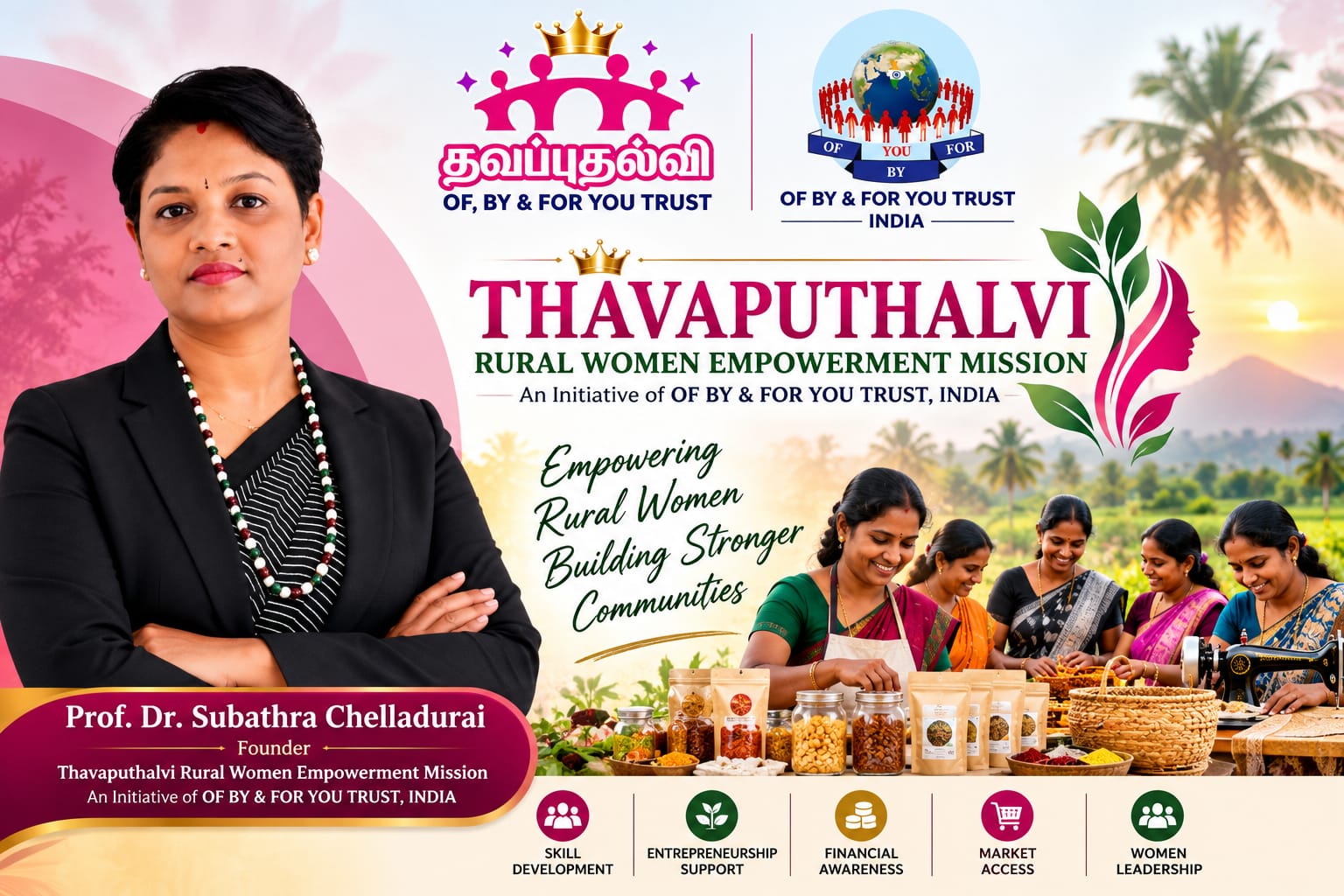
In a society striving for inclusive growth and sustainable development, the empowerment of rural women is not merely a social responsibility; it is an essential investment in the future of families, communities, and the nation. Recognising this need, the Thavaputhalvi Rural Women Empowerment Mission, an initiative of OF BY & FOR YOU TRUST, INDIA, seeks to create meaningful opportunities for rural women to develop their skills, pursue entrepreneurship, achieve economic independence, and emerge as leaders of change.

Beyond Empowerment: Building Economic Independence

Rural women play a vital role in agriculture, household management, traditional occupations, food preparation, handicrafts, and community development. Despite their contributions, many face barriers that limit their economic advancement. Inadequate access to business training, financial resources, market opportunities, technology, professional networks, and institutional support can prevent their skills from becoming sustainable sources of income.

The Thavaputhalvi Rural Women Empowerment Mission envisions a future in which rural women are recognised not only for their contributions to families and communities but also as entrepreneurs, producers, business owners, decision-makers, and agents of social transformation.

The mission's underlying philosophy is that women should have the opportunity to move beyond economic dependency and become confident participants in the economic development of their communities.

Transforming Skills into Sustainable Livelihoods

One of the mission's central priorities is to encourage rural women to identify their strengths, develop practical skills, and explore viable entrepreneurial opportunities. Women who possess traditional knowledge or experience in food production, tailoring, handicrafts, natural products, agriculture-related activities, and other local occupations can be supported in transforming these capabilities into organised business ventures.

However, entrepreneurship requires more than an idea or a product. It also demands planning, financial awareness, quality management, packaging, branding, pricing, customer relations, and access to markets.

Accordingly, the mission seeks to promote a comprehensive approach to women's entrepreneurship through capacity-building programmes, enterprise development guidance, product improvement, marketing support, and connections with appropriate institutions and business networks.

Particular importance can be given to locally available resources and traditional skills, enabling women to develop enterprises that respond to market demand while preserving the value of local knowledge and culture.

Creating Market Opportunities for Rural Women

For many small producers, developing a product is only the first step. Reaching customers, securing fair prices, maintaining product quality, and competing in an increasingly digital marketplace can be equally challenging.

The Thavaputhalvi mission seeks to address these challenges by encouraging women entrepreneurs to strengthen their product identity, improve presentation and packaging, explore digital marketing, and establish connections with retailers, institutions, consumers, and other potential buyers.

Collective marketing and collaborative business models may also help women share resources, improve visibility, and explore larger market opportunities.

By connecting skill development with business guidance and market access, the mission aims to create an enabling environment in which rural women can pursue more sustainable livelihoods and build confidence in their entrepreneurial abilities.

Financial Literacy and Responsible Enterprise Development

Access to finance is an important consideration for women seeking to establish or expand a business. Yet financial support is most effective when accompanied by appropriate guidance, realistic business planning, and an understanding of repayment responsibilities.

The mission seeks to encourage financial literacy and awareness of suitable government schemes, institutional credit facilities, and entrepreneurship support programmes, subject to eligibility and the applicable requirements of the respective institutions.

The objective is to help women make informed financial decisions, understand business risks, and develop enterprises with a stronger foundation for long-term sustainability.

Economic empowerment should not be measured solely by the number of businesses established. It should also be reflected in women's ability to make independent financial decisions, contribute to household well-being, participate in community affairs, and plan confidently for their futures.

A Community-Centred Vision for Women's Leadership

The impact of empowering a woman can extend beyond her individual enterprise. When women gain skills, confidence, income, and decision-making opportunities, they can become role models for younger generations and contribute to the progress of their communities.

Thavaputhalvi aspires to encourage a culture in which rural women support one another, exchange knowledge, build professional relationships, and work collectively towards shared economic goals.

The mission's long-term vision is to nurture a network of capable rural women entrepreneurs who can inspire others, strengthen local economies, and contribute to inclusive development.

Progress towards this vision will depend on collaboration among women, community organisations, educational institutions, financial institutions, government agencies, responsible businesses, and potential supporters.

The Vision Behind Thavaputhalvi

Founded by Prof. Dr. Subathra Chelladurai, the Thavaputhalvi Rural Women Empowerment Mission reflects a commitment to connecting women's empowerment with practical economic opportunities. Through OF BY & FOR YOU TRUST, INDIA, the initiative seeks to promote a development approach that values women's abilities and supports their journey towards entrepreneurship, independence, and leadership.

The name Thavaputhalvi represents an identity associated with purpose, dignity, and positive social contribution. The mission aspires to translate these values into opportunities that help rural women recognise their potential and take meaningful steps towards economic self-reliance.

Its vision is not simply to encourage women to earn an income, but to help create conditions in which they can build sustainable enterprises, strengthen their confidence, and participate more actively in shaping their futures.

Empowering Women, Strengthening India

India's development journey becomes more inclusive when rural women have access to the knowledge, resources, opportunities, and networks needed to realise their potential. Supporting women-led enterprises can contribute to livelihood generation, local economic activity, family well-being, and stronger communities.

The Thavaputhalvi Rural Women Empowerment Mission seeks to contribute to this broader vision by placing rural women at the centre of economic opportunity and community development.

When a rural woman is empowered with skills, opportunity, confidence, and market access, she gains more than the possibility of earning an income—she gains greater power to shape her own future.

Through its commitment to rural women's entrepreneurship and economic independence, Thavaputhalvi aspires to help turn women's potential into opportunity, opportunity into enterprise, and enterprise into lasting social progress.


Prof.Dr. SUBATHRA CHELLADURAI- Founder

THAVAPUTHALVI RURAL WOMEN EMPOWERMENT MISSION

An Initiative of OF BY & FOR YOU TRUST, INDIA

Instapage: https://www.instagram.com/thavaputhalvi_youtrust

Website: https://thavaputhalvi.in, Whatsapp/ Call : +91-7358102775


Empowering Rural Women • Inspiring Change


 Thavaputhalvi Rural Women Empowerment Mission: Empowering Rural Women to Become Entrepreneurs and Leaders - By Prof. Dr. Subathra Chelladurai, Founder, THAVAPUTHALVI RURAL WOMEN EMPOWERMENT MISSION, An Initiative of OF BY & FOR YOU TRUST, INDIA


In a society striving for inclusive growth and sustainable development, the empowerment of rural women is not merely a social responsibility; it is an essential investment in the future of families, communities, and the nation. Recognising this need, the Thavaputhalvi Rural Women Empowerment Mission, an initiative of OF BY & FOR YOU TRUST, INDIA, seeks to create meaningful opportunities for rural women to develop their skills, pursue entrepreneurship, achieve economic independence, and emerge as leaders of change.

Beyond Empowerment: Building Economic Independence

Rural women play a vital role in agriculture, household management, traditional occupations, food preparation, handicrafts, and community development. Despite their contributions, many face barriers that limit their economic advancement. Inadequate access to business training, financial resources, market opportunities, technology, professional networks, and institutional support can prevent their skills from becoming sustainable sources of income.

The Thavaputhalvi Rural Women Empowerment Mission envisions a future in which rural women are recognised not only for their contributions to families and communities but also as entrepreneurs, producers, business owners, decision-makers, and agents of social transformation.

The mission's underlying philosophy is that women should have the opportunity to move beyond economic dependency and become confident participants in the economic development of their communities.

Transforming Skills into Sustainable Livelihoods

One of the mission's central priorities is to encourage rural women to identify their strengths, develop practical skills, and explore viable entrepreneurial opportunities. Women who possess traditional knowledge or experience in food production, tailoring, handicrafts, natural products, agriculture-related activities, and other local occupations can be supported in transforming these capabilities into organised business ventures.

However, entrepreneurship requires more than an idea or a product. It also demands planning, financial awareness, quality management, packaging, branding, pricing, customer relations, and access to markets.

Accordingly, the mission seeks to promote a comprehensive approach to women's entrepreneurship through capacity-building programmes, enterprise development guidance, product improvement, marketing support, and connections with appropriate institutions and business networks.

Particular importance can be given to locally available resources and traditional skills, enabling women to develop enterprises that respond to market demand while preserving the value of local knowledge and culture.

Creating Market Opportunities for Rural Women

For many small producers, developing a product is only the first step. Reaching customers, securing fair prices, maintaining product quality, and competing in an increasingly digital marketplace can be equally challenging.

The Thavaputhalvi mission seeks to address these challenges by encouraging women entrepreneurs to strengthen their product identity, improve presentation and packaging, explore digital marketing, and establish connections with retailers, institutions, consumers, and other potential buyers.

Collective marketing and collaborative business models may also help women share resources, improve visibility, and explore larger market opportunities.

By connecting skill development with business guidance and market access, the mission aims to create an enabling environment in which rural women can pursue more sustainable livelihoods and build confidence in their entrepreneurial abilities.

Financial Literacy and Responsible Enterprise Development

Access to finance is an important consideration for women seeking to establish or expand a business. Yet financial support is most effective when accompanied by appropriate guidance, realistic business planning, and an understanding of repayment responsibilities.

The mission seeks to encourage financial literacy and awareness of suitable government schemes, institutional credit facilities, and entrepreneurship support programmes, subject to eligibility and the applicable requirements of the respective institutions.

The objective is to help women make informed financial decisions, understand business risks, and develop enterprises with a stronger foundation for long-term sustainability.

Economic empowerment should not be measured solely by the number of businesses established. It should also be reflected in women's ability to make independent financial decisions, contribute to household well-being, participate in community affairs, and plan confidently for their futures.

A Community-Centred Vision for Women's Leadership

The impact of empowering a woman can extend beyond her individual enterprise. When women gain skills, confidence, income, and decision-making opportunities, they can become role models for younger generations and contribute to the progress of their communities.

Thavaputhalvi aspires to encourage a culture in which rural women support one another, exchange knowledge, build professional relationships, and work collectively towards shared economic goals.

The mission's long-term vision is to nurture a network of capable rural women entrepreneurs who can inspire others, strengthen local economies, and contribute to inclusive development.

Progress towards this vision will depend on collaboration among women, community organisations, educational institutions, financial institutions, government agencies, responsible businesses, and potential supporters.

The Vision Behind Thavaputhalvi

Founded by Prof. Dr. Subathra Chelladurai, the Thavaputhalvi Rural Women Empowerment Mission reflects a commitment to connecting women's empowerment with practical economic opportunities. Through OF BY & FOR YOU TRUST, INDIA, the initiative seeks to promote a development approach that values women's abilities and supports their journey towards entrepreneurship, independence, and leadership.

The name Thavaputhalvi represents an identity associated with purpose, dignity, and positive social contribution. The mission aspires to translate these values into opportunities that help rural women recognise their potential and take meaningful steps towards economic self-reliance.

Its vision is not simply to encourage women to earn an income, but to help create conditions in which they can build sustainable enterprises, strengthen their confidence, and participate more actively in shaping their futures.

Empowering Women, Strengthening India

India's development journey becomes more inclusive when rural women have access to the knowledge, resources, opportunities, and networks needed to realise their potential. Supporting women-led enterprises can contribute to livelihood generation, local economic activity, family well-being, and stronger communities.

The Thavaputhalvi Rural Women Empowerment Mission seeks to contribute to this broader vision by placing rural women at the centre of economic opportunity and community development.

When a rural woman is empowered with skills, opportunity, confidence, and market access, she gains more than the possibility of earning an income—she gains greater power to shape her own future.

Through its commitment to rural women's entrepreneurship and economic independence, Thavaputhalvi aspires to help turn women's potential into opportunity, opportunity into enterprise, and enterprise into lasting social progress.


Prof.Dr. SUBATHRA CHELLADURAI- Founder

THAVAPUTHALVI RURAL WOMEN EMPOWERMENT MISSION

An Initiative of OF BY & FOR YOU TRUST, INDIA

Instapage: https://www.instagram.com/thavaputhalvi_youtrust

Website: https://thavaputhalvi.in, Whatsapp/ Call : +91-7358102775


Empowering Rural Women • Inspiring Change



 Thavaputhalvi Rural Women Empowerment Mission: Empowering Rural Women to Become Entrepreneurs and Leaders - By Prof. Dr. Subathra Chelladurai, Founder, THAVAPUTHALVI RURAL WOMEN EMPOWERMENT MISSION, An Initiative of OF BY & FOR YOU TRUST, INDIA


In a society striving for inclusive growth and sustainable development, the empowerment of rural women is not merely a social responsibility; it is an essential investment in the future of families, communities, and the nation. Recognising this need, the Thavaputhalvi Rural Women Empowerment Mission, an initiative of OF BY & FOR YOU TRUST, INDIA, seeks to create meaningful opportunities for rural women to develop their skills, pursue entrepreneurship, achieve economic independence, and emerge as leaders of change.

Beyond Empowerment: Building Economic Independence

Rural women play a vital role in agriculture, household management, traditional occupations, food preparation, handicrafts, and community development. Despite their contributions, many face barriers that limit their economic advancement. Inadequate access to business training, financial resources, market opportunities, technology, professional networks, and institutional support can prevent their skills from becoming sustainable sources of income.

The Thavaputhalvi Rural Women Empowerment Mission envisions a future in which rural women are recognised not only for their contributions to families and communities but also as entrepreneurs, producers, business owners, decision-makers, and agents of social transformation.

The mission's underlying philosophy is that women should have the opportunity to move beyond economic dependency and become confident participants in the economic development of their communities.

Transforming Skills into Sustainable Livelihoods

One of the mission's central priorities is to encourage rural women to identify their strengths, develop practical skills, and explore viable entrepreneurial opportunities. Women who possess traditional knowledge or experience in food production, tailoring, handicrafts, natural products, agriculture-related activities, and other local occupations can be supported in transforming these capabilities into organised business ventures.

However, entrepreneurship requires more than an idea or a product. It also demands planning, financial awareness, quality management, packaging, branding, pricing, customer relations, and access to markets.

Accordingly, the mission seeks to promote a comprehensive approach to women's entrepreneurship through capacity-building programmes, enterprise development guidance, product improvement, marketing support, and connections with appropriate institutions and business networks.

Particular importance can be given to locally available resources and traditional skills, enabling women to develop enterprises that respond to market demand while preserving the value of local knowledge and culture.

Creating Market Opportunities for Rural Women

For many small producers, developing a product is only the first step. Reaching customers, securing fair prices, maintaining product quality, and competing in an increasingly digital marketplace can be equally challenging.

The Thavaputhalvi mission seeks to address these challenges by encouraging women entrepreneurs to strengthen their product identity, improve presentation and packaging, explore digital marketing, and establish connections with retailers, institutions, consumers, and other potential buyers.

Collective marketing and collaborative business models may also help women share resources, improve visibility, and explore larger market opportunities.

By connecting skill development with business guidance and market access, the mission aims to create an enabling environment in which rural women can pursue more sustainable livelihoods and build confidence in their entrepreneurial abilities.

Financial Literacy and Responsible Enterprise Development

Access to finance is an important consideration for women seeking to establish or expand a business. Yet financial support is most effective when accompanied by appropriate guidance, realistic business planning, and an understanding of repayment responsibilities.

The mission seeks to encourage financial literacy and awareness of suitable government schemes, institutional credit facilities, and entrepreneurship support programmes, subject to eligibility and the applicable requirements of the respective institutions.

The objective is to help women make informed financial decisions, understand business risks, and develop enterprises with a stronger foundation for long-term sustainability.

Economic empowerment should not be measured solely by the number of businesses established. It should also be reflected in women's ability to make independent financial decisions, contribute to household well-being, participate in community affairs, and plan confidently for their futures.

A Community-Centred Vision for Women's Leadership

The impact of empowering a woman can extend beyond her individual enterprise. When women gain skills, confidence, income, and decision-making opportunities, they can become role models for younger generations and contribute to the progress of their communities.

Thavaputhalvi aspires to encourage a culture in which rural women support one another, exchange knowledge, build professional relationships, and work collectively towards shared economic goals.

The mission's long-term vision is to nurture a network of capable rural women entrepreneurs who can inspire others, strengthen local economies, and contribute to inclusive development.

Progress towards this vision will depend on collaboration among women, community organisations, educational institutions, financial institutions, government agencies, responsible businesses, and potential supporters.

The Vision Behind Thavaputhalvi

Founded by Prof. Dr. Subathra Chelladurai, the Thavaputhalvi Rural Women Empowerment Mission reflects a commitment to connecting women's empowerment with practical economic opportunities. Through OF BY & FOR YOU TRUST, INDIA, the initiative seeks to promote a development approach that values women's abilities and supports their journey towards entrepreneurship, independence, and leadership.

The name Thavaputhalvi represents an identity associated with purpose, dignity, and positive social contribution. The mission aspires to translate these values into opportunities that help rural women recognise their potential and take meaningful steps towards economic self-reliance.

Its vision is not simply to encourage women to earn an income, but to help create conditions in which they can build sustainable enterprises, strengthen their confidence, and participate more actively in shaping their futures.

Empowering Women, Strengthening India

India's development journey becomes more inclusive when rural women have access to the knowledge, resources, opportunities, and networks needed to realise their potential. Supporting women-led enterprises can contribute to livelihood generation, local economic activity, family well-being, and stronger communities.

The Thavaputhalvi Rural Women Empowerment Mission seeks to contribute to this broader vision by placing rural women at the centre of economic opportunity and community development.

When a rural woman is empowered with skills, opportunity, confidence, and market access, she gains more than the possibility of earning an income—she gains greater power to shape her own future.

Through its commitment to rural women's entrepreneurship and economic independence, Thavaputhalvi aspires to help turn women's potential into opportunity, opportunity into enterprise, and enterprise into lasting social progress.


Prof.Dr. SUBATHRA CHELLADURAI- Founder

THAVAPUTHALVI RURAL WOMEN EMPOWERMENT MISSION

An Initiative of OF BY & FOR YOU TRUST, INDIA

Instapage: https://www.instagram.com/thavaputhalvi_youtrust

Website: https://thavaputhalvi.in, Whatsapp/ Call : +91-7358102775


Empowering Rural Women • Inspiring Change



Made in Delhi, Worn Around the World: How Corset Vogue Grew from a Setback

Some of the most interesting brands are born in difficult moments. Corset Vogue is one of them.Its story begins not in a boardroom, but with a corset designer named Ravinder Singh who suddenly found himself out of work, in an industry where jobs were almost impossible to find.

A Rare Skill in a Small Industry

Corset making is a specialised craft. It takes precise pattern work, the right materials and a deep understanding of how structure meets the body. Ravinder had built that knowledge over years as a corset designer.

The problem was that India had very few corset manufacturers. When he lost his job, there was simply nowhere else to take his skills. The industry was too small to absorb him.

So he stopped looking for a place in it and decided to make one.

The First Machine

In 2021, Ravinder started Corset Vogue in Delhi with one second-hand sewing machine. It was a modest start, but it was enough to make the kind of corsets he believed in: steel boned, carefully shaped and built to last.

Word spread through customers who loved the fit. The collection grew to include steampunk corsets with a Victorian, industrial feel, gothic corsets for lovers of dark fashion, versatile underbust corsets, bold overbust corsets and elegant corset dresses.

Crossing Borders

As the quality became known, a new kind of customer arrived: international brands.

Today, Corset Vogue manufactures and exports corsets for international brands. Designs made in Delhi now travel to customers in other countries under other labels. For a business that began with one used machine, that is a remarkable step, and proof that specialist craftsmanship from India can compete anywhere.

Making Room for the Next Generation

Growing bigger did not make Corset Vogue forget where it came from. The brand saw how hard it was for small boutiques, resellers and new labels to work with manufacturers who demanded huge orders.

So Corset Vogue keeps its minimum order quantity at just 20 pieces, with very reasonable prices. Whether it is a brand abroad testing a new line or a boutique in India adding corsets for the first time, the door is open to start small.

It is the same principle Ravinder built his own business on: take the first practical step, and grow from there.

What Comes Next

Corset Vogue now runs on three tracks: its own online store for customers across India, wholesale for resellers and boutiques, and manufacturing and export for international brands. The goal ahead is to take the Corset Vogue name itself to corset lovers worldwide.

Connect with Corset Vogue

For manufacturing, export or wholesale enquiries, visit the wholesale page or email the collection at www.corsetvogue.com and follow the journey on Instagram Vogue: Sculpt Your Silhouette.

Understanding Migraine: A Complete Guide to the 4 Stages of Migraine

Discover the 4 stages of migraine, common symptoms, causes, and supportive care options at Spiritual Homeopathy in Hyderabad for better health awareness.

Introduction to Migraine

Migraine is a neurological condition that can cause recurring headaches, nausea, vomiting, and sensitivity to light and sound. These symptoms may interfere with work, sleep, and everyday activities. Understanding the 4 stages of migraine helps individuals recognize early warning signs and understand how a migraine attack progresses. While some people experience all four stages, others may experience only a few.

Exploring the 4 Stages of Migraine

1. Prodrome: Early Warning Signs

The first of the 4 stages of migraine is the prodrome stage. It may begin several hours or days before the headache. Common symptoms include tiredness, frequent yawning, mood changes, food cravings, neck stiffness, and difficulty concentrating. Identifying these early signs may help individuals recognize their migraine patterns.

2. Aura: Temporary Sensory Changes

The second stage of the 4 stages of migraine is the aura stage. It affects some individuals and may cause flashing lights, zigzag patterns, blind spots, tingling sensations, or temporary speech difficulties. Aura generally lasts between 5 and 60 minutes. New or sudden neurological symptoms should be assessed urgently by a healthcare professional.

3. Headache: The Painful Phase

The third of the 4 stages of migraine is the headache stage. Symptoms may include throbbing head pain, nausea, vomiting, and sensitivity to light, sound, or smells. Pain can affect one or both sides of the head and make daily activities difficult. An untreated migraine attack may last between 4 and 72 hours.

4. Postdrome: The Recovery Phase

The final stage of the 4 stages of migraine is postdrome. After the headache improves, some people experience fatigue, dizziness, low energy, and difficulty concentrating. Adequate rest, hydration, and regular meals may support general recovery.

Common Migraine Causes and Triggers

The 4 stages of migraine may be associated with different triggers. Common factors include stress, irregular sleep, dehydration, skipped meals, hormonal changes, bright lights, and fluctuations in caffeine consumption. Keeping a headache diary can help identify individual triggers and support discussions with a healthcare professional.

Homeopathy and Migraine Care

People interested in homeopathy may seek personalized consultations to discuss migraine symptoms, lifestyle habits, and general well-being. However, scientific evidence does not establish homeopathy as an effective treatment for migraine. It should not replace evidence-based medical care. Consulting a qualified healthcare professional helps individuals understand appropriate treatment and prevention options.

Spiritual Homeopathy in Hyderabad

Spiritual Homeopathy offers consultations for individuals seeking guidance about their health concerns. People in Hyderabad can contact the clinic to learn about available consultation services and discuss their symptoms with a practitioner. Understanding the 4 stages of migraine can help individuals explain their experiences and make informed healthcare decisions.

Take the Next Step Toward Better Health

If recurring headaches affect your daily routine, seek professional medical advice to identify possible causes and suitable treatment options.

Contact Spiritual Homeopathy: 9069176176.

#spiritualhomeo  #bestdoctors  #migrane

From Slum Lanes to a National Vision: Mangan Thomas Rijoy Introduces Desiya Suraksha Party

Chennai, India | October 8, 2026

Desiya Suraksha Party emerges from five years of grassroots work through the Secure Our City campaign, with a focus on safety, housing, education and healthcare.

“Why should a woman feel unsafe in her own street?” This question became the starting point of Secure Our City, a community safety campaign initiated by Mangan Thomas Rijoy (MTR), President of Desiya Suraksha Party (DSP)

According to the campaign's account, the initiative began in Chennai five years ago with a commitment to provide 10,000 free CCTV cameras in selected Indian cities. Working without NGO backing, corporate funding or political support, the campaign reports that it has helped secure 5,000 houses in Chennai's slum communities.

However, years of working closely with residents led MTR to reconsider what safety means for families facing economic hardship.

Living and interacting with communities helped bring wider challenges into focus, including inadequate housing, access to food, healthcare, clothing and education. The experience shaped a broader vision that extends beyond surveillance and neighbourhood security

“A camera cannot secure a hungry stomach. A camera cannot secure a homeless family,” MTR said, describing the thinking behind the next phase of his work

This experience eventually led to the formation of Desiya Suraksha Party (DSP), a political initiative intended, according to its stated mission, to raise questions about public accountability, resource distribution and the living conditions of ordinary citizens.


Desiya Suraksha Party's Key Prioritie

DSP has outlined five principal commitments in its proposed social agenda

Housing for every family: A minimum 500-square-foot home for every Indian family.

Dignity and basic necessities: Access to good-quality clothing and essential living conditions.

Free education and healthcare: Education and medical services at international standards, provided free of charge.

A future for every child: A home, family environment and future for children without parental care, with the state acting as guardian where necessary.

Safety for women and children: Recognition of personal safety as a fundamental right rather than merely a government scheme.

These commitments represent the party's stated policy vision. Their implementation would require detailed plans covering funding, administration, eligibility and delivery.


A Campaign with a Wider Purpose

The Secure Our City initiative was originally intended to establish a community safety model that could later expand through SecureCam India and potential corporate social responsibility (CSR) funding.

DSP now says the campaign will continue alongside its broader social agenda. Following its first Maanadu, scheduled for December 10, 2026, in Chennai, the party plans to expand the initiative across India.

The campaign also proposes security audits for homes and buildings, with a minimum security guarantee. Further details on implementation and coverage are expected to clarify how this proposal would operate.


Beginning in Tamil Nadu and Kerala


DSP has identified Tamil Nadu and Kerala as the starting points for its next phase. MTR has invited people interested in community safety and social welfare to learn about the party and its stated objectives.

The party's central message is that public safety involves more than preventing crime. It also encompasses access to shelter, healthcare, education and dignified living conditions.

As DSP prepares for its December gathering, the transition from a neighbourhood CCTV campaign to a broader political platform marks a new stage in MTR's stated public-service journey.


About Desiya Suraksha Party

Desiya Suraksha Party (DSP) is led by President Mangan Thomas Rijoy (MTR). Its stated priorities include community safety, housing, education, healthcare, child welfare and public accountability.


Media Contact

Desiya Suraksha Party

President: Mangan Thomas Rijoy (MTR)

Tamil Nadu & Kerala Unit

Website: https://secureourcity.org/

Phone: +91 96054 35521


BUZZ. BELIEF. PERFORMANCE. DESI WARRIORZ INTO THE SEMIS!

YANA League’s Most Popular Team Desi WarriorZ Storms Into Semi-Finals, Eyes Historic Championship

Mumbai, October 4: Desi WarriorZ, one of the most popular and talked-about teams of the YANA Table Tennis League, has stormed into the semi-finals, turning the tremendous buzz around the team into a powerful run on the table.

From making waves at the auction to emerging as one of the league’s biggest crowd-pullers, Desi WarriorZ has carried a distinct energy throughout the tournament. With a place in the final four, the team now finds itself within touching distance of the championship.

Owned by Rajveer Singh, with Anjuri Sinha as Partner, Desi WarriorZ has an unusual story behind its success. Neither comes from a table-tennis playing background, yet together they built a competitive squad and created a franchise identity that became hugely popular even before the first ball was played.

The credit on the table, however, belongs to the Desi WarriorZ players, who have delivered under pressure and carried the team into the semi-finals.

Founded by Krishna Kotian, the YANA Table Tennis League brings the sporting community together while supporting the important cause of Breast Cancer Awareness.

For Desi WarriorZ, what started at the auction table has now reached the final four.

The popularity created the buzz. The players delivered the performance. And now, Desi WarriorZ are in the semi-finals.

From Auction to the Final Four — Desi WarriorZ Are Coming for the Crown.

How Digital Notarisation Is Simplifying

Documentation for Businesses in India From employee onboarding and vendor agreements to bulk document processing, digital notarisation is helping Indian businesses explore more organised, technology-enabled approaches to eligible corporate documentation.NOIDA, UTTAR PRADESH —

As Indian businesses expand their operations, manage distributed teams and work with vendors across multiple locations, legal documentation has become an increasingly important operational responsibility. Employment-related declarations, vendor agreements, financial documents, corporate affidavits and other formal paperwork may require verification, signatures or notarisation before they can be used. Traditionally, these activities have relied on physical paperwork, in-person appointments and manual coordination. For organisations managing large workforces, multiple vendors or geographically dispersed operations, arranging each step can add administrative effort and interrupt routine business processes. Digital notarisation is one area businesses are examining as they modernise documentation workflows. Depending on the document and applicable legal requirements, a digital process may combine a live interaction with an authorised Notary Public, identity verification, electronic signatures and electronic records. These tools may make coordination more convenient, but they do not remove the need to comply with legal and institutional requirements.

Why Traditional Notarisation Can Be Challenging for Businesses

Corporate documentation often involves several departments, employees, external partners and legal stakeholders. Physical notarisation can become difficult to coordinate when signatories are located in different cities or when many documents need attention within a short period.

· Time-consuming coordination: Employees or authorised representatives may need to travel,

arrange appointments and coordinate document submissions. This can add steps to routine administration.

· Bulk documentation: Organisations with large workforces or vendor networks may need to process

many declarations and agreements. Managing each document separately can make tracking and follow-up more demanding.

· Employee onboarding: Some onboarding processes involve declarations, affidavits or other formal

documents. Where notarisation is required, arranging it can add another coordination step.

· Vendor and partner coordination: Suppliers, contractors and service providers may operate from

different locations, making physical execution inconvenient.

· Document storage and retrieval: Physical records require organised filing and storage. Retrieving

older documents and maintaining consistent records can become harder as organisations grow.

How Digital Notarisation May Support Corporate

Documentation Digital notarisation introduces electronic tools into procedures that have traditionally depended on paper and physical coordination. Depending on the document category and applicable law, the workflow may include a live audio-video interaction with an authorised Notary Public, identity checks, electronic signing and digital document records. For businesses, the potential value lies in making eligible documentation easier to coordinate across locations and departments. Employees, vendors and authorised representatives may be able to participate remotely where the process is legally appropriate and accepted by the receiving institution. Companies should first identify which documents genuinely require notarisation, which can be executed through other legally recognised methods, and what the receiving organisation will accept. This distinction helps prevent digital convenience from being mistaken for automatic legal validity.

Bulk Notarisation: Coordinating Multiple Documents

Bulk document processing is an important operational consideration for organisations that regularly handle employee declarations, vendor agreements, contractual paperwork and other formal records. A digital platform with enterprise-oriented workflows may help centralise requests, coordinate participants and organise document status. Depending on the platform’s capabilities and the legal requirements applicable to each document, businesses may look for:

· Centralised coordination: A common workflow for initiating and monitoring multiple documentation

requests.

· Participant management: Clear steps for identifying the signatories and other people who need to

take part.

· Status visibility: A way for authorised teams to track which documents are pending, completed or

require attention.

· Electronic record access: Organised access to completed documents for authorised users, subject

to privacy, security and retention requirements. These capabilities can support administration, but bulk processing does not change the legal requirements applicable to each individual document or notarial act.

The Role of HR, Legal and Procurement Teams

HR teams may encounter notarisation requirements in specific employee declarations or supporting documents. Legal teams may coordinate affidavits, authorisations and other instruments, while procurement and operations teams may manage vendor-related paperwork. A consistent workflow can help these departments understand who is responsible for each step and where a document stands. Before adopting a digital process, organisations should consult their legal advisers and confirm the requirements of the institution receiving the document. They should also establish internal controls for identity verification, access permissions, document accuracy, retention and auditability.

Legal Recognition and Compliance Remain Essential

India’s legal framework does not make every document suitable for electronic notarisation simply because electronic signatures and digital records are recognised in certain circumstances. The Information Technology Act, 2000 addresses electronic records and electronic signatures, while notarial functions are governed by the Notaries Act, 1952 and the Notaries Rules, 1956. e-signing, e-stamping and notarisation remain distinct processes. A September 2026 development in the Karnataka High Court brought the issue into sharper focus. The Court took on record an electronically notarised affidavit and directed its Registry to bring the possibility of implementing e-notarisation for High Court and District Court filings to the attention of the relevant administrative officials. The direction was to examine the possibility; it does not amount to universal approval of all electronically notarised documents. Separately, the Ministry of Law and Justice stated in an April 2026 Rajya Sabha response that no proposal for a uniform nationwide e-notarisation framework was under consideration. For businesses, this underlines the importance of checking document-specific legal requirements and the acceptance policies of the relevant recipient before relying on a digital process.

What Businesses Should Evaluate Before Adopting a Platform

A business considering digital notarisation should assess more than convenience. It should understand how the platform verifies participants, connects them with an authorised notary, records the notarial process, applies the notary’s signature and official seal where required, and provides the completed document. The organisation should also review privacy safeguards, access controls, storage arrangements, customer support and the ability to retrieve records. Most importantly, the company should confirm whether the intended document can be handled through the proposed process and whether the receiving court, government department, bank, counterparty or other institution will accept it. Legal review should be part of implementation rather than an afterthought. How Digital Platforms Are Entering the Corporate Documentation Space Technology providers are developing services intended to make eligible documentation workflows easier to coordinate. EZNotary, operated by Quereshan Solutions Private Limited, is one such platform. It offers digital notarisation-related workflows, eSigning and eStamping services through an online platform, including a feature that connects users with a live Notary Public through a video call. The company describes enterprise-oriented capabilities for documentation requirements such as bulk notarisation workflows, HR onboarding agreements, vendor contracts and other corporate paperwork. The suitability of any particular document depends on the applicable legal requirements and the policies of the organisation receiving it. EZNotary’s approach reflects a broader shift in how businesses are exploring digital tools for legal and administrative documentation. The platform’s role is best understood as part of an evolving market in which convenience must be balanced with legal compliance, data protection and institutional acceptance.

A More Organised Approach to Business Documentation

As organisations become more geographically distributed, the ability to coordinate documentation across locations is likely to remain an operational priority. Digital tools may help reduce manual follow-up, improve visibility and make eligible processes more accessible to employees and business partners. The long-term value of digital notarisation will depend not simply on moving paperwork online, but on whether the process is legally appropriate, secure and accepted by the relevant institution. Businesses that combine careful legal review with well-managed digital workflows will be better placed to benefit from the changing documentation landscape.

About EZNotary

EZNotary is a digital documentation platform operated by Quereshan Solutions Private Limited. It offers online notarisation-related workflows, eSigning and eStamping services, including live connectivity with a Notary Public. Its enterprise-oriented services are designed to support eligible business documentation workflows. For more information: www.eznotary.in

EDITORIAL FACT-CHECK REFERENCES

The following references support the legal and regulatory context in this article. This reference page is for editorial

verification and may be removed by the publishing desk.

Karnataka High Court development — Bar & Bench, 10 September 2026

Reports that the Court took an electronically notarised affidavit on record and directed the Registry to consider

implementation for court filings.

https://www.barandbench.com/news/litigation/karnataka-hc-calls-for-implementation-of-e-notarisation-in-high-cou

rt-and-district-courts

Karnataka High Court development — LawStreet, 11 September 2026

Provides procedural context and clarifies that the direction concerned examination of possible implementation.

https://lawstreet.co/judiciary/karnataka-hc-asks-registry-to-examine-enotarisation-for-court-filings

Ministry of Law and Justice — Rajya Sabha Unstarred Question No. 4437, answered 2 April 2026

Official response stating that no proposal for a uniform nationwide e-notarisation framework was under

consideration.

https://www.doj.gov.in/static/uploads/2026/04/b7b4da487543be9a9f1d1558d06d76d2.pdf

The Notaries Act, 1952 — India Code

Primary legislation governing notaries in India.

https://www.indiacode.nic.in/bitstream/123456789/17288/1/notaries_act_1952.pdf

Ministry of Law and Justice — Digital Modernisation of Notary Portal, 13 March 2026

Government information on the Notary Portal and its digital administrative functions.

https://www.pib.gov.in/PressReleasePage.aspx?PRID=2239464&lang=1®=6

EZNotary company statement on the Karnataka High Court matter

Company-published account identifying EZNotary's role in the affidavit process; attribute platform-specific details

to the company.

https://eznotary.in/blog/karnataka-high-court-accepts-e-notarised-affidavit-via-eznotary


From California to Khamla to Fireblaze: DrAnup Kelkar Joins Fireblaze AI School as Python Academy Is Acquired

The VNIT and IIIT Nagpur alumnus will lead academics and corporate relations at one ofVidarbha's largest AI and data science institutes

NAGPUR, 4 November 2026: Dr Anup Kelkar, a US-returned technologist with a PhD in AI/

ML, has joined Fireblaze AI School as Director of Academics and Corporate Relations,

following Fireblaze AI School's acquisition of his institute, Anup Kelkar's Python Academy,

Khamla.


Early in his career, Dr Kelkar worked with Tata Consultancy Services (TCS) in California,

USA. He returned to Nagpur to bring global industry practice into the classroom and

founded Python Academy in 2016, making it one of the city's first data analytics academies.

Close to a decade later, Python Academy's courses, alumni network and Khamla operations

move under Fireblaze AI School, a NASSCOM partner institute that has trained more than

20,000 learners across three Nagpur centres.


"I started Python Academy to give Nagpur students the same skills I saw global technology

teams rely on. Fireblaze shares that project-first philosophy, and together we can take that

teaching to many more students, colleges and companies," said Dr Anup Kelkar.


A Teacher, Researcher and Entrepreneur


Dr Kelkar holds B.Tech and M.Tech degrees in Computer Science from VNIT Nagpur and

recently completed a PhD in AI/ML at IIIT Nagpur. He has served as a Technical Trainer with

the IIIT Nagpur Training and Placement Cell, conducted a full-semester IT workshop for IIIT

Nagpur, and led more than 20 faculty development seminars on Python and R under NIT

Warangal (HRD Ministry) and IIIT Nagpur programmes. He has presented research in

Singapore on predicting the NIFTY Auto Index using Twitter sentiment, and regularly

conducts sessions at engineering colleges across Nagpur.


He is also Founder and CEO of SpringBoard and Senior Technical Advisor at TechQuadra

Software Solutions. Python Academy holds ratings of 4.9 on Sulekha and 4.6 on Lyfskills.


His Role at Fireblaze AI School


As Director of Academics and Corporate Relations, Dr Kelkar will lead curriculum design and

teaching quality across Fireblaze AI School, and build partnerships with colleges and

companies. He joins an institute that already works with colleges including KDK College of

Engineering, YCCE, KITS Ramtek and Rashtrasant Tukadoji Maharaj Nagpur University, and that has trained 350+ professionals at organisations including ICICI Bank, Solar Industries,Navbharat Media and Basant Agro Tech.


"Dr Kelkar brings research depth, global industry experience and the trust of thousands of

students. Bringing our institutions together means learners in Vidarbha get world-class AI

education without having to leave the city," said Aniruddha Kalbande, Founder and CEO,

Fireblaze AI School.


Two Founders, One Institute


Aniruddha Abhay Kalbande founded Fireblaze AI School and Fireblaze Technologies Private

Limited in October 2017, and has helped students, freshers and working professionals across

India, the USA and Europe build careers in data science, machine learning and AI. He was

Visiting Faculty at upGrad from 2019 to 2022, is an Associate Member of TiE Nagpur, and is

a Global Shaper with the World Economic Forum's Global Shapers Community, Nagpur Hub.

Under his leadership, Fireblaze AI School has grown into a three-centre institute with a

NASSCOM partnership, a corporate training practice and its own learning platform.


For Students and Partners


Students get a curriculum led by a PhD in AI/ML, programmes in data science, data

analytics, Generative AI and AI-powered full stack development, and placement support

including resume building, mock interviews and hiring-partner access.


All learners get Fireblaze Learn, the official student app on Google Play, with live classes,

self-paced lessons, doubt chat with faculty and placement tools. The app is rated 5.0.


Colleges get one partner for faculty development, cohort training under MOU, capstone

projects and guest sessions.


Companies get onsite and online training in Generative AI, Python, data analytics and

Power BI.

Hiring partners get access to job-ready graduates from both institutes.


Current Python Academy students can contact any Fireblaze AI School centre in Nagpur for

details about their batch.


About Fireblaze AI School


Fireblaze AI School is an AI and data science training institute headquartered at Mate

Square, Nagpur, and a unit of Fireblaze Technologies Private Limited. Founded on 31

October 2017 by Aniruddha Abhay Kalbande, it runs centres at Mate Square, Nandanvan and Sadar. The institute has trained more than 20,000 learners in data science, data analytics,

Generative AI, AI-powered full stack development and AI marketing, and has been a

NASSCOM partners for its PGP in Data Science and Analytics since 2024. Learn more at

fireblazeaischool.in.


About Anup Kelkar's Python Academy


Founded in 2016 in Khamla, Nagpur, Anup Kelkar's Python Academy was one of the city's

first data analytics academies. It trains students in Python programming, AI-integrated data

science and machine learning, Gen AI engineering and Python full stack development, and

also offers corporate training and career mentorship. The academy is rated 4.9 on Sulekha

and 4.6 on Lyfskills.


Media Contact

Fireblaze AI School

Email: +91 85301 07029

Website: fireblazeaischool.in


Before Fraud Costs You: How Mr. Sankar Rao Sees AI Transforming Business Risk Management

As businesses increasingly embrace digital operations, fraud prevention and risk management have become essential to protecting customer trust, business data and operational efficiency. From suspicious enquiries and inaccurate customer information to duplicate records and unusual activity, organizations face growing challenges in identifying potential risks. Artificial intelligence (AI) is emerging as a valuable tool in addressing these challenges by helping businesses analyze data, identify patterns, and make more informed decisions. Unlike traditional approaches that rely heavily on manual checks and predefined rules, AI-powered systems can process large volumes of data and help teams' priorities cases requiring further investigation. While these technologies can strengthen risk monitoring, their effectiveness depends on data quality, appropriate implementation, and human oversight.  


Surefy.ai: Bringing AI and Verification Capabilities Together

Founded by Mr. Sankar Rao, Surefy.ai is an AI-first customer engagement platform offering solutions for lead management, customer verification, campaign analytics, and multi-channel communication. Its offerings include Surefy Insight, positioned as a campaign and fraud analytics engine, and Surefy Console, which provides KYC and verified business APIs.

 These capabilities support businesses seeking to improve visibility into customer information and organize verification-related workflows. An AI Lead Management Platform can help structure enquiry management, while AI Lead Verification and Customer Data Validation focus on improving the reliability of lead information.  

Similarly, a Customer Verification Platform, Lead Verification Software, and Business Verification API can support organizations that require structured checks on customer or business information. Surefy.ai also offers capabilities for lead qualification, automated voice calling and communication through SMS and WhatsApp.  

By connecting these functions, the platform supports a more organized approach to customer acquisition and engagement. Its verification and analytics capabilities are relevant to businesses seeking to strengthen their processes, although no technology can guarantee the detection or prevention of every fraudulent activity.  


Helping Businesses Make More Informed Decisions

 Adopting AI requires businesses to evaluate more than automation features. Data security, privacy safeguards, integration requirements, reporting capabilities, and human oversight are important considerations when selecting a solution. Organizations should also understand which checks are performed and what risks a particular system is designed to identify.  

Solutions associated with AI Sales Automation, Lead Qualification Software, an AI Lead Verification Platform, and a Customer Data Verification Platform can contribute to more structured operations when aligned with specific business needs. The objective should be to make measurable improvements in data quality, workflow efficiency, and risk monitoring.


 Rethinking Risk Management for the Digital Future  

As digital business continues to evolve, combining reliable information, intelligent analysis and responsible decision-making will become increasingly important. AI can help organizations identify potential warning signs and improve verification processes, while established security controls and human judgement remain essential.

 Through Surefy.ai, Mr. Sankar Rao is pursuing a technology-led approach to business challenges involving customer verification, lead management, analytics, and engagement. Businesses interested in exploring the company's available solutions can visit Surefy.ai to learn more about its platform and capabilities.


Thavaputhalvi Rural Women Empowerment Mission: Empowering Rural Women to Become Entrepreneurs and Leaders - By Prof. Dr. Subathra Chelladurai, F

In a society striving for inclusive growth and sustainable development, the empowerment of rural women is not merely a social responsibility; it is an essential investment in the future of families, communities, and the nation. Recognising this need, the Thavaputhalvi Rural Women Empowerment Mission, an initiative of OF BY & FOR YOU TRUST, INDIA, seeks to create meaningful opportunities for rural women to develop their skills, pursue entrepreneurship, achieve economic independence, and emerge as leaders of change.

Beyond Empowerment: Building Economic Independence

Rural women play a vital role in agriculture, household management, traditional occupations, food preparation, handicrafts, and community development. Despite their contributions, many face barriers that limit their economic advancement. Inadequate access to business training, financial resources, market opportunities, technology, professional networks, and institutional support can prevent their skills from becoming sustainable sources of income.

The Thavaputhalvi Rural Women Empowerment Mission envisions a future in which rural women are recognised not only for their contributions to families and communities but also as entrepreneurs, producers, business owners, decision-makers, and agents of social transformation.

The mission's underlying philosophy is that women should have the opportunity to move beyond economic dependency and become confident participants in the economic development of their communities.

Transforming Skills into Sustainable Livelihoods

One of the mission's central priorities is to encourage rural women to identify their strengths, develop practical skills, and explore viable entrepreneurial opportunities. Women who possess traditional knowledge or experience in food production, tailoring, handicrafts, natural products, agriculture-related activities, and other local occupations can be supported in transforming these capabilities into organised business ventures.

However, entrepreneurship requires more than an idea or a product. It also demands planning, financial awareness, quality management, packaging, branding, pricing, customer relations, and access to markets.

Accordingly, the mission seeks to promote a comprehensive approach to women's entrepreneurship through capacity-building programmes, enterprise development guidance, product improvement, marketing support, and connections with appropriate institutions and business networks.

Particular importance can be given to locally available resources and traditional skills, enabling women to develop enterprises that respond to market demand while preserving the value of local knowledge and culture.

Creating Market Opportunities for Rural Women

For many small producers, developing a product is only the first step. Reaching customers, securing fair prices, maintaining product quality, and competing in an increasingly digital marketplace can be equally challenging.

The Thavaputhalvi mission seeks to address these challenges by encouraging women entrepreneurs to strengthen their product identity, improve presentation and packaging, explore digital marketing, and establish connections with retailers, institutions, consumers, and other potential buyers.

Collective marketing and collaborative business models may also help women share resources, improve visibility, and explore larger market opportunities.

By connecting skill development with business guidance and market access, the mission aims to create an enabling environment in which rural women can pursue more sustainable livelihoods and build confidence in their entrepreneurial abilities.

Financial Literacy and Responsible Enterprise Development

Access to finance is an important consideration for women seeking to establish or expand a business. Yet financial support is most effective when accompanied by appropriate guidance, realistic business planning, and an understanding of repayment responsibilities.

The mission seeks to encourage financial literacy and awareness of suitable government schemes, institutional credit facilities, and entrepreneurship support programmes, subject to eligibility and the applicable requirements of the respective institutions.

The objective is to help women make informed financial decisions, understand business risks, and develop enterprises with a stronger foundation for long-term sustainability.

Economic empowerment should not be measured solely by the number of businesses established. It should also be reflected in women's ability to make independent financial decisions, contribute to household well-being, participate in community affairs, and plan confidently for their futures.

A Community-Centred Vision for Women's Leadership

The impact of empowering a woman can extend beyond her individual enterprise. When women gain skills, confidence, income, and decision-making opportunities, they can become role models for younger generations and contribute to the progress of their communities.

Thavaputhalvi aspires to encourage a culture in which rural women support one another, exchange knowledge, build professional relationships, and work collectively towards shared economic goals.

The mission's long-term vision is to nurture a network of capable rural women entrepreneurs who can inspire others, strengthen local economies, and contribute to inclusive development.

Progress towards this vision will depend on collaboration among women, community organisations, educational institutions, financial institutions, government agencies, responsible businesses, and potential supporters.

The Vision Behind Thavaputhalvi

Founded by Prof. Dr. Subathra Chelladurai, the Thavaputhalvi Rural Women Empowerment Mission reflects a commitment to connecting women's empowerment with practical economic opportunities. Through OF BY & FOR YOU TRUST, INDIA, the initiative seeks to promote a development approach that values women's abilities and supports their journey towards entrepreneurship, independence, and leadership.

The name Thavaputhalvi represents an identity associated with purpose, dignity, and positive social contribution. The mission aspires to translate these values into opportunities that help rural women recognise their potential and take meaningful steps towards economic self-reliance.

Its vision is not simply to encourage women to earn an income, but to help create conditions in which they can build sustainable enterprises, strengthen their confidence, and participate more actively in shaping their futures.

Empowering Women, Strengthening India

India's development journey becomes more inclusive when rural women have access to the knowledge, resources, opportunities, and networks needed to realise their potential. Supporting women-led enterprises can contribute to livelihood generation, local economic activity, family well-being, and stronger communities.

The Thavaputhalvi Rural Women Empowerment Mission seeks to contribute to this broader vision by placing rural women at the centre of economic opportunity and community development.

When a rural woman is empowered with skills, opportunity, confidence, and market access, she gains more than the possibility of earning an income—she gains greater power to shape her own future.

Through its commitment to rural women's entrepreneurship and economic independence, Thavaputhalvi aspires to help turn women's potential into opportunity, opportunity into enterprise, and enterprise into lasting social progress.


Prof.Dr. SUBATHRA CHELLADURAI- Founder

THAVAPUTHALVI RURAL WOMEN EMPOWERMENT MISSION

An Initiative of OF BY & FOR YOU TRUST, INDIA

Instapage: https://www.instagram.com/thavaputhalvi_youtrust

Website: https://thavaputhalvi.in, Whatsapp/ Call : +91-7358102775


Empowering Rural Women • Inspiring Change


 Thavaputhalvi Rural Women Empowerment Mission: Empowering Rural Women to Become Entrepreneurs and Leaders - By Prof. Dr. Subathra Chelladurai, Founder, THAVAPUTHALVI RURAL WOMEN EMPOWERMENT MISSION, An Initiative of OF BY & FOR YOU TRUST, INDIA


In a society striving for inclusive growth and sustainable development, the empowerment of rural women is not merely a social responsibility; it is an essential investment in the future of families, communities, and the nation. Recognising this need, the Thavaputhalvi Rural Women Empowerment Mission, an initiative of OF BY & FOR YOU TRUST, INDIA, seeks to create meaningful opportunities for rural women to develop their skills, pursue entrepreneurship, achieve economic independence, and emerge as leaders of change.

Beyond Empowerment: Building Economic Independence

Rural women play a vital role in agriculture, household management, traditional occupations, food preparation, handicrafts, and community development. Despite their contributions, many face barriers that limit their economic advancement. Inadequate access to business training, financial resources, market opportunities, technology, professional networks, and institutional support can prevent their skills from becoming sustainable sources of income.

The Thavaputhalvi Rural Women Empowerment Mission envisions a future in which rural women are recognised not only for their contributions to families and communities but also as entrepreneurs, producers, business owners, decision-makers, and agents of social transformation.

The mission's underlying philosophy is that women should have the opportunity to move beyond economic dependency and become confident participants in the economic development of their communities.

Transforming Skills into Sustainable Livelihoods

One of the mission's central priorities is to encourage rural women to identify their strengths, develop practical skills, and explore viable entrepreneurial opportunities. Women who possess traditional knowledge or experience in food production, tailoring, handicrafts, natural products, agriculture-related activities, and other local occupations can be supported in transforming these capabilities into organised business ventures.

However, entrepreneurship requires more than an idea or a product. It also demands planning, financial awareness, quality management, packaging, branding, pricing, customer relations, and access to markets.

Accordingly, the mission seeks to promote a comprehensive approach to women's entrepreneurship through capacity-building programmes, enterprise development guidance, product improvement, marketing support, and connections with appropriate institutions and business networks.

Particular importance can be given to locally available resources and traditional skills, enabling women to develop enterprises that respond to market demand while preserving the value of local knowledge and culture.

Creating Market Opportunities for Rural Women

For many small producers, developing a product is only the first step. Reaching customers, securing fair prices, maintaining product quality, and competing in an increasingly digital marketplace can be equally challenging.

The Thavaputhalvi mission seeks to address these challenges by encouraging women entrepreneurs to strengthen their product identity, improve presentation and packaging, explore digital marketing, and establish connections with retailers, institutions, consumers, and other potential buyers.

Collective marketing and collaborative business models may also help women share resources, improve visibility, and explore larger market opportunities.

By connecting skill development with business guidance and market access, the mission aims to create an enabling environment in which rural women can pursue more sustainable livelihoods and build confidence in their entrepreneurial abilities.

Financial Literacy and Responsible Enterprise Development

Access to finance is an important consideration for women seeking to establish or expand a business. Yet financial support is most effective when accompanied by appropriate guidance, realistic business planning, and an understanding of repayment responsibilities.

The mission seeks to encourage financial literacy and awareness of suitable government schemes, institutional credit facilities, and entrepreneurship support programmes, subject to eligibility and the applicable requirements of the respective institutions.

The objective is to help women make informed financial decisions, understand business risks, and develop enterprises with a stronger foundation for long-term sustainability.

Economic empowerment should not be measured solely by the number of businesses established. It should also be reflected in women's ability to make independent financial decisions, contribute to household well-being, participate in community affairs, and plan confidently for their futures.

A Community-Centred Vision for Women's Leadership

The impact of empowering a woman can extend beyond her individual enterprise. When women gain skills, confidence, income, and decision-making opportunities, they can become role models for younger generations and contribute to the progress of their communities.

Thavaputhalvi aspires to encourage a culture in which rural women support one another, exchange knowledge, build professional relationships, and work collectively towards shared economic goals.

The mission's long-term vision is to nurture a network of capable rural women entrepreneurs who can inspire others, strengthen local economies, and contribute to inclusive development.

Progress towards this vision will depend on collaboration among women, community organisations, educational institutions, financial institutions, government agencies, responsible businesses, and potential supporters.

The Vision Behind Thavaputhalvi

Founded by Prof. Dr. Subathra Chelladurai, the Thavaputhalvi Rural Women Empowerment Mission reflects a commitment to connecting women's empowerment with practical economic opportunities. Through OF BY & FOR YOU TRUST, INDIA, the initiative seeks to promote a development approach that values women's abilities and supports their journey towards entrepreneurship, independence, and leadership.

The name Thavaputhalvi represents an identity associated with purpose, dignity, and positive social contribution. The mission aspires to translate these values into opportunities that help rural women recognise their potential and take meaningful steps towards economic self-reliance.

Its vision is not simply to encourage women to earn an income, but to help create conditions in which they can build sustainable enterprises, strengthen their confidence, and participate more actively in shaping their futures.

Empowering Women, Strengthening India

India's development journey becomes more inclusive when rural women have access to the knowledge, resources, opportunities, and networks needed to realise their potential. Supporting women-led enterprises can contribute to livelihood generation, local economic activity, family well-being, and stronger communities.

The Thavaputhalvi Rural Women Empowerment Mission seeks to contribute to this broader vision by placing rural women at the centre of economic opportunity and community development.

When a rural woman is empowered with skills, opportunity, confidence, and market access, she gains more than the possibility of earning an income—she gains greater power to shape her own future.

Through its commitment to rural women's entrepreneurship and economic independence, Thavaputhalvi aspires to help turn women's potential into opportunity, opportunity into enterprise, and enterprise into lasting social progress.


Prof.Dr. SUBATHRA CHELLADURAI- Founder

THAVAPUTHALVI RURAL WOMEN EMPOWERMENT MISSION

An Initiative of OF BY & FOR YOU TRUST, INDIA

Instapage: https://www.instagram.com/thavaputhalvi_youtrust

Website: https://thavaputhalvi.in, Whatsapp/ Call : +91-7358102775


Empowering Rural Women • Inspiring Change


Made in Delhi, Worn Around the World: How Corset Vogue Grew from a Setback

Some of the most interesting brands are born in difficult moments. Corset Vogue is one of them.Its story begins not in a boardroom, but with a corset designer named Ravinder Singh who suddenly found himself out of work, in an industry where jobs were almost impossible to find.

A Rare Skill in a Small Industry

Corset making is a specialised craft. It takes precise pattern work, the right materials and a deep understanding of how structure meets the body. Ravinder had built that knowledge over years as a corset designer.

The problem was that India had very few corset manufacturers. When he lost his job, there was simply nowhere else to take his skills. The industry was too small to absorb him.

So he stopped looking for a place in it and decided to make one.

The First Machine

In 2021, Ravinder started Corset Vogue in Delhi with one second-hand sewing machine. It was a modest start, but it was enough to make the kind of corsets he believed in: steel boned, carefully shaped and built to last.

Word spread through customers who loved the fit. The collection grew to include steampunk corsets with a Victorian, industrial feel, gothic corsets for lovers of dark fashion, versatile underbust corsets, bold overbust corsets and elegant corset dresses.

Crossing Borders

As the quality became known, a new kind of customer arrived: international brands.

Today, Corset Vogue manufactures and exports corsets for international brands. Designs made in Delhi now travel to customers in other countries under other labels. For a business that began with one used machine, that is a remarkable step, and proof that specialist craftsmanship from India can compete anywhere.

Making Room for the Next Generation

Growing bigger did not make Corset Vogue forget where it came from. The brand saw how hard it was for small boutiques, resellers and new labels to work with manufacturers who demanded huge orders.

So Corset Vogue keeps its minimum order quantity at just 20 pieces, with very reasonable prices. Whether it is a brand abroad testing a new line or a boutique in India adding corsets for the first time, the door is open to start small.

It is the same principle Ravinder built his own business on: take the first practical step, and grow from there.

What Comes Next

Corset Vogue now runs on three tracks: its own online store for customers across India, wholesale for resellers and boutiques, and manufacturing and export for international brands. The goal ahead is to take the Corset Vogue name itself to corset lovers worldwide.

Connect with Corset Vogue

For manufacturing, export or wholesale enquiries, visit the wholesale page or email the collection at www.corsetvogue.com and follow the journey on Instagram Vogue: Sculpt Your Silhouette.

Understanding Migraine: A Complete Guide to the 4 Stages of Migraine

Discover the 4 stages of migraine, common symptoms, causes, and supportive care options at Spiritual Homeopathy in Hyderabad for better health awareness.

Introduction to Migraine

Migraine is a neurological condition that can cause recurring headaches, nausea, vomiting, and sensitivity to light and sound. These symptoms may interfere with work, sleep, and everyday activities. Understanding the 4 stages of migraine helps individuals recognize early warning signs and understand how a migraine attack progresses. While some people experience all four stages, others may experience only a few.

Exploring the 4 Stages of Migraine

1. Prodrome: Early Warning Signs

The first of the 4 stages of migraine is the prodrome stage. It may begin several hours or days before the headache. Common symptoms include tiredness, frequent yawning, mood changes, food cravings, neck stiffness, and difficulty concentrating. Identifying these early signs may help individuals recognize their migraine patterns.

2. Aura: Temporary Sensory Changes

The second stage of the 4 stages of migraine is the aura stage. It affects some individuals and may cause flashing lights, zigzag patterns, blind spots, tingling sensations, or temporary speech difficulties. Aura generally lasts between 5 and 60 minutes. New or sudden neurological symptoms should be assessed urgently by a healthcare professional.

3. Headache: The Painful Phase

The third of the 4 stages of migraine is the headache stage. Symptoms may include throbbing head pain, nausea, vomiting, and sensitivity to light, sound, or smells. Pain can affect one or both sides of the head and make daily activities difficult. An untreated migraine attack may last between 4 and 72 hours.

4. Postdrome: The Recovery Phase

The final stage of the 4 stages of migraine is postdrome. After the headache improves, some people experience fatigue, dizziness, low energy, and difficulty concentrating. Adequate rest, hydration, and regular meals may support general recovery.

Common Migraine Causes and Triggers

The 4 stages of migraine may be associated with different triggers. Common factors include stress, irregular sleep, dehydration, skipped meals, hormonal changes, bright lights, and fluctuations in caffeine consumption. Keeping a headache diary can help identify individual triggers and support discussions with a healthcare professional.

Homeopathy and Migraine Care

People interested in homeopathy may seek personalized consultations to discuss migraine symptoms, lifestyle habits, and general well-being. However, scientific evidence does not establish homeopathy as an effective treatment for migraine. It should not replace evidence-based medical care. Consulting a qualified healthcare professional helps individuals understand appropriate treatment and prevention options.

Spiritual Homeopathy in Hyderabad

Spiritual Homeopathy offers consultations for individuals seeking guidance about their health concerns. People in Hyderabad can contact the clinic to learn about available consultation services and discuss their symptoms with a practitioner. Understanding the 4 stages of migraine can help individuals explain their experiences and make informed healthcare decisions.

Take the Next Step Toward Better Health

If recurring headaches affect your daily routine, seek professional medical advice to identify possible causes and suitable treatment options.

Contact Spiritual Homeopathy: 9069176176.

#spiritualhomeo  #bestdoctors  #migrane

From Slum Lanes to a National Vision: Mangan Thomas Rijoy Introduces Desiya Suraksha Party

Chennai, India | October 8, 2026

Desiya Suraksha Party emerges from five years of grassroots work through the Secure Our City campaign, with a focus on safety, housing, education and healthcare.

“Why should a woman feel unsafe in her own street?” This question became the starting point of Secure Our City, a community safety campaign initiated by Mangan Thomas Rijoy (MTR), President of Desiya Suraksha Party (DSP)

According to the campaign's account, the initiative began in Chennai five years ago with a commitment to provide 10,000 free CCTV cameras in selected Indian cities. Working without NGO backing, corporate funding or political support, the campaign reports that it has helped secure 5,000 houses in Chennai's slum communities.

However, years of working closely with residents led MTR to reconsider what safety means for families facing economic hardship.

Living and interacting with communities helped bring wider challenges into focus, including inadequate housing, access to food, healthcare, clothing and education. The experience shaped a broader vision that extends beyond surveillance and neighbourhood security

“A camera cannot secure a hungry stomach. A camera cannot secure a homeless family,” MTR said, describing the thinking behind the next phase of his work

This experience eventually led to the formation of Desiya Suraksha Party (DSP), a political initiative intended, according to its stated mission, to raise questions about public accountability, resource distribution and the living conditions of ordinary citizens.


Desiya Suraksha Party's Key Prioritie

DSP has outlined five principal commitments in its proposed social agenda

Housing for every family: A minimum 500-square-foot home for every Indian family.

Dignity and basic necessities: Access to good-quality clothing and essential living conditions.

Free education and healthcare: Education and medical services at international standards, provided free of charge.

A future for every child: A home, family environment and future for children without parental care, with the state acting as guardian where necessary.

Safety for women and children: Recognition of personal safety as a fundamental right rather than merely a government scheme.

These commitments represent the party's stated policy vision. Their implementation would require detailed plans covering funding, administration, eligibility and delivery.


A Campaign with a Wider Purpose

The Secure Our City initiative was originally intended to establish a community safety model that could later expand through SecureCam India and potential corporate social responsibility (CSR) funding.

DSP now says the campaign will continue alongside its broader social agenda. Following its first Maanadu, scheduled for December 10, 2026, in Chennai, the party plans to expand the initiative across India.

The campaign also proposes security audits for homes and buildings, with a minimum security guarantee. Further details on implementation and coverage are expected to clarify how this proposal would operate.


Beginning in Tamil Nadu and Kerala


DSP has identified Tamil Nadu and Kerala as the starting points for its next phase. MTR has invited people interested in community safety and social welfare to learn about the party and its stated objectives.

The party's central message is that public safety involves more than preventing crime. It also encompasses access to shelter, healthcare, education and dignified living conditions.

As DSP prepares for its December gathering, the transition from a neighbourhood CCTV campaign to a broader political platform marks a new stage in MTR's stated public-service journey.


About Desiya Suraksha Party

Desiya Suraksha Party (DSP) is led by President Mangan Thomas Rijoy (MTR). Its stated priorities include community safety, housing, education, healthcare, child welfare and public accountability.


Media Contact

Desiya Suraksha Party

President: Mangan Thomas Rijoy (MTR)

Tamil Nadu & Kerala Unit

Website: https://secureourcity.org/

Phone: +91 96054 35521


BUZZ. BELIEF. PERFORMANCE. DESI WARRIORZ INTO THE SEMIS!

YANA League’s Most Popular Team Desi WarriorZ Storms Into Semi-Finals, Eyes Historic Championship

Mumbai, October 4: Desi WarriorZ, one of the most popular and talked-about teams of the YANA Table Tennis League, has stormed into the semi-finals, turning the tremendous buzz around the team into a powerful run on the table.

From making waves at the auction to emerging as one of the league’s biggest crowd-pullers, Desi WarriorZ has carried a distinct energy throughout the tournament. With a place in the final four, the team now finds itself within touching distance of the championship.

Owned by Rajveer Singh, with Anjuri Sinha as Partner, Desi WarriorZ has an unusual story behind its success. Neither comes from a table-tennis playing background, yet together they built a competitive squad and created a franchise identity that became hugely popular even before the first ball was played.

The credit on the table, however, belongs to the Desi WarriorZ players, who have delivered under pressure and carried the team into the semi-finals.

Founded by Krishna Kotian, the YANA Table Tennis League brings the sporting community together while supporting the important cause of Breast Cancer Awareness.

For Desi WarriorZ, what started at the auction table has now reached the final four.

The popularity created the buzz. The players delivered the performance. And now, Desi WarriorZ are in the semi-finals.

From Auction to the Final Four — Desi WarriorZ Are Coming for the Crown.