/home/streetbuzz1/public_html/ajaydev/system/../storage/avatars/thumbs1/_noavatar_user.gif/home/streetbuzz1/public_html/ajaydev/system/../storage/avatars/thumbs4/_noavatar_user.gif/home/streetbuzz1/public_html/ajaydev/system/../storage/avatars/thumbs5/_noavatar_user.gif/home/streetbuzz1/public_html/ajaydev/system/../storage/avatars/thumbs1/_noavatar_user.gif/home/streetbuzz1/public_html/ajaydev/system/../storage/avatars/thumbs4/_noavatar_user.gif/home/streetbuzz1/public_html/ajaydev/system/../storage/avatars/thumbs5/_noavatar_user.gif/home/streetbuzz1/public_html/ajaydev/system/../storage/avatars/thumbs1/_noavatar_user.gif/home/streetbuzz1/public_html/ajaydev/system/../storage/avatars/thumbs4/_noavatar_user.gif/home/streetbuzz1/public_html/ajaydev/system/../storage/avatars/thumbs5/_noavatar_user.gif/home/streetbuzz1/public_html/ajaydev/system/../storage/avatars/thumbs1/_noavatar_user.gif/home/streetbuzz1/public_html/ajaydev/system/../storage/avatars/thumbs4/_noavatar_user.gif/home/streetbuzz1/public_html/ajaydev/system/../storage/avatars/thumbs5/_noavatar_user.gif/home/streetbuzz1/public_html/ajaydev/system/../storage/avatars/thumbs1/_noavatar_user.gif/home/streetbuzz1/public_html/ajaydev/system/../storage/avatars/thumbs4/_noavatar_user.gif/home/streetbuzz1/public_html/ajaydev/system/../storage/avatars/thumbs5/_noavatar_user.gif/home/streetbuzz1/public_html/ajaydev/system/../storage/avatars/thumbs1/_noavatar_user.gif/home/streetbuzz1/public_html/ajaydev/system/../storage/avatars/thumbs4/_noavatar_user.gif/home/streetbuzz1/public_html/ajaydev/system/../storage/avatars/thumbs5/_noavatar_user.gif/home/streetbuzz1/public_html/ajaydev/system/../storage/avatars/thumbs1/_noavatar_user.gif/home/streetbuzz1/public_html/ajaydev/system/../storage/avatars/thumbs4/_noavatar_user.gif/home/streetbuzz1/public_html/ajaydev/system/../storage/avatars/thumbs5/_noavatar_user.gif/home/streetbuzz1/public_html/ajaydev/system/../storage/avatars/thumbs1/_noavatar_user.gif/home/streetbuzz1/public_html/ajaydev/system/../storage/avatars/thumbs4/_noavatar_user.gif/home/streetbuzz1/public_html/ajaydev/system/../storage/avatars/thumbs5/_noavatar_user.gif/home/streetbuzz1/public_html/ajaydev/system/../storage/avatars/thumbs1/_noavatar_user.gif/home/streetbuzz1/public_html/ajaydev/system/../storage/avatars/thumbs4/_noavatar_user.gif/home/streetbuzz1/public_html/ajaydev/system/../storage/avatars/thumbs5/_noavatar_user.gif/home/streetbuzz1/public_html/ajaydev/system/../storage/avatars/thumbs1/_noavatar_user.gif/home/streetbuzz1/public_html/ajaydev/system/../storage/avatars/thumbs4/_noavatar_user.gif/home/streetbuzz1/public_html/ajaydev/system/../storage/avatars/thumbs5/_noavatar_user.gif StreetBuzz Thavaputhalvi Rural Women Empowerment Mission: Empowering Rural Women to Become Entrepreneurs and Leaders - By Prof. Dr. Subathra Chelladurai, F Streetbuzz
Thavaputhalvi Rural Women Empowerment Mission: Empowering Rural Women to Become Entrepreneurs and Leaders - By Prof. Dr. Subathra Chelladurai, F
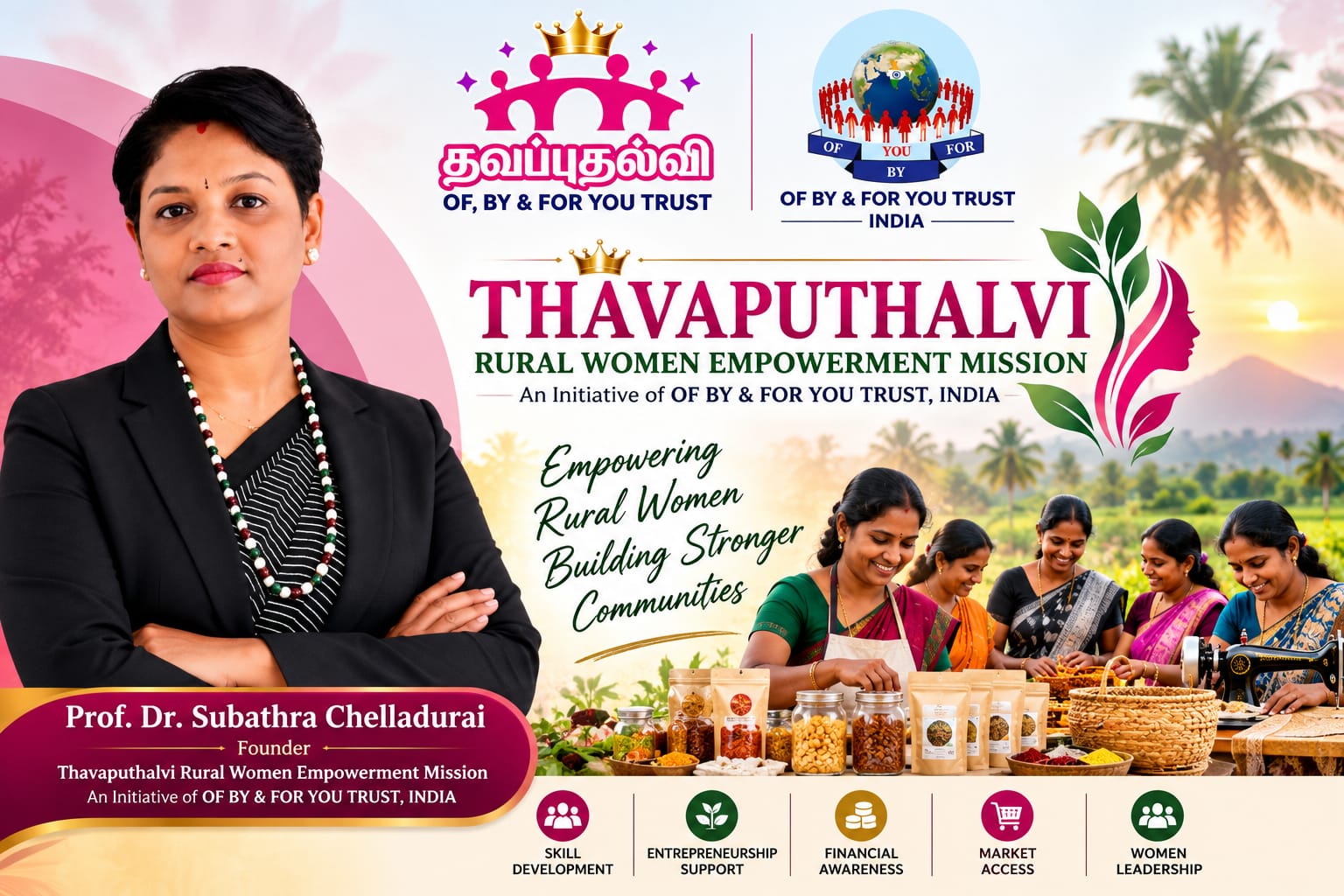
In a society striving for inclusive growth and sustainable development, the empowerment of rural women is not merely a social responsibility; it is an essential investment in the future of families, communities, and the nation. Recognising this need, the Thavaputhalvi Rural Women Empowerment Mission, an initiative of OF BY & FOR YOU TRUST, INDIA, seeks to create meaningful opportunities for rural women to develop their skills, pursue entrepreneurship, achieve economic independence, and emerge as leaders of change.

Beyond Empowerment: Building Economic Independence

Rural women play a vital role in agriculture, household management, traditional occupations, food preparation, handicrafts, and community development. Despite their contributions, many face barriers that limit their economic advancement. Inadequate access to business training, financial resources, market opportunities, technology, professional networks, and institutional support can prevent their skills from becoming sustainable sources of income.

The Thavaputhalvi Rural Women Empowerment Mission envisions a future in which rural women are recognised not only for their contributions to families and communities but also as entrepreneurs, producers, business owners, decision-makers, and agents of social transformation.

The mission's underlying philosophy is that women should have the opportunity to move beyond economic dependency and become confident participants in the economic development of their communities.

Transforming Skills into Sustainable Livelihoods

One of the mission's central priorities is to encourage rural women to identify their strengths, develop practical skills, and explore viable entrepreneurial opportunities. Women who possess traditional knowledge or experience in food production, tailoring, handicrafts, natural products, agriculture-related activities, and other local occupations can be supported in transforming these capabilities into organised business ventures.

However, entrepreneurship requires more than an idea or a product. It also demands planning, financial awareness, quality management, packaging, branding, pricing, customer relations, and access to markets.

Accordingly, the mission seeks to promote a comprehensive approach to women's entrepreneurship through capacity-building programmes, enterprise development guidance, product improvement, marketing support, and connections with appropriate institutions and business networks.

Particular importance can be given to locally available resources and traditional skills, enabling women to develop enterprises that respond to market demand while preserving the value of local knowledge and culture.

Creating Market Opportunities for Rural Women

For many small producers, developing a product is only the first step. Reaching customers, securing fair prices, maintaining product quality, and competing in an increasingly digital marketplace can be equally challenging.

The Thavaputhalvi mission seeks to address these challenges by encouraging women entrepreneurs to strengthen their product identity, improve presentation and packaging, explore digital marketing, and establish connections with retailers, institutions, consumers, and other potential buyers.

Collective marketing and collaborative business models may also help women share resources, improve visibility, and explore larger market opportunities.

By connecting skill development with business guidance and market access, the mission aims to create an enabling environment in which rural women can pursue more sustainable livelihoods and build confidence in their entrepreneurial abilities.

Financial Literacy and Responsible Enterprise Development

Access to finance is an important consideration for women seeking to establish or expand a business. Yet financial support is most effective when accompanied by appropriate guidance, realistic business planning, and an understanding of repayment responsibilities.

The mission seeks to encourage financial literacy and awareness of suitable government schemes, institutional credit facilities, and entrepreneurship support programmes, subject to eligibility and the applicable requirements of the respective institutions.

The objective is to help women make informed financial decisions, understand business risks, and develop enterprises with a stronger foundation for long-term sustainability.

Economic empowerment should not be measured solely by the number of businesses established. It should also be reflected in women's ability to make independent financial decisions, contribute to household well-being, participate in community affairs, and plan confidently for their futures.

A Community-Centred Vision for Women's Leadership

The impact of empowering a woman can extend beyond her individual enterprise. When women gain skills, confidence, income, and decision-making opportunities, they can become role models for younger generations and contribute to the progress of their communities.

Thavaputhalvi aspires to encourage a culture in which rural women support one another, exchange knowledge, build professional relationships, and work collectively towards shared economic goals.

The mission's long-term vision is to nurture a network of capable rural women entrepreneurs who can inspire others, strengthen local economies, and contribute to inclusive development.

Progress towards this vision will depend on collaboration among women, community organisations, educational institutions, financial institutions, government agencies, responsible businesses, and potential supporters.

The Vision Behind Thavaputhalvi

Founded by Prof. Dr. Subathra Chelladurai, the Thavaputhalvi Rural Women Empowerment Mission reflects a commitment to connecting women's empowerment with practical economic opportunities. Through OF BY & FOR YOU TRUST, INDIA, the initiative seeks to promote a development approach that values women's abilities and supports their journey towards entrepreneurship, independence, and leadership.

The name Thavaputhalvi represents an identity associated with purpose, dignity, and positive social contribution. The mission aspires to translate these values into opportunities that help rural women recognise their potential and take meaningful steps towards economic self-reliance.

Its vision is not simply to encourage women to earn an income, but to help create conditions in which they can build sustainable enterprises, strengthen their confidence, and participate more actively in shaping their futures.

Empowering Women, Strengthening India

India's development journey becomes more inclusive when rural women have access to the knowledge, resources, opportunities, and networks needed to realise their potential. Supporting women-led enterprises can contribute to livelihood generation, local economic activity, family well-being, and stronger communities.

The Thavaputhalvi Rural Women Empowerment Mission seeks to contribute to this broader vision by placing rural women at the centre of economic opportunity and community development.

When a rural woman is empowered with skills, opportunity, confidence, and market access, she gains more than the possibility of earning an income—she gains greater power to shape her own future.

Through its commitment to rural women's entrepreneurship and economic independence, Thavaputhalvi aspires to help turn women's potential into opportunity, opportunity into enterprise, and enterprise into lasting social progress.


Prof.Dr. SUBATHRA CHELLADURAI- Founder

THAVAPUTHALVI RURAL WOMEN EMPOWERMENT MISSION

An Initiative of OF BY & FOR YOU TRUST, INDIA

Instapage: https://www.instagram.com/thavaputhalvi_youtrust

Website: https://thavaputhalvi.in, Whatsapp/ Call : +91-7358102775


Empowering Rural Women • Inspiring Change


 Thavaputhalvi Rural Women Empowerment Mission: Empowering Rural Women to Become Entrepreneurs and Leaders - By Prof. Dr. Subathra Chelladurai, Founder, THAVAPUTHALVI RURAL WOMEN EMPOWERMENT MISSION, An Initiative of OF BY & FOR YOU TRUST, INDIA


In a society striving for inclusive growth and sustainable development, the empowerment of rural women is not merely a social responsibility; it is an essential investment in the future of families, communities, and the nation. Recognising this need, the Thavaputhalvi Rural Women Empowerment Mission, an initiative of OF BY & FOR YOU TRUST, INDIA, seeks to create meaningful opportunities for rural women to develop their skills, pursue entrepreneurship, achieve economic independence, and emerge as leaders of change.

Beyond Empowerment: Building Economic Independence

Rural women play a vital role in agriculture, household management, traditional occupations, food preparation, handicrafts, and community development. Despite their contributions, many face barriers that limit their economic advancement. Inadequate access to business training, financial resources, market opportunities, technology, professional networks, and institutional support can prevent their skills from becoming sustainable sources of income.

The Thavaputhalvi Rural Women Empowerment Mission envisions a future in which rural women are recognised not only for their contributions to families and communities but also as entrepreneurs, producers, business owners, decision-makers, and agents of social transformation.

The mission's underlying philosophy is that women should have the opportunity to move beyond economic dependency and become confident participants in the economic development of their communities.

Transforming Skills into Sustainable Livelihoods

One of the mission's central priorities is to encourage rural women to identify their strengths, develop practical skills, and explore viable entrepreneurial opportunities. Women who possess traditional knowledge or experience in food production, tailoring, handicrafts, natural products, agriculture-related activities, and other local occupations can be supported in transforming these capabilities into organised business ventures.

However, entrepreneurship requires more than an idea or a product. It also demands planning, financial awareness, quality management, packaging, branding, pricing, customer relations, and access to markets.

Accordingly, the mission seeks to promote a comprehensive approach to women's entrepreneurship through capacity-building programmes, enterprise development guidance, product improvement, marketing support, and connections with appropriate institutions and business networks.

Particular importance can be given to locally available resources and traditional skills, enabling women to develop enterprises that respond to market demand while preserving the value of local knowledge and culture.

Creating Market Opportunities for Rural Women

For many small producers, developing a product is only the first step. Reaching customers, securing fair prices, maintaining product quality, and competing in an increasingly digital marketplace can be equally challenging.

The Thavaputhalvi mission seeks to address these challenges by encouraging women entrepreneurs to strengthen their product identity, improve presentation and packaging, explore digital marketing, and establish connections with retailers, institutions, consumers, and other potential buyers.

Collective marketing and collaborative business models may also help women share resources, improve visibility, and explore larger market opportunities.

By connecting skill development with business guidance and market access, the mission aims to create an enabling environment in which rural women can pursue more sustainable livelihoods and build confidence in their entrepreneurial abilities.

Financial Literacy and Responsible Enterprise Development

Access to finance is an important consideration for women seeking to establish or expand a business. Yet financial support is most effective when accompanied by appropriate guidance, realistic business planning, and an understanding of repayment responsibilities.

The mission seeks to encourage financial literacy and awareness of suitable government schemes, institutional credit facilities, and entrepreneurship support programmes, subject to eligibility and the applicable requirements of the respective institutions.

The objective is to help women make informed financial decisions, understand business risks, and develop enterprises with a stronger foundation for long-term sustainability.

Economic empowerment should not be measured solely by the number of businesses established. It should also be reflected in women's ability to make independent financial decisions, contribute to household well-being, participate in community affairs, and plan confidently for their futures.

A Community-Centred Vision for Women's Leadership

The impact of empowering a woman can extend beyond her individual enterprise. When women gain skills, confidence, income, and decision-making opportunities, they can become role models for younger generations and contribute to the progress of their communities.

Thavaputhalvi aspires to encourage a culture in which rural women support one another, exchange knowledge, build professional relationships, and work collectively towards shared economic goals.

The mission's long-term vision is to nurture a network of capable rural women entrepreneurs who can inspire others, strengthen local economies, and contribute to inclusive development.

Progress towards this vision will depend on collaboration among women, community organisations, educational institutions, financial institutions, government agencies, responsible businesses, and potential supporters.

The Vision Behind Thavaputhalvi

Founded by Prof. Dr. Subathra Chelladurai, the Thavaputhalvi Rural Women Empowerment Mission reflects a commitment to connecting women's empowerment with practical economic opportunities. Through OF BY & FOR YOU TRUST, INDIA, the initiative seeks to promote a development approach that values women's abilities and supports their journey towards entrepreneurship, independence, and leadership.

The name Thavaputhalvi represents an identity associated with purpose, dignity, and positive social contribution. The mission aspires to translate these values into opportunities that help rural women recognise their potential and take meaningful steps towards economic self-reliance.

Its vision is not simply to encourage women to earn an income, but to help create conditions in which they can build sustainable enterprises, strengthen their confidence, and participate more actively in shaping their futures.

Empowering Women, Strengthening India

India's development journey becomes more inclusive when rural women have access to the knowledge, resources, opportunities, and networks needed to realise their potential. Supporting women-led enterprises can contribute to livelihood generation, local economic activity, family well-being, and stronger communities.

The Thavaputhalvi Rural Women Empowerment Mission seeks to contribute to this broader vision by placing rural women at the centre of economic opportunity and community development.

When a rural woman is empowered with skills, opportunity, confidence, and market access, she gains more than the possibility of earning an income—she gains greater power to shape her own future.

Through its commitment to rural women's entrepreneurship and economic independence, Thavaputhalvi aspires to help turn women's potential into opportunity, opportunity into enterprise, and enterprise into lasting social progress.


Prof.Dr. SUBATHRA CHELLADURAI- Founder

THAVAPUTHALVI RURAL WOMEN EMPOWERMENT MISSION

An Initiative of OF BY & FOR YOU TRUST, INDIA

Instapage: https://www.instagram.com/thavaputhalvi_youtrust

Website: https://thavaputhalvi.in, Whatsapp/ Call : +91-7358102775


Empowering Rural Women • Inspiring Change



 Thavaputhalvi Rural Women Empowerment Mission: Empowering Rural Women to Become Entrepreneurs and Leaders - By Prof. Dr. Subathra Chelladurai, Founder, THAVAPUTHALVI RURAL WOMEN EMPOWERMENT MISSION, An Initiative of OF BY & FOR YOU TRUST, INDIA


In a society striving for inclusive growth and sustainable development, the empowerment of rural women is not merely a social responsibility; it is an essential investment in the future of families, communities, and the nation. Recognising this need, the Thavaputhalvi Rural Women Empowerment Mission, an initiative of OF BY & FOR YOU TRUST, INDIA, seeks to create meaningful opportunities for rural women to develop their skills, pursue entrepreneurship, achieve economic independence, and emerge as leaders of change.

Beyond Empowerment: Building Economic Independence

Rural women play a vital role in agriculture, household management, traditional occupations, food preparation, handicrafts, and community development. Despite their contributions, many face barriers that limit their economic advancement. Inadequate access to business training, financial resources, market opportunities, technology, professional networks, and institutional support can prevent their skills from becoming sustainable sources of income.

The Thavaputhalvi Rural Women Empowerment Mission envisions a future in which rural women are recognised not only for their contributions to families and communities but also as entrepreneurs, producers, business owners, decision-makers, and agents of social transformation.

The mission's underlying philosophy is that women should have the opportunity to move beyond economic dependency and become confident participants in the economic development of their communities.

Transforming Skills into Sustainable Livelihoods

One of the mission's central priorities is to encourage rural women to identify their strengths, develop practical skills, and explore viable entrepreneurial opportunities. Women who possess traditional knowledge or experience in food production, tailoring, handicrafts, natural products, agriculture-related activities, and other local occupations can be supported in transforming these capabilities into organised business ventures.

However, entrepreneurship requires more than an idea or a product. It also demands planning, financial awareness, quality management, packaging, branding, pricing, customer relations, and access to markets.

Accordingly, the mission seeks to promote a comprehensive approach to women's entrepreneurship through capacity-building programmes, enterprise development guidance, product improvement, marketing support, and connections with appropriate institutions and business networks.

Particular importance can be given to locally available resources and traditional skills, enabling women to develop enterprises that respond to market demand while preserving the value of local knowledge and culture.

Creating Market Opportunities for Rural Women

For many small producers, developing a product is only the first step. Reaching customers, securing fair prices, maintaining product quality, and competing in an increasingly digital marketplace can be equally challenging.

The Thavaputhalvi mission seeks to address these challenges by encouraging women entrepreneurs to strengthen their product identity, improve presentation and packaging, explore digital marketing, and establish connections with retailers, institutions, consumers, and other potential buyers.

Collective marketing and collaborative business models may also help women share resources, improve visibility, and explore larger market opportunities.

By connecting skill development with business guidance and market access, the mission aims to create an enabling environment in which rural women can pursue more sustainable livelihoods and build confidence in their entrepreneurial abilities.

Financial Literacy and Responsible Enterprise Development

Access to finance is an important consideration for women seeking to establish or expand a business. Yet financial support is most effective when accompanied by appropriate guidance, realistic business planning, and an understanding of repayment responsibilities.

The mission seeks to encourage financial literacy and awareness of suitable government schemes, institutional credit facilities, and entrepreneurship support programmes, subject to eligibility and the applicable requirements of the respective institutions.

The objective is to help women make informed financial decisions, understand business risks, and develop enterprises with a stronger foundation for long-term sustainability.

Economic empowerment should not be measured solely by the number of businesses established. It should also be reflected in women's ability to make independent financial decisions, contribute to household well-being, participate in community affairs, and plan confidently for their futures.

A Community-Centred Vision for Women's Leadership

The impact of empowering a woman can extend beyond her individual enterprise. When women gain skills, confidence, income, and decision-making opportunities, they can become role models for younger generations and contribute to the progress of their communities.

Thavaputhalvi aspires to encourage a culture in which rural women support one another, exchange knowledge, build professional relationships, and work collectively towards shared economic goals.

The mission's long-term vision is to nurture a network of capable rural women entrepreneurs who can inspire others, strengthen local economies, and contribute to inclusive development.

Progress towards this vision will depend on collaboration among women, community organisations, educational institutions, financial institutions, government agencies, responsible businesses, and potential supporters.

The Vision Behind Thavaputhalvi

Founded by Prof. Dr. Subathra Chelladurai, the Thavaputhalvi Rural Women Empowerment Mission reflects a commitment to connecting women's empowerment with practical economic opportunities. Through OF BY & FOR YOU TRUST, INDIA, the initiative seeks to promote a development approach that values women's abilities and supports their journey towards entrepreneurship, independence, and leadership.

The name Thavaputhalvi represents an identity associated with purpose, dignity, and positive social contribution. The mission aspires to translate these values into opportunities that help rural women recognise their potential and take meaningful steps towards economic self-reliance.

Its vision is not simply to encourage women to earn an income, but to help create conditions in which they can build sustainable enterprises, strengthen their confidence, and participate more actively in shaping their futures.

Empowering Women, Strengthening India

India's development journey becomes more inclusive when rural women have access to the knowledge, resources, opportunities, and networks needed to realise their potential. Supporting women-led enterprises can contribute to livelihood generation, local economic activity, family well-being, and stronger communities.

The Thavaputhalvi Rural Women Empowerment Mission seeks to contribute to this broader vision by placing rural women at the centre of economic opportunity and community development.

When a rural woman is empowered with skills, opportunity, confidence, and market access, she gains more than the possibility of earning an income—she gains greater power to shape her own future.

Through its commitment to rural women's entrepreneurship and economic independence, Thavaputhalvi aspires to help turn women's potential into opportunity, opportunity into enterprise, and enterprise into lasting social progress.


Prof.Dr. SUBATHRA CHELLADURAI- Founder

THAVAPUTHALVI RURAL WOMEN EMPOWERMENT MISSION

An Initiative of OF BY & FOR YOU TRUST, INDIA

Instapage: https://www.instagram.com/thavaputhalvi_youtrust

Website: https://thavaputhalvi.in, Whatsapp/ Call : +91-7358102775


Empowering Rural Women • Inspiring Change



From Kasaragod to Thiruvananthapuram, One Anthem: 'Ente Keralam' is a Prayer to the Motherland

Thiruvananthapuram: Can one song hold an entire state? 'Ente Keralam' proves it can.

Released on the evening of October 31st as a tribute to Kerala's 70th anniversary, 'Ente Keralam' is being hailed as the most beautiful musical album dedicated to Kerala. The album is the brainchild of Rajesh Babu K Sooranad, who has handled its concept, music and visual direction.

The central idea is profound yet simple: to show Kerala as she is - diverse, divine and united. To achieve this, the team embarked on a 30-day-long visual yatra. With three cameras, they traversed the length and breadth of the state, shooting in all 14 districts. The visuals capture the essence of each district - the Theyyam courtyards of Kannur, the fort of Bekal, the tea gardens of Munnar, the houseboats of Alappuzha, the festivals of Thrissur and the beaches of Kovalam.

The album's heart beats in its art forms. In a remarkable feat of choreography and coordination, the team has documented Kerala's living traditions. Viewers will witness the serenity of Sopana Sangeetham, the storytelling eyes of Kathakali, the swaying grace of Mohiniyattam, the folk energy of Kerala Natanam, the spiritual rhythm of Margamkali, the bridal joy of Oppana, the synchronized elegance of Thiruvathira, and the fiery, divine presence of Theyyam and Thira. These performances were led by choreographers Louna & Abitha and performers like Louna, Abitha, Ashwini, Aswathi, Niranjana and many more, along with additional choreographers Aprasanth Krishndevak and Krishnja Prasanth.

The lyrics, written by the celebrated poet P K Gopi, begin with the evocative lines - "Amma kadal petta theerangal ente bhoothalam, Nanmathira pattil neeradum ente poovanam..." - which translates to a child speaking to his motherland whose shores were born from the mother sea. This poetic depth is what gives the album its soul.

The music is rendered by ten singers from different parts of Kerala - Madhu Balakrishnan, Biju Narayanan, Anwar Sadath, P K Sunil Kumar, Ganga, Sindhu Premkumar, Vinitha, Dilna and others - each bringing their regional flavor, yet singing as one. The music arrangements, mixing and mastering by Shimjith Sivan, with keyboard and rhythm programming by Ajmal Basheer and Suhas Bachu, creates a soundscape that is both traditional and contemporary.

The project was produced by Justin A Ambalan. The man who held this massive production together was Production Controller Shanoop, a familiar face in Malayalam films. Co-producers Kalamandalam Narasim and O K Ahammedkutty, Project Designer Anju Mukundan, Creative Director V M Anil, Chief Choreographer Kalakshethra Aniyan T S, DOP Shobin C Johny, Editor Sanal Kumar P S and Sound Engineers Ajmal Basheer, Suhas Bachu & Athul formed the backbone. The featured dancer Vaiga K Sajeeve leads a troupe of young talents including Thejal, Shanvika, Sanviya Lakshmi, Aanviya Sureshbabu, Sivananda, Dr. Sruthi T P and many others.

The album is now streaming on

YouTube: https://youtu.be/YWuuMealu7M?si=EuKlGUEpDSF_rq5i

Apponix Academy Launches Career-Focused Cyber Security Course in Bangalore as Digital Threats Continue to Rise

As businesses move more of their operations, payments and customer data online, organisations of every size need trained people to defend their systems. Apponix Academy has responded with its Cyber Security course in Bangalore, a 70-hour, practice-led programme designed to prepare learners for entry-level and mid-level security roles.
Why cyber security skills matter now

Data breaches, phishing attacks and ransomware incidents are a constant concern for IT teams. Companies need professionals who can find weaknesses, monitor for threats and respond quickly. A structured course with hands-on practice helps beginners build these skills in a clear sequence rather than learning from scattered online material.

What the programme offers

●     70 hours of instructor-led training in the classroom or online

●     Hands-on lab practice, with labs accessible 24/7 for most Apponix courses

●     Assistance with EC-Council certification

●     Training led by Mr. Hasit, an instructor with more than 20 years of experience in cyber security

●     Flexible batches from 7:00 AM to 9:00 PM

●     Placement assistance, resume support and interview preparation

Practice before theory

Apponix builds its courses around industry scenarios so that learners can apply what they study. In the cyber security programme, students practise in lab environments and repeat exercises until they are comfortable, which helps them speak with confidence about their work in interviews. At the end of each programme, trainers walk learners through the technical questions they are likely to face.

Options for different goals

Learners who want a longer, structured path can look at the institute's Master Program in Cyber Security. Those drawn to the offensive side of security can explore the Ethical Hacking course. Related infrastructure skills are available through Linux Administration and Microsoft Server training.

Career support

Apponix works with recruitment consultancies and companies and is an official partner of the Talentsarena.com job portal. The institute offers placement assistance to freshers and experienced professionals alike.

Who should join: IT graduates, system and network administrators, software professionals and anyone who wants to start a career in information security.

Course page: https://www.apponix.com/cyber-security-certification/

About Apponix Academy

Apponix Academy is a training institute established in 2013 and has trained more than 50,000 learners. It has centres in Bangalore, Pune, Hubli, Mumbai, Trichy, Ranchi, Gwalior and Tumkur. It is ISO 9001:2015 certified and an IABAC authorised partner, and is rated 4.6 on Google according to its website.


Karnataka Vakeel Offers Property Documents Support, from E-Khata and Sale Deeds Gift Deed Will to BESCOM Name Transfer

Most families in Karnataka, property is the largest asset they will ever hold and the paperwork around it is rarely simple A purchase an inheritance a gift between relatives or a division among siblings each requires specific documents official records and registrations A missing paper a mismatched name or an outdated record can delay a transaction by weeks Karnataka Vakeel a digital platform powered by i One Global Solutions aims to help by bringing property documents services in Karnataka together in one place.


About Karnataka Vakeel

Karnataka Vakeel is designed as a single point of enquiry for All Your property related documentation Work Its services include E Khata B Khata to A Khata RTC Mutation Podi Phani and mony More Property Documents assistance sale deed gift deed Will Deed partition deed and GPA Registration support and BESCOM electricity bill name transfer It is an assistance service It is not a government office does not claim government affiliation and does not guarantee outcomes Decisions rest with the relevant authority subject to eligibility and applicable law.

E Khata Services

In Karnataka Property khata and E khata is the record maintained by the local urban body that identifies a property and its owner for tax purposes E Khata is its digital form It is commonly needed for property tax payments, sale transactions loans and utility connections Karnataka Vakeel offers E Khata assistance helping owners gather ownership identity and property tax records before submission.

B Khata to A Khata Transfer

Properties classified under B Khata are generally those that do not fully meet layout or approval norms, while A Khata is associated with properties that comply with the prescribed requirements. Owners often ask about moving from B-Khata to A Khata Whether a property qualifies depends on its legal status and the rules in force Karnataka Vakeel offers assistance with documentation for such applications, and approval remains with the concerned authority.

Absolute Sale Deed or Sale Deed

A Sale Deed is the document that transfers ownership from seller to buyer and is registered under the applicable registration law with stamp duty payable because it forms the core of a property transaction, accuracy matters Karnataka Vakeel offers sale deed documentation assistance for buyers and sellers who want their papers organised before registration.

Gift deed and partition deed GPA

Property often moves within families. A gift deed records the voluntary transfer of property without payment while a partition deed records how jointly held property is divided among co owners Both can carry legal and tax implications and requirements vary by case Karnataka Vakeel offers gift deed and partition deed documentation assistance helping families prepare details and supporting records.

Will deed

A will sets out how a person wishes their property to be distributed after their lifetime Registration of a will is not compulsory, but many people choose to register it Karnataka Vakeel offers will deed documentation assistance for individuals who want their wishes recorded clearly.

BESCOM Name transfer

After a purchase or inheritance the electricity connection often remains in the previous owners name A BESCOM name change updates the connection to the current owner, and ownership proof is usually required Karnataka Vakeel offers assistance with preparing the documents for this transfer Requirements are set by the electricity supply company.


Clarity and coordination

The platforms stated focus is accessibility clear communication and organised documentation A single property event such as a purchase may involve a sale deed a khata update and a BESCOM transfer Coordinating these through one service provider can help clients keep track of requirements Timelines will depend on the case and the authority concerned.

Karnataka Vakeel Learn more

Property owners buyers and families who want to understand the services available can visit Karnataka Vakeel at https://www.karnatakavakeel.com/ and make an enquiry.


Swarat Madhav Industries Limited: Leading India’s Next Agricultural Revolution Under Ashish Kumar Tiwari

The backbone of India has long been its villages, powered by millions of farmers who work the land. Yet, for generations, the agricultural sector has grappled with fragmentation, unpredictable market dynamics, and a stark lack of modern technological infrastructure. Enter Ashish Kumar Tiwari (Brahmachari Madhav Ji), the Founder, Chairman, and Managing Director of Swarat Madhav Industries Limited. Tiwari is not just participating in the sector; he is actively engineering a blueprint for its future, seamlessly weaving deeply rooted Indian traditions with cutting-edge technology.Driven by the foundational ethos, “Agricultural Solutions for a Better Tomorrow,” Tiwari’s work transcends traditional corporate boundaries. He envisions an ecosystem where profit aligns with purpose, and where the farmer is elevated from a vulnerable worker to an empowered entrepreneur.


A Tech-Driven Blueprint for the Indian Farm


At the core of Tiwari’s vision is the complete modernization of the crop lifecycle. For too long, Indian agriculture has relied on legacy methods that leave yield and quality to chance. Under his leadership, Swarat Madhav Industries Limited is pioneering the integration of technology-driven farming practices.

By introducing data-backed precision agriculture, smart irrigation techniques, and soil-health analytics, Tiwari aims to take the guesswork out of farming. This transition allows smallholders to optimize their resource inputs—such as water, organic fertilizers, and seeds—resulting in higher crop yields, reduced overhead costs, and a significantly smaller environmental footprint. For Tiwari, technology is the ultimate equalizer, capable of bringing global farming standards straight to the heart of rural India.


Solving the Post-Harvest Crisis


Increased yields mean very little if the produce rots before it ever reaches a consumer's plate. India loses a staggering percentage of its annual harvest to inadequate storage and fractured supply chains. Recognizing this critical bottleneck, Tiwari has focused heavily on building modern cold-chain infrastructure and advanced warehousing systems.

By establishing high-tech storage hubs closer to rural clusters, Swarat Madhav Industries Limited provides farmers with a vital safety net. Instead of being forced into distress sales immediately after a harvest when prices are at their lowest, farmers can safely store their yields. This preservation infrastructure maintains crop quality, staggers market supply, stabilizes consumer pricing, and directly boosts the income of the rural workforce.


Streamlining Markets and Driving Sustainable Growth


Beyond the fields and warehouses, Tiwari is heavily invested in bridging the massive gap between rural producers and urban consumers. By leveraging digital platforms and building highly efficient distribution channels, he is systematically cutting out unnecessary intermediaries. This direct-to-market connection ensures that farmers receive a fair, transparent price for their hard work, while urban markets get access to fresher, traceable, and safer food products.

Sustainability is the invisible thread running through every aspect of this model. Tiwari strongly champions agricultural practices that protect the earth for future generations. From advocating for regenerative farming to promoting the reduction of post-harvest waste, his strategy balances economic viability with ecological preservation.


Empowering Communities Beyond the Balance Sheet


What truly distinguishes Ashish Kumar Tiwari’s trajectory is his profound commitment to human capital. He views the transformation of Indian agriculture not merely as a business opportunity, but as a primary vehicle for rural development and national self-reliance. By bringing innovation to the grassroots, he is creating sustainable livelihoods, curbing forced urban migration, and restoring a sense of pride to the farming profession.

As India moves steadily toward a tech-empowered future, the work being done at Swarat Madhav Industries Limited stands as a powerful testament to what can be achieved when vision meets execution. Through an unyielding commitment to technology, infrastructure, and the welfare of the farmer, Ashish Kumar Tiwari is successfully building the foundations for a resilient, sustainable, and highly prosperous rural India.


Visit our official website

https://www.swaratmadhavindustrieslimited.com/


How Shubham Rajput & Dev Solanki Are Building Smarter Businesses with Y2WAY

A business owner can have the latest software, a strong team and an impressive customer base—and still lose hours every day because the systems connecting everything do not work properly.


Customer information might sit in spreadsheets. Payments might be tracked manually. Factory activity may be visible on CCTV without producing useful operational insights. Employees may spend more time preparing reports than acting on them.

These everyday problems are central to the thinking behind Y2WAY Universal Consultancy, the venture built by young entrepreneurs Shubham Sanjaysinh Rajput and Dev Virendrakumar Solanki.

Their idea is straightforward: before adding more technology, understand why the existing process is inefficient.

It is an approach shaped by a freelancing journey that began in 2017 and has since evolved into a multidisciplinary consultancy. According to the founders, they have delivered 187 projects in the past two years across their freelance-to-consultancy journey, responding to different business and technology requirements. Both founders received appreciation in July 2026 from Rivaba Ravindrasinh Jadeja, Gujarat’s Minister of State for Primary, Secondary and Adult Education.

The Hidden Cost of Doing Things the Old Way

Indian businesses are increasingly exploring artificial intelligence, customer management software and workflow automation. However, buying a digital product does not automatically make a company more efficient.

A standard CRM might offer dozens of features while missing the few that a particular business genuinely needs. An automated reporting tool may still require employees to enter the same information repeatedly. An AI application may sound impressive without delivering a useful business outcome.

Shubham Sanjaysinh Rajput and Dev Virendrakumar Solanki believe the real opportunity lies in designing technology around a company’s actual operations.

Through Y2WAY Universal Consultancy, they aim to connect technical implementation with process understanding, usability and commercial value.

Their work emphasizes asking fundamental questions: Which activities are repetitive? Where is information getting lost? Which decisions need better data? What can be simplified before it is automated?

Answering those questions helps determine whether the solution requires a new application, a customized algorithm, integrated software or a redesigned workflow.

What Makes Y2WAY’s Optimization Approach Different?

A central area of interest for Y2WAY Universal Consultancy is algorithmic optimization—designing logical systems that perform useful tasks while reducing unnecessary steps.

An algorithm does not have to be a mysterious black box. In practical business applications, it may determine how information moves between departments, how records are organized, how exceptions are flagged or when users should receive an alert.

The founders’ approach combines such logic with artificial intelligence where it adds value.

For an industrial setting, this could involve examining production data, machine activity or operational patterns. In customer-facing businesses, it could mean improving membership records, billing, inventory control and follow-up processes.

Computer vision and IoT systems can introduce additional possibilities, allowing certain physical activities to be translated into useful digital information.

The objective is not automation for its own sake. It is to help organizations operate with fewer unnecessary steps and more timely information.

From Freelance Thinking to a Multidisciplinary Consultancy

The company’s beginnings in freelancing remain relevant to how it approaches projects.

Freelance work requires adaptability because no two client briefs are identical. Over time, Shubham Sanjaysinh Rajput and Dev Virendrakumar Solanki began using that experience to combine development, design, creative strategy and business consulting into one service model.

Y2WAY Universal Consultancy now positions itself across more than 12 industry and solution areas, including manufacturing, industrial IoT, smart automation, CRM technology, healthcare, fitness and wellness, education, retail, hospitality, logistics, financial operations, and marketing and media.

The sectors may appear unrelated, but many share similar underlying problems: disconnected information, repetitive administration, limited visibility and software that does not fit the organization.

This creates opportunities to reuse problem-solving principles while developing solutions specific to each client.

A Commercial Opportunity Built on Real Problems

The transition from freelancers to consultancy founders has also created a broader revenue model based on technology projects, business services and potential long-term client engagements.

Although the founders have not disclosed revenue figures for this story, their reported project volume reflects an expanding delivery portfolio.

For Shubham Sanjaysinh Rajput and Dev Virendrakumar Solanki, the larger ambition is to help Indian enterprises see automation as a practical business investment rather than an intimidating technological shift.

The founders envision a future in which software can be customized more intelligently and small and medium businesses can make better use of tools once associated primarily with larger corporations.

Whether that vision becomes a major force in India’s AI industry will depend on future execution and measurable client outcomes.

But the principle behind Y2WAY Universal Consultancy is worth examining: sometimes the smartest innovation is not adding another tool, but making the entire system work better.

For more information you can visit on Website: https://www.y2way.com/


Made in Delhi, Worn Around the World: How Corset Vogue Grew from a Setback

Some of the most interesting brands are born in difficult moments. Corset Vogue is one of them.Its story begins not in a boardroom, but with a corset designer named Ravinder Singh who suddenly found himself out of work, in an industry where jobs were almost impossible to find.

A Rare Skill in a Small Industry

Corset making is a specialised craft. It takes precise pattern work, the right materials and a deep understanding of how structure meets the body. Ravinder had built that knowledge over years as a corset designer.

The problem was that India had very few corset manufacturers. When he lost his job, there was simply nowhere else to take his skills. The industry was too small to absorb him.

So he stopped looking for a place in it and decided to make one.

The First Machine

In 2021, Ravinder started Corset Vogue in Delhi with one second-hand sewing machine. It was a modest start, but it was enough to make the kind of corsets he believed in: steel boned, carefully shaped and built to last.

Word spread through customers who loved the fit. The collection grew to include steampunk corsets with a Victorian, industrial feel, gothic corsets for lovers of dark fashion, versatile underbust corsets, bold overbust corsets and elegant corset dresses.

Crossing Borders

As the quality became known, a new kind of customer arrived: international brands.

Today, Corset Vogue manufactures and exports corsets for international brands. Designs made in Delhi now travel to customers in other countries under other labels. For a business that began with one used machine, that is a remarkable step, and proof that specialist craftsmanship from India can compete anywhere.

Making Room for the Next Generation

Growing bigger did not make Corset Vogue forget where it came from. The brand saw how hard it was for small boutiques, resellers and new labels to work with manufacturers who demanded huge orders.

So Corset Vogue keeps its minimum order quantity at just 20 pieces, with very reasonable prices. Whether it is a brand abroad testing a new line or a boutique in India adding corsets for the first time, the door is open to start small.

It is the same principle Ravinder built his own business on: take the first practical step, and grow from there.

What Comes Next

Corset Vogue now runs on three tracks: its own online store for customers across India, wholesale for resellers and boutiques, and manufacturing and export for international brands. The goal ahead is to take the Corset Vogue name itself to corset lovers worldwide.

Connect with Corset Vogue

For manufacturing, export or wholesale enquiries, visit the wholesale page or email the collection at www.corsetvogue.com and follow the journey on Instagram Vogue: Sculpt Your Silhouette.

How To Reduce Eczema Rashes In Children Naturally?

Atopic dermatitis is one of the most common types of eczema (called Vicharchika in Ayurveda) that is mainly seen among kids. The disease can affect anyone irrespective their age and gender. However, in most cases (roughly around 70-80%), kids are affected by atopic dermatitis.

-Says Skin Specialists at Dr. Sharda Ayurveda


Atopic Dermatitis- Meaning

In Ayurveda, this tvacha vikaara (skin disease) is considered the result of Tridosha imbalance, namely: Vata Dosha, Pitta Dosha, and Kapha dosha. Whereas Medical science names it a chronic inflammatory condition that mainly affects the skin. Here, the skin starts to lose its ability to protect itself from external harmful substances.


But there is good news too. This condition is not contagious at all. So if anyone is suffering from it, they do not necessarily have to maintain a physical distance from them.


Often patients try self-treatment measures including applying medicated creams, ointments, pastes, or even taking painkillers to cure atopic dermatitis disease. But this Be-Your-Own-Doctor philosophy often makes the condition worse by aggrevating the symptoms.


Relation between Atopic Dermatitis and Eczema

Well, there are simply no verses between these 2 terms because Atopic dermatitis is eczema itself. We can also say that it is a sub-type of eczema. Depending upon the varying causative factors and symptoms, Eczema can be of multiple types, and Atopic dermatitis is simply one of those types.


Who gets Atopic Dermatitis the most?

Although, the article has already mentioned that kids get this skin disease the most. It is because the immunity power of kids, and teenagers is comparatively low as compared to adults. Furthermore, their dietary choices of junk, excessively oily, fried, sugar-containing items, etc, further support the development of this skin disease.


In the Western medication system, often only skin-soothing ointments and creams are advised for eczema treatment, and no medications are given for kids because of their possible side effects. But not in the case of Ayurveda and Homeopathy.


Both are natural treatment pathies that focus more on the diet and lifestyle of a patient along with oral medications. Atopic dermatitis medicine in Ayurveda and Homeopathy is made mainly using natural ingredients and herbs that cause no side effects to the body. Anyone irrespective of age, if suffering from atopic dermatitis, or any other skin disease, can try these 2 holistic healing approaches for natural relief.


Atopic Dermatitis- Symptoms

Among patients, Atopic dermatitis symptoms can vary significantly depending on the severity, immune power, and ethnicity. But below are some common signs that confirm the presence of atopic dermatitis:


1.       Itching, redness, and patches

2.       Dryness and skin cracking

3.       Scales and bumps

4.       Skin warmness

5.              Inflammation of the skin

6.       Rashes that may ooze and weep fluid, or blood when scratched


Causes of Atopic Dermatitis

There exists no single cause that can be held responsible for this skin disease. The development of Atopic dermatitis is believed to be a result of certain internal stimuli and external environmental factors covering mainly:


1. Allergens: It is also possible that certain substances work as allergens and support the development of atopic dermatitis. It mainly includes pet dander, pollen, fumes, dust mites, animal waste, skin flakes, mold, etc.


2. Irritants: Besides allergens, there are also some agents that may increase the risk of atopic dermatitis. These agents basically include soaps, detergents, shampoos, washing-up liquids, bubble baths, and rough materials like wool.


3. Diet: The food a person consumes may also work as a prime cause for the occurrence of this skin problem. Gluten, excessive dairy, non-vegetarian diet, and all types of junk, fried, and processed foods are triggering heads that should be avoided in Atopic dermatitis.


4. Genes: In some cases, this type of eczema may run in families and a child may get it from their parents, either mother, father, or both.


5. Stress: When it comes to skin health, mental health is as important as physcial. Taking excessive stress often causes hormonal imbalance which further impairs the skin barrier, and damages the skin.


Ways to Manage Atopic Dermatitis Naturally

In Ayurveda, several natural measures are available that work none other than magic when it comes to alleviating the pain and discomfort of eczema. Atopic dermatitis treatment mainly covers the following:


Use of herbs:

Countless herbs are there to help patients dealing with atopic dermatitis. The best part is that patients do not have to wander here and there to find these skin-health-boosting herbs as most of these might already be available in the house, either in the kitchen, or the garden. For atopic dermatitis, the best and proven herbs are chandan, neem, tulsi, aloe vera, triphala, anantmool, giloy, and babool.


Mindful dietary choices:

Diet is yet a crucial aspect that requires proper attention for the treatment of any health issue. For atopic dermatitis, the patients are encouraged to make healthy changes in their routine diet such as incorporating fresh fruits and vegetables into the routine, and completely excluding all the junk, fried, oily, and processed food.


 Quite Shocking!

For skin conditions like dermatitis and vitiligo (white patches), the consumption of dairy products and non-vegetarian food items is also not advised. As they can trigger the disease's symptoms.


Skin nourishment:

To cope with the dryness accompanied by atopic dermatitis, often certain natural practices are followed so that skin stays hydrated, nourished, and nurtured. Taking a bath with lukewarm water, oatmeal, and herbal water can be highly beneficial during this condition. Additionally, a gentle massage with virgin coconut oil, cow's ghee, buttermilk, etc also shows effective results.


Stress-management techniques:

To maintain a healthy balance between your mental and physical health, the adoption of certain stress-management practices is also advised. Performing yoga, and meditation for 10-20 minutes a day will keep your mind calm and mental health under control, which will eventually contribute to eczema management.


For more information you can visite on website:https://drshardaayurveda.com/