Thavaputhalvi Rural Women Empowerment Mission: Empowering Rural Women to Become Entrepreneurs and Leaders - By Prof. Dr. Subathra Chelladurai, F
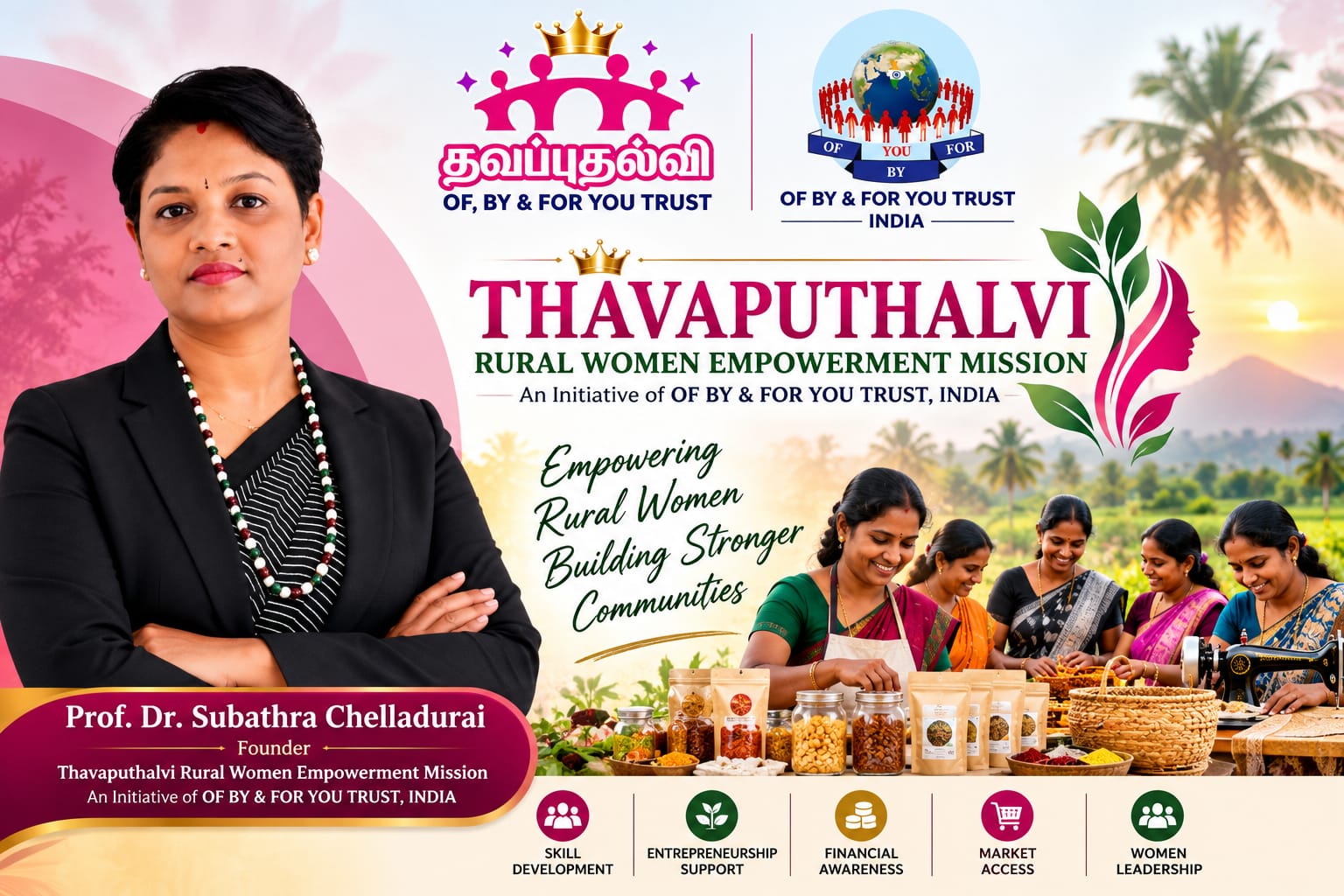
In a society striving for inclusive growth and sustainable development, the empowerment of rural women is not merely a social responsibility; it is an essential investment in the future of families, communities, and the nation. Recognising this need, the Thavaputhalvi Rural Women Empowerment Mission, an initiative of OF BY & FOR YOU TRUST, INDIA, seeks to create meaningful opportunities for rural women to develop their skills, pursue entrepreneurship, achieve economic independence, and emerge as leaders of change.

Beyond Empowerment: Building Economic Independence

Rural women play a vital role in agriculture, household management, traditional occupations, food preparation, handicrafts, and community development. Despite their contributions, many face barriers that limit their economic advancement. Inadequate access to business training, financial resources, market opportunities, technology, professional networks, and institutional support can prevent their skills from becoming sustainable sources of income.

The Thavaputhalvi Rural Women Empowerment Mission envisions a future in which rural women are recognised not only for their contributions to families and communities but also as entrepreneurs, producers, business owners, decision-makers, and agents of social transformation.

The mission's underlying philosophy is that women should have the opportunity to move beyond economic dependency and become confident participants in the economic development of their communities.

Transforming Skills into Sustainable Livelihoods

One of the mission's central priorities is to encourage rural women to identify their strengths, develop practical skills, and explore viable entrepreneurial opportunities. Women who possess traditional knowledge or experience in food production, tailoring, handicrafts, natural products, agriculture-related activities, and other local occupations can be supported in transforming these capabilities into organised business ventures.

However, entrepreneurship requires more than an idea or a product. It also demands planning, financial awareness, quality management, packaging, branding, pricing, customer relations, and access to markets.

Accordingly, the mission seeks to promote a comprehensive approach to women's entrepreneurship through capacity-building programmes, enterprise development guidance, product improvement, marketing support, and connections with appropriate institutions and business networks.

Particular importance can be given to locally available resources and traditional skills, enabling women to develop enterprises that respond to market demand while preserving the value of local knowledge and culture.

Creating Market Opportunities for Rural Women

For many small producers, developing a product is only the first step. Reaching customers, securing fair prices, maintaining product quality, and competing in an increasingly digital marketplace can be equally challenging.

The Thavaputhalvi mission seeks to address these challenges by encouraging women entrepreneurs to strengthen their product identity, improve presentation and packaging, explore digital marketing, and establish connections with retailers, institutions, consumers, and other potential buyers.

Collective marketing and collaborative business models may also help women share resources, improve visibility, and explore larger market opportunities.

By connecting skill development with business guidance and market access, the mission aims to create an enabling environment in which rural women can pursue more sustainable livelihoods and build confidence in their entrepreneurial abilities.

Financial Literacy and Responsible Enterprise Development

Access to finance is an important consideration for women seeking to establish or expand a business. Yet financial support is most effective when accompanied by appropriate guidance, realistic business planning, and an understanding of repayment responsibilities.

The mission seeks to encourage financial literacy and awareness of suitable government schemes, institutional credit facilities, and entrepreneurship support programmes, subject to eligibility and the applicable requirements of the respective institutions.

The objective is to help women make informed financial decisions, understand business risks, and develop enterprises with a stronger foundation for long-term sustainability.

Economic empowerment should not be measured solely by the number of businesses established. It should also be reflected in women's ability to make independent financial decisions, contribute to household well-being, participate in community affairs, and plan confidently for their futures.

A Community-Centred Vision for Women's Leadership

The impact of empowering a woman can extend beyond her individual enterprise. When women gain skills, confidence, income, and decision-making opportunities, they can become role models for younger generations and contribute to the progress of their communities.

Thavaputhalvi aspires to encourage a culture in which rural women support one another, exchange knowledge, build professional relationships, and work collectively towards shared economic goals.

The mission's long-term vision is to nurture a network of capable rural women entrepreneurs who can inspire others, strengthen local economies, and contribute to inclusive development.

Progress towards this vision will depend on collaboration among women, community organisations, educational institutions, financial institutions, government agencies, responsible businesses, and potential supporters.

The Vision Behind Thavaputhalvi

Founded by Prof. Dr. Subathra Chelladurai, the Thavaputhalvi Rural Women Empowerment Mission reflects a commitment to connecting women's empowerment with practical economic opportunities. Through OF BY & FOR YOU TRUST, INDIA, the initiative seeks to promote a development approach that values women's abilities and supports their journey towards entrepreneurship, independence, and leadership.

The name Thavaputhalvi represents an identity associated with purpose, dignity, and positive social contribution. The mission aspires to translate these values into opportunities that help rural women recognise their potential and take meaningful steps towards economic self-reliance.

Its vision is not simply to encourage women to earn an income, but to help create conditions in which they can build sustainable enterprises, strengthen their confidence, and participate more actively in shaping their futures.

Empowering Women, Strengthening India

India's development journey becomes more inclusive when rural women have access to the knowledge, resources, opportunities, and networks needed to realise their potential. Supporting women-led enterprises can contribute to livelihood generation, local economic activity, family well-being, and stronger communities.

The Thavaputhalvi Rural Women Empowerment Mission seeks to contribute to this broader vision by placing rural women at the centre of economic opportunity and community development.

When a rural woman is empowered with skills, opportunity, confidence, and market access, she gains more than the possibility of earning an income—she gains greater power to shape her own future.

Through its commitment to rural women's entrepreneurship and economic independence, Thavaputhalvi aspires to help turn women's potential into opportunity, opportunity into enterprise, and enterprise into lasting social progress.


Prof.Dr. SUBATHRA CHELLADURAI- Founder

THAVAPUTHALVI RURAL WOMEN EMPOWERMENT MISSION

An Initiative of OF BY & FOR YOU TRUST, INDIA

Instapage: https://www.instagram.com/thavaputhalvi_youtrust

Website: https://thavaputhalvi.in, Whatsapp/ Call : +91-7358102775


Empowering Rural Women • Inspiring Change


 Thavaputhalvi Rural Women Empowerment Mission: Empowering Rural Women to Become Entrepreneurs and Leaders - By Prof. Dr. Subathra Chelladurai, Founder, THAVAPUTHALVI RURAL WOMEN EMPOWERMENT MISSION, An Initiative of OF BY & FOR YOU TRUST, INDIA


In a society striving for inclusive growth and sustainable development, the empowerment of rural women is not merely a social responsibility; it is an essential investment in the future of families, communities, and the nation. Recognising this need, the Thavaputhalvi Rural Women Empowerment Mission, an initiative of OF BY & FOR YOU TRUST, INDIA, seeks to create meaningful opportunities for rural women to develop their skills, pursue entrepreneurship, achieve economic independence, and emerge as leaders of change.

Beyond Empowerment: Building Economic Independence

Rural women play a vital role in agriculture, household management, traditional occupations, food preparation, handicrafts, and community development. Despite their contributions, many face barriers that limit their economic advancement. Inadequate access to business training, financial resources, market opportunities, technology, professional networks, and institutional support can prevent their skills from becoming sustainable sources of income.

The Thavaputhalvi Rural Women Empowerment Mission envisions a future in which rural women are recognised not only for their contributions to families and communities but also as entrepreneurs, producers, business owners, decision-makers, and agents of social transformation.

The mission's underlying philosophy is that women should have the opportunity to move beyond economic dependency and become confident participants in the economic development of their communities.

Transforming Skills into Sustainable Livelihoods

One of the mission's central priorities is to encourage rural women to identify their strengths, develop practical skills, and explore viable entrepreneurial opportunities. Women who possess traditional knowledge or experience in food production, tailoring, handicrafts, natural products, agriculture-related activities, and other local occupations can be supported in transforming these capabilities into organised business ventures.

However, entrepreneurship requires more than an idea or a product. It also demands planning, financial awareness, quality management, packaging, branding, pricing, customer relations, and access to markets.

Accordingly, the mission seeks to promote a comprehensive approach to women's entrepreneurship through capacity-building programmes, enterprise development guidance, product improvement, marketing support, and connections with appropriate institutions and business networks.

Particular importance can be given to locally available resources and traditional skills, enabling women to develop enterprises that respond to market demand while preserving the value of local knowledge and culture.

Creating Market Opportunities for Rural Women

For many small producers, developing a product is only the first step. Reaching customers, securing fair prices, maintaining product quality, and competing in an increasingly digital marketplace can be equally challenging.

The Thavaputhalvi mission seeks to address these challenges by encouraging women entrepreneurs to strengthen their product identity, improve presentation and packaging, explore digital marketing, and establish connections with retailers, institutions, consumers, and other potential buyers.

Collective marketing and collaborative business models may also help women share resources, improve visibility, and explore larger market opportunities.

By connecting skill development with business guidance and market access, the mission aims to create an enabling environment in which rural women can pursue more sustainable livelihoods and build confidence in their entrepreneurial abilities.

Financial Literacy and Responsible Enterprise Development

Access to finance is an important consideration for women seeking to establish or expand a business. Yet financial support is most effective when accompanied by appropriate guidance, realistic business planning, and an understanding of repayment responsibilities.

The mission seeks to encourage financial literacy and awareness of suitable government schemes, institutional credit facilities, and entrepreneurship support programmes, subject to eligibility and the applicable requirements of the respective institutions.

The objective is to help women make informed financial decisions, understand business risks, and develop enterprises with a stronger foundation for long-term sustainability.

Economic empowerment should not be measured solely by the number of businesses established. It should also be reflected in women's ability to make independent financial decisions, contribute to household well-being, participate in community affairs, and plan confidently for their futures.

A Community-Centred Vision for Women's Leadership

The impact of empowering a woman can extend beyond her individual enterprise. When women gain skills, confidence, income, and decision-making opportunities, they can become role models for younger generations and contribute to the progress of their communities.

Thavaputhalvi aspires to encourage a culture in which rural women support one another, exchange knowledge, build professional relationships, and work collectively towards shared economic goals.

The mission's long-term vision is to nurture a network of capable rural women entrepreneurs who can inspire others, strengthen local economies, and contribute to inclusive development.

Progress towards this vision will depend on collaboration among women, community organisations, educational institutions, financial institutions, government agencies, responsible businesses, and potential supporters.

The Vision Behind Thavaputhalvi

Founded by Prof. Dr. Subathra Chelladurai, the Thavaputhalvi Rural Women Empowerment Mission reflects a commitment to connecting women's empowerment with practical economic opportunities. Through OF BY & FOR YOU TRUST, INDIA, the initiative seeks to promote a development approach that values women's abilities and supports their journey towards entrepreneurship, independence, and leadership.

The name Thavaputhalvi represents an identity associated with purpose, dignity, and positive social contribution. The mission aspires to translate these values into opportunities that help rural women recognise their potential and take meaningful steps towards economic self-reliance.

Its vision is not simply to encourage women to earn an income, but to help create conditions in which they can build sustainable enterprises, strengthen their confidence, and participate more actively in shaping their futures.

Empowering Women, Strengthening India

India's development journey becomes more inclusive when rural women have access to the knowledge, resources, opportunities, and networks needed to realise their potential. Supporting women-led enterprises can contribute to livelihood generation, local economic activity, family well-being, and stronger communities.

The Thavaputhalvi Rural Women Empowerment Mission seeks to contribute to this broader vision by placing rural women at the centre of economic opportunity and community development.

When a rural woman is empowered with skills, opportunity, confidence, and market access, she gains more than the possibility of earning an income—she gains greater power to shape her own future.

Through its commitment to rural women's entrepreneurship and economic independence, Thavaputhalvi aspires to help turn women's potential into opportunity, opportunity into enterprise, and enterprise into lasting social progress.


Prof.Dr. SUBATHRA CHELLADURAI- Founder

THAVAPUTHALVI RURAL WOMEN EMPOWERMENT MISSION

An Initiative of OF BY & FOR YOU TRUST, INDIA

Instapage: https://www.instagram.com/thavaputhalvi_youtrust

Website: https://thavaputhalvi.in, Whatsapp/ Call : +91-7358102775


Empowering Rural Women • Inspiring Change



 Thavaputhalvi Rural Women Empowerment Mission: Empowering Rural Women to Become Entrepreneurs and Leaders - By Prof. Dr. Subathra Chelladurai, Founder, THAVAPUTHALVI RURAL WOMEN EMPOWERMENT MISSION, An Initiative of OF BY & FOR YOU TRUST, INDIA


In a society striving for inclusive growth and sustainable development, the empowerment of rural women is not merely a social responsibility; it is an essential investment in the future of families, communities, and the nation. Recognising this need, the Thavaputhalvi Rural Women Empowerment Mission, an initiative of OF BY & FOR YOU TRUST, INDIA, seeks to create meaningful opportunities for rural women to develop their skills, pursue entrepreneurship, achieve economic independence, and emerge as leaders of change.

Beyond Empowerment: Building Economic Independence

Rural women play a vital role in agriculture, household management, traditional occupations, food preparation, handicrafts, and community development. Despite their contributions, many face barriers that limit their economic advancement. Inadequate access to business training, financial resources, market opportunities, technology, professional networks, and institutional support can prevent their skills from becoming sustainable sources of income.

The Thavaputhalvi Rural Women Empowerment Mission envisions a future in which rural women are recognised not only for their contributions to families and communities but also as entrepreneurs, producers, business owners, decision-makers, and agents of social transformation.

The mission's underlying philosophy is that women should have the opportunity to move beyond economic dependency and become confident participants in the economic development of their communities.

Transforming Skills into Sustainable Livelihoods

One of the mission's central priorities is to encourage rural women to identify their strengths, develop practical skills, and explore viable entrepreneurial opportunities. Women who possess traditional knowledge or experience in food production, tailoring, handicrafts, natural products, agriculture-related activities, and other local occupations can be supported in transforming these capabilities into organised business ventures.

However, entrepreneurship requires more than an idea or a product. It also demands planning, financial awareness, quality management, packaging, branding, pricing, customer relations, and access to markets.

Accordingly, the mission seeks to promote a comprehensive approach to women's entrepreneurship through capacity-building programmes, enterprise development guidance, product improvement, marketing support, and connections with appropriate institutions and business networks.

Particular importance can be given to locally available resources and traditional skills, enabling women to develop enterprises that respond to market demand while preserving the value of local knowledge and culture.

Creating Market Opportunities for Rural Women

For many small producers, developing a product is only the first step. Reaching customers, securing fair prices, maintaining product quality, and competing in an increasingly digital marketplace can be equally challenging.

The Thavaputhalvi mission seeks to address these challenges by encouraging women entrepreneurs to strengthen their product identity, improve presentation and packaging, explore digital marketing, and establish connections with retailers, institutions, consumers, and other potential buyers.

Collective marketing and collaborative business models may also help women share resources, improve visibility, and explore larger market opportunities.

By connecting skill development with business guidance and market access, the mission aims to create an enabling environment in which rural women can pursue more sustainable livelihoods and build confidence in their entrepreneurial abilities.

Financial Literacy and Responsible Enterprise Development

Access to finance is an important consideration for women seeking to establish or expand a business. Yet financial support is most effective when accompanied by appropriate guidance, realistic business planning, and an understanding of repayment responsibilities.

The mission seeks to encourage financial literacy and awareness of suitable government schemes, institutional credit facilities, and entrepreneurship support programmes, subject to eligibility and the applicable requirements of the respective institutions.

The objective is to help women make informed financial decisions, understand business risks, and develop enterprises with a stronger foundation for long-term sustainability.

Economic empowerment should not be measured solely by the number of businesses established. It should also be reflected in women's ability to make independent financial decisions, contribute to household well-being, participate in community affairs, and plan confidently for their futures.

A Community-Centred Vision for Women's Leadership

The impact of empowering a woman can extend beyond her individual enterprise. When women gain skills, confidence, income, and decision-making opportunities, they can become role models for younger generations and contribute to the progress of their communities.

Thavaputhalvi aspires to encourage a culture in which rural women support one another, exchange knowledge, build professional relationships, and work collectively towards shared economic goals.

The mission's long-term vision is to nurture a network of capable rural women entrepreneurs who can inspire others, strengthen local economies, and contribute to inclusive development.

Progress towards this vision will depend on collaboration among women, community organisations, educational institutions, financial institutions, government agencies, responsible businesses, and potential supporters.

The Vision Behind Thavaputhalvi

Founded by Prof. Dr. Subathra Chelladurai, the Thavaputhalvi Rural Women Empowerment Mission reflects a commitment to connecting women's empowerment with practical economic opportunities. Through OF BY & FOR YOU TRUST, INDIA, the initiative seeks to promote a development approach that values women's abilities and supports their journey towards entrepreneurship, independence, and leadership.

The name Thavaputhalvi represents an identity associated with purpose, dignity, and positive social contribution. The mission aspires to translate these values into opportunities that help rural women recognise their potential and take meaningful steps towards economic self-reliance.

Its vision is not simply to encourage women to earn an income, but to help create conditions in which they can build sustainable enterprises, strengthen their confidence, and participate more actively in shaping their futures.

Empowering Women, Strengthening India

India's development journey becomes more inclusive when rural women have access to the knowledge, resources, opportunities, and networks needed to realise their potential. Supporting women-led enterprises can contribute to livelihood generation, local economic activity, family well-being, and stronger communities.

The Thavaputhalvi Rural Women Empowerment Mission seeks to contribute to this broader vision by placing rural women at the centre of economic opportunity and community development.

When a rural woman is empowered with skills, opportunity, confidence, and market access, she gains more than the possibility of earning an income—she gains greater power to shape her own future.

Through its commitment to rural women's entrepreneurship and economic independence, Thavaputhalvi aspires to help turn women's potential into opportunity, opportunity into enterprise, and enterprise into lasting social progress.


Prof.Dr. SUBATHRA CHELLADURAI- Founder

THAVAPUTHALVI RURAL WOMEN EMPOWERMENT MISSION

An Initiative of OF BY & FOR YOU TRUST, INDIA

Instapage: https://www.instagram.com/thavaputhalvi_youtrust

Website: https://thavaputhalvi.in, Whatsapp/ Call : +91-7358102775


Empowering Rural Women • Inspiring Change



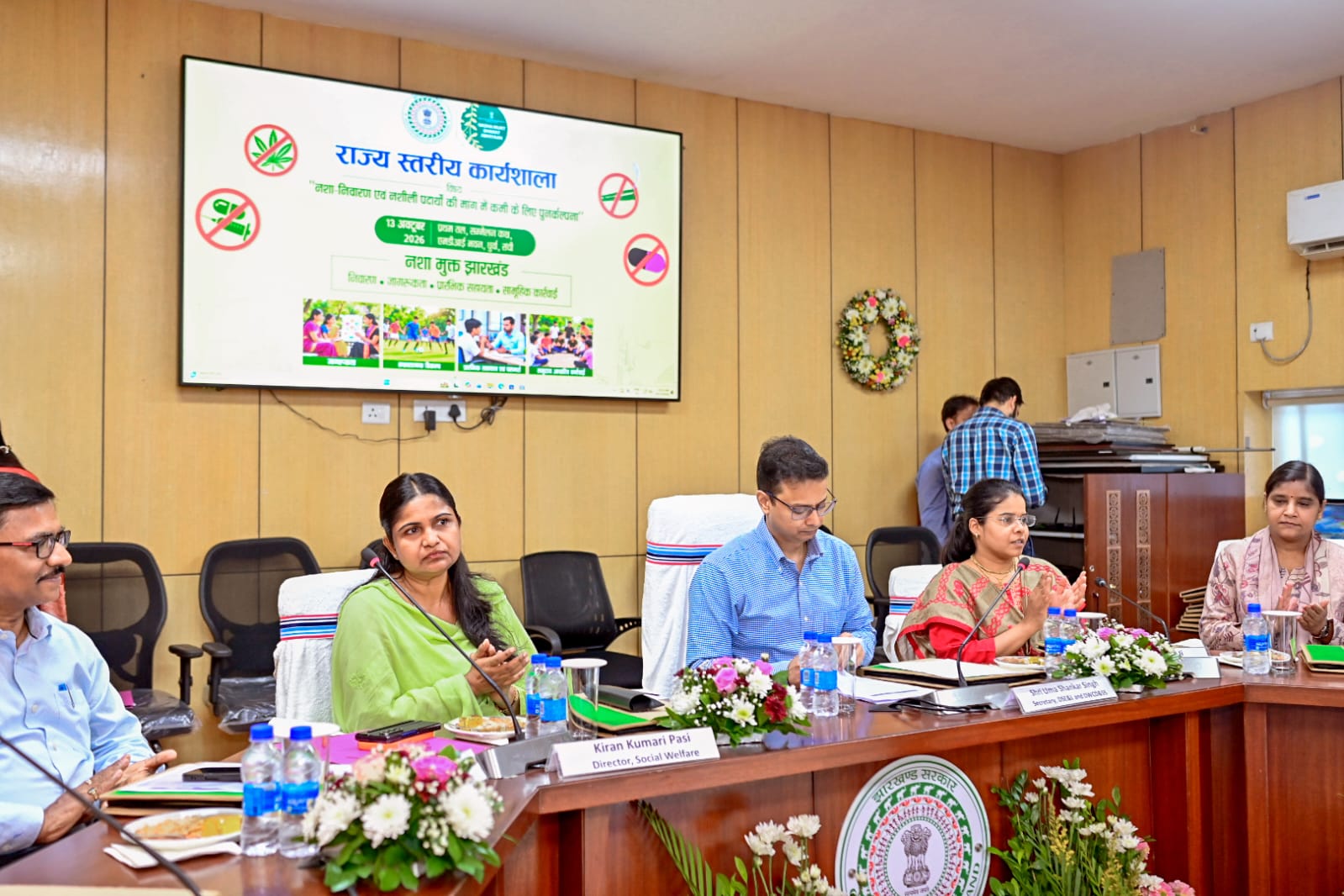
*नशामुक्त झारखंड के लिए रोकथाम को जनआंदोलन बनाना होगा: सचिव उमाशंकर सिंह, एमडीआई में राज्यस्तरीय कार्यशाला आयोजित*

रांची:- श्री उमाशंकर सिंह , सचिव, स्कूली शिक्षा एवं साक्षरता विभाग सह महिला, बाल विकास एवं सामाजिक सुरक्षा विभाग ने कहा कि नशे की चुनौती केवल कानून-व्यवस्था का विषय नहीं, बल्कि युवाओं, परिवारों और समाज के भविष्य से जुड़ा गंभीर मुद्दा है। हमारी सफलता गतिविधियों की संख्या से नहीं, बल्कि इस बात से मापी जानी चाहिए कि हम कितने लोगों को नशे से बचा सके और उनके जीवन में कितना सकारात्मक बदलाव ला सके।" उन्होंने कहा कि नशा रोकथाम को पंचायतों, शैक्षणिक संस्थानों, समुदायों और विभिन्न विभागों की साझा जिम्मेदारी बनाना होगा, ताकि इसे जमीनी स्तर पर प्रभावी जनआंदोलन का स्वरूप दिया जा सके”।वे मंगलवार को एमडीआई बिल्डिंग प्रोजेक्ट भवन में आयोजित एक कार्यशाला को बतौर मुख्य अतिथि संबोधित कर रहे थे । उन्होंने नशा मुक्ति को केवल जागरूकता तक सीमित न रखकर रोकथाम, व्यवहार परिवर्तन और सामुदायिक नेतृत्व आधारित जनआंदोलन बनाने का आह्वान किया।

मंगलवार को एमडीआई बिल्डिंग प्रोजेक्ट भवन में सामाजिक न्याय एवं अधिकारिता मंत्रालय, भारत सरकार के निर्देशानुसार झारखंड सरकार द्वारा नशीले पदार्थों की मांग में कमी (Drug Demand Reduction) एवं रोकथाम आधारित रणनीतियों को सुदृढ़ करने के उद्देश्य से महिला, बाल विकास एवं सामाजिक सुरक्षा विभाग द्वारा राज्य स्तरीय परामर्श कार्यशाला “Reimagining Prevention and Drug Demand Reduction in India” का आयोजन किया गया था ।

निदेशक, सामाजिक कल्याण श्रीमती किरण कुमारी पासी ने कहा कि नशे की रोकथाम में परिवार और समुदाय की भूमिका सबसे महत्वपूर्ण है। समय पर सही जानकारी, उचित मार्गदर्शन और सहयोग उपलब्ध कराकर हजारों युवाओं को नशे की चपेट में आने से बचाया जा सकता है। "नशे के खिलाफ लड़ाई की सबसे बड़ी ताकत हमारा समाज, परिवार और समुदाय हैं। यह केवल सरकार की जिम्मेदारी नहीं है। उन्होंने स्वयं सहायता समूहों, सहिया, आंगनबाड़ी कार्यकर्ताओं, पंचायत प्रतिनिधियों और युवा संगठनों को नशा रोकथाम, प्रारंभिक पहचान, परामर्श एवं सामुदायिक जागरूकता के प्रमुख साझेदार के रूप में सशक्त बनाने पर बल दिया । उन्होंने स्वयं सहायता समूहों, सहिया, आंगनबाड़ी कार्यकर्ताओं, पंचायत प्रतिनिधियों और युवा संगठनों को नशा रोकथाम, प्रारंभिक पहचान, परामर्श एवं सामुदायिक जागरूकता के प्रमुख साझेदार के रूप में सशक्त बनाने पर बल दिया।

कार्यशाला में विभिन्न विभागों, development partners, एवं विशेषज्ञों ने साक्ष्य आधारित, result oriented और समुदाय केंद्रित नशा रोकथाम मॉडल पर चर्चा की। जिला, प्रखंड और ग्राम स्तर पर समन्वित कार्ययोजना विकसित करने तथा रोकथाम, परामर्श, उपचार, पुनर्वास और सामाजिक पुनर्समेकन को एकीकृत रूप से लागू करने की आवश्यकता पर जोर दिया गया।

कार्यशाला में पंचायती राज, नगर विकास, गृह विभाग के नारकोटिक्स प्रकोष्ठ, उच्च एवं तकनीकी शिक्षा, सामाजिक सुरक्षा, आई.सी.पीएस तथा जे.एस.एल.पी.एस सहित विभिन्न विभागों के प्रतिनिधियों ने भाग लेकर अपने विचार साझा किए। सभी प्रतिभागियों ने नशा मुक्ति के लिए सामाजिक समावेशन एवं विभागीय convergence को आवश्यक बताते हुए नशा मुक्त हेल्पलाइन 14446 तथा उपलब्ध परामर्श, उपचार एवं पुनर्वास सेवाओं के व्यापक प्रचार-प्रसार पर बल दिया ।

कार्यशाला के अंत में झारखंड में नशीले पदार्थों की मांग में कमी लाने हेतु राज्य की प्रतिबद्धता के तहत एक कार्ययोजना तैयार की गई, जिसे सामाजिक न्याय एवं अधिकारिता मंत्रालय को प्रेषित किया जाएगा।

Trailer Driving School in Kerala: Master the Reverse That Fails Most Candidates, on A2Z's Own Trailers

A2Z International Heavy Equipment Institute, training drivers and operators in Kerala since 1978, runs normal and container trailer courses on its own vehicles and practice ground, with 19 branches and a main campus at Willingdon Island, Kochi.A2Z International Heavy Equipment Institute runs two trailer courses, one for normal trailers and one for container trailers, aimed at drivers who want work at ports, with logistics companies and in heavy haulage in India and the Gulf. The institute says most candidates underestimate the same two things: the order in which the licences have to be earned, and reversing an articulated vehicle.

The licence is a ladder

A trailer licence is not a standalone licence. It is an endorsement added to an existing heavy vehicle licence, and it sits at the top of a sequence. A driver starts with an LMV licence, adds a transport or commercial endorsement, moves up to a heavy goods vehicle licence (HMV or HTV), and only then qualifies for the trailer endorsement that covers articulated and multi-axle vehicles. Each step generally requires holding the previous one for a qualifying period set by the RTO. Commercial driving in Kerala also needs a separate driver's badge.

"Half the people who call us have planned around a timeline they read online, and then find their licence dates don't qualify them yet," said Aravind, Executive Director of A2Z International Heavy Equipment Institute. "The first thing any trailer driving school in Kerala should do is look at what you hold and when you got it. Then we can tell you your real route, and it saves people months."

What the practical test asks for

The trailer practical tests five things: a pre-trip inspection including the coupling, coupling and uncoupling, controlled manoeuvring and turning with the articulation, reversing, and safe road handling under load. Reversing is where most candidates fail. In reverse, an articulated trailer swings the opposite way to the steering input.

"People expect the highway to be the hard part," Aravind said. "Then you ask a man to reverse a trailer into a bay, and for the first week he turns the wheel the wrong way every time. You can't learn that from a video. You need hours on a real trailer with an instructor next to you telling you what your hands are doing."

Two courses on one owned fleet

A2Z trains on trailers it owns, on a dedicated practice ground, instead of booking time on hired vehicles. Students can choose normal trailer training or container trailer training. Both follow a seven-stage curriculum: vehicle parts, controls and pre-trip checks; coupling and uncoupling; reversing, turning and manoeuvring; container handling and load securing; highway driving, gradients and braking; daily checks and basic maintenance; and licence and assessment preparation.

Graduates receive ISO and Operator Card certification along with guidance on heavy transport licensing. The main campus at Willingdon Island has a hostel for students who travel in.

A trailer driving school in Kerala with its own vehicles can give students more practice. On a hired trailer, time runs out when the booking ends. On an owned one, students keep practising until the reverse is under control.

An institute of firsts since 1978

A2Z opened in 1978. It is the only JCB-authorised operator training institute in Kerala and the state's only fixed tower crane training institute, and it was the first in Kerala to offer imported Zoomlion crane operator training. It owns every machine and vehicle it trains on and works with more than 527 placement partner companies.

Where trailer drivers work

The institute describes trailer driving as one of the better-paying commercial driving categories. Demand comes from Kerala's ports, from logistics corridors across India, and from heavy haulage in the Gulf. Graduates train for roles as trailer drivers, container and port trailer drivers, transport and logistics drivers, and heavy vehicle drivers in India and the Gulf.

Gulf haulage employers usually require a practical trade test. A2Z runs that test at its own Heavy Equipment International Trade Test Centre at Willingdon Island, following the skill verification requirements of GCC countries including Saudi Arabia, the UAE, Qatar and Kuwait. Candidates train and test on the same trailers.

A2Z provides training, assessment and placement assistance. It does not recruit for overseas jobs and refers candidates who want to work abroad to licensed recruiting agents.

Who can join

Entry depends on the licence ladder rather than on education. The minimum age follows RTO norms for heavy vehicles, which is higher than the age for a car licence. Candidates need basic physical fitness and government photo ID and proof of address, and an existing light vehicle licence helps.

Anyone comparing a trailer driving school in Kerala can ask three things: whether the school owns its trailers, whether it offers container trailer training as well as normal trailer training, and whether it can run the trade test that Gulf employers ask for.

Course details and eligibility for A2Z's trailer driving school in Kerala are at https://a2zinstitute.in/courses/trailer-operator-training/

For fees, batch dates and the nearest of the 19 branches, send the admissions team details of the licence you hold by phone or WhatsApp.


About A2Z International Heavy Equipment Institute

Founded in 1978, A2Z International Heavy Equipment Institute is an ISO 9001:2015 certified heavy equipment and heavy driving training institute in Kerala, India. It is the only JCB-authorised operator training institute in Kerala and the state's only fixed tower crane training institute, and it was the first in Kerala to offer imported Zoomlion crane operator training. The institute owns all of its training machines. It runs a Heavy Equipment International Trade Test Centre at Willingdon Island, Kochi, and works with more than 527 placement partner companies. Website: https://a2zinstitute.in

Media Contact

A2Z International Heavy Equipment Institute

Willingdon Island, Kochi, Kerala, India

Admissions: +91 85900 85591

Web: https://a2zinstitute.in

Who Really Makes Money in India’s F&O Market?

Smart Money Club Is Asking the Harder Question

For years, the main F&O headline has been simple: more than 90% of retail traders lose money every year. SEBI’s FY25 study says around 91% of individual traders lost. But that is only one side of the story. The harder question is who is making the money.

SEBI’s FY24 data answers it. Individual traders lost about ₹41,500 crore in gross F&O P&L, while proprietary desks and FPIs together made around ₹61,000 crore, and 96% of proprietary-trader profits and 97% of FPI profits came from algo-driven entities. That is who retail traders were competing against. Even individuals who used algos did not escape: as a group, they still lost around ₹13,900 crore on the same basis.

Put together, F&O looks less like a fair game for retail and more like a transfer: individual traders keep entering and mostly keep losing, while the profits keep showing up with professional desks and algo-driven players. That does not mean F&O was created to take money from retail traders. But the money has been moving in one direction for years: away from individuals and towards professional desks.

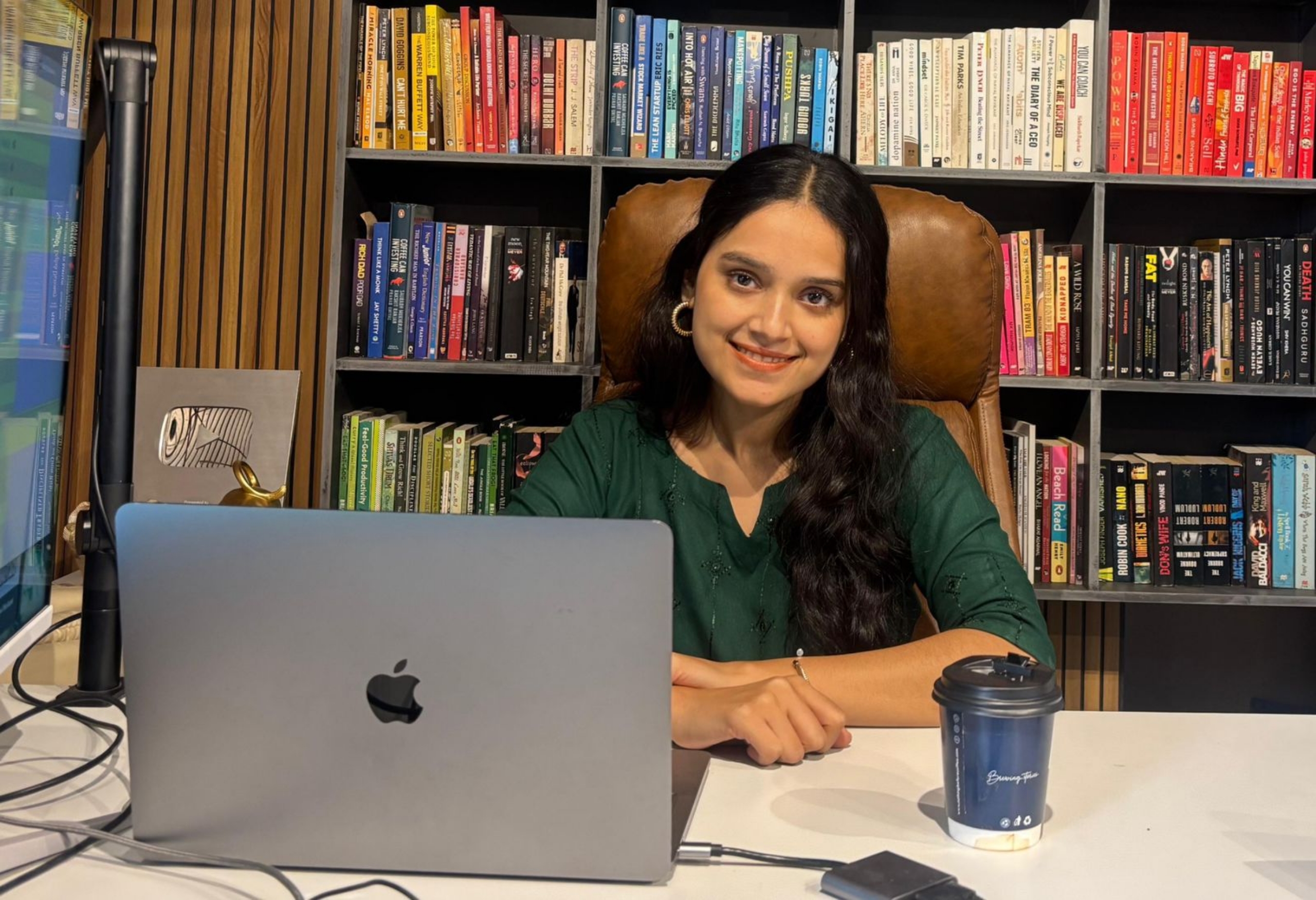
This is one of the reasons Pranjal Rastogi and CA Harshitha Iyer took Smart Money Club in a different direction. The Surat-based SEBI-registered firm focuses on equity swing and positional trading and has deliberately stayed away from teaching F&O and intraday trading despite steady demand for both.

Their concern was where a beginner starts. If almost all the profits on the professional side come from algos, why are beginners still pushed towards F&O as their first way to earn trading?

For a lot of people entering the market today, F&O is where trading begins rather than where it arrives after years of experience. Options look easy to access, the capital required can look small, and social media is full of gurus promising quick money. Someone who has barely studied a stock can open an account and start trading options almost immediately.

What makes this worse is how F&O is sold to beginners. For an education business, it is the easier product to market: more trades, more screenshots, more action and a simpler promise of quick money. And when people lose, the blame usually comes back to them. If you end up on the losing side, which SEBI’s data says happens to roughly nine out of ten individual traders, the explanation is often that you lacked “discipline” or could not “control your emotions”. Far less attention goes to the fact that you were sent into a market where the other side is often running far more sophisticated systems.

Rastogi and Iyer had already seen how this content cycle works while building Captum, the financial-markets channel that crossed 100,000 subscribers before Smart Money Club took shape. The content that travelled fastest was usually built around a strong hook, a quick takeaway of something that kept people watching till the end. It worked for reach. Teaching someone to trade needed something different, and that shaped what Smart Money Club would focus on.

Smart Money Club was built around swing and positional trading from the start, for people with jobs, businesses and full-time careers: people who could not make the market the centre of their day. For that audience, intraday trading and F&O made little sense. Both require much closer tracking of the market and, with leverage and expiry involved, mistakes get expensive quickly. Swing and positional trading fit better. Trades play out over days or weeks, which gives the trader time to study the overall market, choose the sector and stock, plan the entry and risk, and then manage the position without sitting in front of the screen all day.

That choice set the order of the entire SMC process: market first, then sectors, stock selection, setups, entries, risk and trade management. The same sequence runs through its weekly Live Inner Circle sessions, recorded course videos and its in-house platform, ProScreener.

The firm has worked with more than 16,000 people through its workshops and programmes, most of them working professionals and business owners. For them, a trading style that needs constant decisions through the day would not fit real life. Smart Money Club chose to build around real reality instead of around what was easiest to sell.

Swing trading does not remove risk, and SMC does not present it as an easier route to profits. Stocks can fall, setups fail and traders still make mistakes. The difference is the type of game being played. There is no weekly expiry forcing a position to resolve within a few hours or days. A trader can take time finding the right stock, define the risk before entering and stay out when the market is not offering a trade that fits.

India has made trading easy to access, and that is a good thing. But easy access to a sophisticated product does not make the product simple. If SEBI’s numbers show retail traders losing while professional and algo-driven players take home most of the profits, trading education may need to reconsider where the first lesson begins.

Smart Money Club’s answer is straightforward: a retail trader does not need to become a weaker version of a professional trading desk. They need a style of trading that fits the life they have.

CA Harshitha Iyer and Pranjal Rastogi are co-founders of Smart Money Club. Wealth Vidhya is a SEBI Registered Research Analyst (INH000028352). Views are personal. Investments in the securities market are subject to market risks. Read all related documents carefully before investing.

Beyond Care: Building India's Longevity Economy By Alok Bhatnagar Founder & CEO, KinKeeper

India stands at the threshold of a demographic transformation that will redefine its economic and social future. For decades, our growth story has been powered by the demographic dividend of a young population. That advantage fuelled entrepreneurship, investment, and innovation. Today, however, a new opportunity is emerging—one that demands an equally ambitious vision.

The future of India's prosperity will not be shaped by youth alone. It will also depend on how successfully we enable millions of older Indians to live healthier, longer, more productive, and financially secure lives.

This is the foundation of the Longevity Economy.

Unlike the traditional view of ageing as a period of dependency, the longevity economy recognises longer lives as an economic asset. It encompasses the products, services, technologies, policies, and infrastructure that enable people to remain healthy, independent, socially connected, and economically active throughout later life. It is about moving beyond care to build an ecosystem that empowers people to age with dignity, purpose, and opportunity.

The scale of this opportunity is significant. According to the UNFPA India Ageing Report 2023, India had approximately 149 million people aged 60 years and above in 2022. By 2050, that number is projected to reach 347 million, representing 20.8% of the population. The population aged 80 years and above is expected to grow by around 279% during the same period. These figures represent one of the most profound demographic shifts in India's history.

The challenge, however, is not simply that people are living longer. It is ensuring they live better. Extending healthspan—the years spent in good physical, mental, and social health—is as important as extending lifespan. Healthier ageing reduces pressure on healthcare systems while enabling people to remain active, independent, and engaged for longer.

This transformation extends far beyond healthcare. It creates opportunities across preventive healthcare, digital health, AgeTech, insurance, retirement planning, accessible housing, mobility, wellness, nutrition, lifelong learning, travel, home modifications, and community-based services. Advances in artificial intelligence, wearable devices, remote monitoring, and assistive technologies are also reshaping how people age safely and independently.

A growing number of senior citizens today possess accumulated savings, home ownership, professional expertise, and decades of experience. They are not merely recipients of care—they are consumers, mentors, entrepreneurs, investors, volunteers, and active contributors to society. Businesses that understand their evolving aspirations will be better positioned to serve one of India's fastest-growing consumer segments.

Recognising this opportunity, NITI Aayog has highlighted the rapid emergence of India's silver economy and the opportunities it presents across healthcare, financial services, housing, technology, wellness, and home-based care. The report also notes that healthcare accounts for nearly 31% of senior citizens' expenditure, underscoring the growing demand for preventive healthcare, rehabilitation, home healthcare, and technology-enabled services.

The longevity economy is also poised to become a major employment generator. As India's population ages, demand will grow for caregivers, geriatric specialists, nurses, physiotherapists, rehabilitation professionals, psychologists, nutritionists, accessibility consultants, financial advisers, and AgeTech innovators. Building this ecosystem can create millions of skilled jobs while improving quality of life and reducing pressure on families.

The Economic Survey 2023–24 introduces the concept of the Silver Dividend, noting that enabling people aged 60–69 to remain economically active could increase GDP across Asian economies by an average of 1.5%. It recommends greater investment in lifelong learning, care infrastructure, workforce development, and age-friendly employment, recognising healthy ageing as both a social and economic priority.

Around the world, countries are already adapting to longer lives. Japan has pioneered AgeTech and robotics for independent living. Germany has strengthened long-term care systems, while Singapore has invested in age-friendly communities and ageing-in-place programmes. Their experience demonstrates that demographic change can become a catalyst for innovation when supported by forward-looking policy and private-sector investment.

India must now develop its own model. Urbanisation, migration, smaller families, and longer life expectancy have changed traditional caregiving patterns. Millions of older parents now live independently while their children pursue careers elsewhere. Meeting their evolving needs will require an integrated ecosystem that combines family support, technology, professional services, and community engagement.

The Government of India has taken encouraging steps through initiatives such as the Senior Ageing Growth Engine (SAGE), which supports startups developing solutions for older adults, alongside programmes that encourage healthy ageing and continued participation in society. Together, these initiatives signal an important shift—from treating ageing primarily as a welfare concern to recognising it as a driver of innovation and economic opportunity.

Yet government action alone will not be enough. Building a longevity economy requires collaboration between policymakers, entrepreneurs, healthcare providers, investors, insurers, technology companies, financial institutions, urban planners, academia, and civil society. Age-friendly infrastructure, preventive healthcare, digital inclusion, lifelong learning, and community-based support must become central to India's development agenda.

As India progresses towards Viksit Bharat 2047, success will not be measured solely by economic growth. It will also be measured by how effectively we enable people of every generation to live healthier, safer, more independent, and financially secure lives.

The question is no longer whether India will become an ageing society—it already is. The real challenge is whether we are prepared to transform longevity into a national advantage.

Building the longevity economy is not simply about caring for older citizens. It is about creating a future where longer lives fuel innovation, strengthen industries, generate employment, and enhance social well-being. India has the scale, entrepreneurial talent, and policy momentum to lead this transformation. If we act with vision today, longevity will become not a demographic challenge, but one of India's greatest economic opportunities.

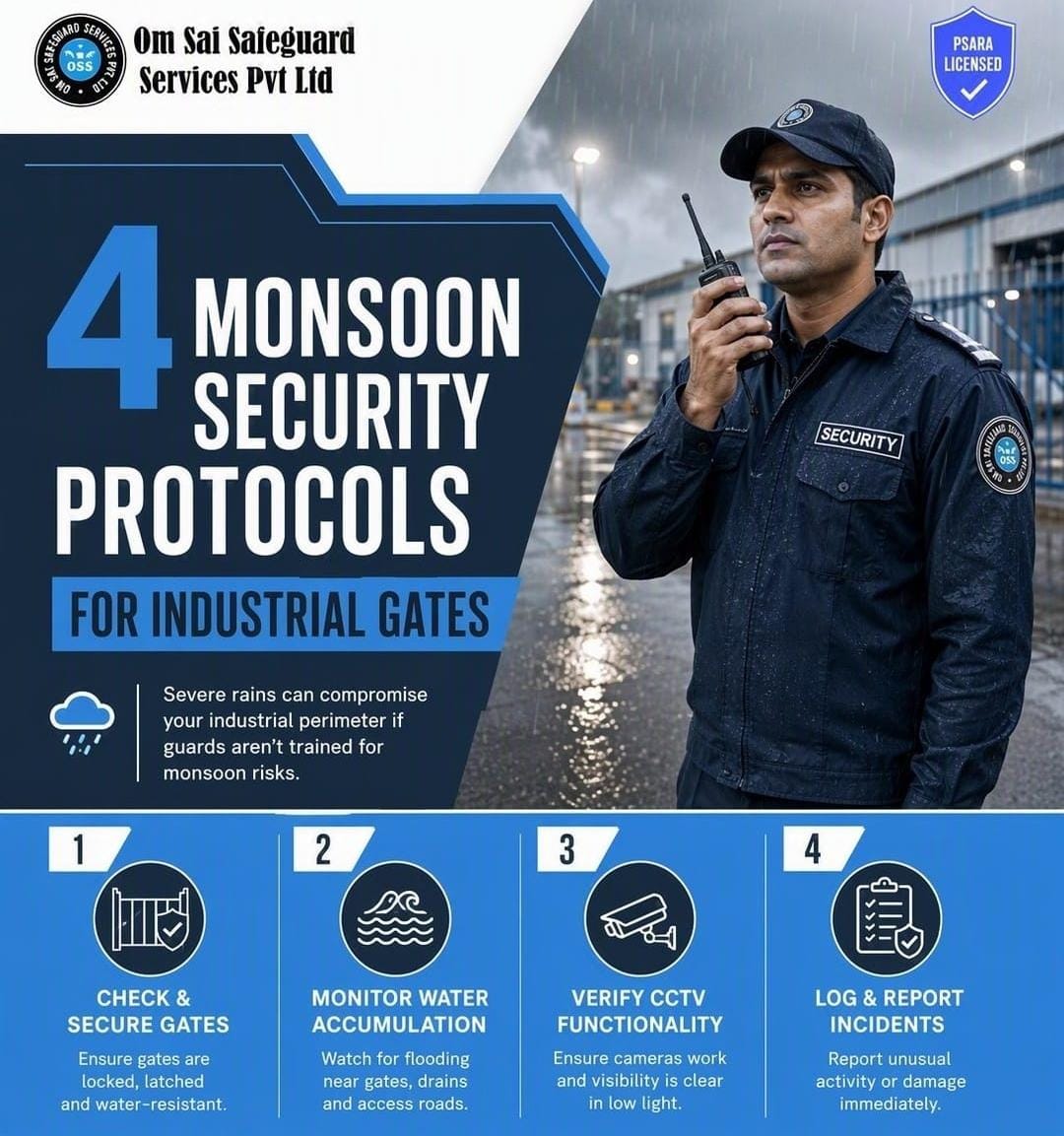
Om Sai Safeguard Services Strengthens Its Presence as a Trusted Provider of Security Services In Delhi

NEW DELHI — As businesses, residential communities, institutions, and commercial establishments increasingly prioritize professional protection, the demand for reliable Security Services In Delhi continues to grow. Om Sai Safeguard Services Pvt. Ltd., an established private security company with operations across multiple states, is strengthening its presence in the national capital by offering trained manpower and customized security solutions for diverse requirements.

Since its establishment in 2018, Om Sai Safeguard Services has steadily expanded its operations and developed experience across residential, commercial, industrial, and institutional security requirements. The company operates in Delhi as well as Maharashtra, Telangana, and Madhya Pradesh, enabling it to serve clients with security needs across different locations.

Delhi is one of India's busiest metropolitan regions, with a wide range of corporate offices, industrial facilities, educational institutions, hospitals, retail spaces, hotels, and residential societies. Every property has different security challenges, making professionally managed Security Services In Delhi increasingly important for organizations and property owners seeking reliable protection.

Om Sai Safeguard Services focuses on providing trained security personnel who can support day-to-day safety, access control, surveillance, patrolling, visitor management, and emergency response. The company's approach combines on-ground security personnel with modern monitoring solutions to create security arrangements suited to individual client requirements.

Comprehensive Security Solutions for Different Sectors

The company's services cover a broad range of industries and establishments. Its security solutions include corporate and office security, industrial security, bank security, hotel security, hospital security, event security, residential security, and lady security guard services.

For corporate offices and commercial establishments, professional security guards can help manage entry and exit points, monitor visitors, protect assets, and maintain order on the premises. Industrial and warehouse facilities often require additional attention to perimeter security, employee movement, and the protection of valuable equipment and materials.

Om Sai Safeguard Services also provides security arrangements for hotels, healthcare facilities, banks, shopping areas, and events. These sectors require personnel who can maintain vigilance while also interacting professionally with employees, visitors, customers, and guests.

Trained Personnel and Responsive Security Support

One of the key factors clients consider when choosing Security Services In Delhi is the quality and preparedness of security personnel. Om Sai Safeguard Services emphasizes trained manpower and disciplined security practices as part of its service approach.

The company also highlights its Quick Response Team and its focus on timely support when situations require immediate attention. A visible and alert security presence can play an important role in identifying unusual activity, managing incidents, and helping maintain a safer environment.

Along with physical guarding, the company supports CCTV monitoring and electronic surveillance as part of its wider security solutions. Combining technology with trained on-site personnel can help organizations maintain better visibility and respond efficiently to security concerns.

Flexible Security Arrangements for Businesses and Properties

Security requirements can vary significantly depending on the size and nature of a property. A residential society may require visitor management and regular patrolling, while a large commercial or industrial facility may need round-the-clock security coverage.

Om Sai Safeguard Services offers flexible security arrangements, including different shift options based on client requirements. This enables businesses, institutions, and property managers to plan security coverage according to their operational schedules and risk assessments.

The company's experience across multiple sectors allows it to develop customized arrangements rather than applying a one-size-fits-all approach. Whether the requirement is for a single location or multiple sites, professional planning and reliable staffing remain important parts of an effective security strategy.

Growing Presence Across Multiple States

While Om Sai Safeguard Services has a strong operational base in Maharashtra, its services extend to Delhi and other parts of India. The company maintains a Delhi branch in Palam and presents itself as a provider of professional security solutions for homes, businesses, and institutions across its service locations.

For organizations looking for Security Services In Delhi, factors such as trained personnel, service flexibility, operational experience, and the ability to understand site-specific requirements can make a meaningful difference. Om Sai Safeguard Services continues to focus on these areas as it expands its presence and serves clients across different sectors.

As security needs evolve alongside urban growth and changing business environments, the role of professional private security providers is becoming increasingly important. With a range of guarding and surveillance solutions, Om Sai Safeguard Services aims to support clients seeking dependable protection for people, property, and business operations.

For more information about Security Services In Delhi and other security solutions, visit Om Sai Safeguard Services in Delhi or contact the company at +91-7070020202.

Nature Hospitality Expands Reach With New International Tour Packages

INDIA — Nature Hospitality, a travel and hospitality provider that has spent over a decade building its name around domestic getaways in Delhi, Bangalore, Mumbai, Chennai, Ahmedabad, Hyderabad and other Indian destinations, has now widened its portfolio to include a full lineup of international tour packages.The company, established in 2014, built its early reputation on curated trips to the Himalayan belt, Wayanad, Munnar, and island destinations such as Lakshadweep. Its move into international travel marks a shift for a brand that has largely been associated with domestic holidays until now.

The new offering includes Paris tour packages built around the Eiffel Tower, the Louvre Museum, and the Seine River, along with broader Europe tour packages covering France, Switzerland, Italy, Germany, and Spain. Travelers looking specifically at the Alps and lake country can also choose dedicated Switzerland tour packages.

Beyond Europe, Nature Hospitality has added USA tour packages featuring New York, Las Vegas, Los Angeles, and Miami, as well as Australia tour packages built around Sydney, Melbourne, and the Gold Coast. The company has also introduced Japan tour packages covering Tokyo, Kyoto, Osaka, and Mount Fuji, giving travelers a route into a market that combines modern cities with traditional culture.

For travelers drawn to desert landscapes and city luxury, the company has rolled out Dubai tour packages that include desert safaris, shopping, and sightseeing alongside stays at upscale hotels. South Africa tour packages round out the list, taking travelers through Cape Town, Johannesburg, and wildlife safaris across the country's landscapes.

"Our clients have been asking for the same kind of planning and support they got on their India trips, but for international destinations," the company said. "This expansion is our way of answering that demand without changing how we work with people."

That approach includes honeymoon and family packages, which the company has customized for couples, families, and groups traveling together. Nature Hospitality is also continuing its practice of building personalized itineraries from scratch, based on a traveler's destination, budget, travel dates, and specific preferences, rather than relying only on fixed departures.

Industry watchers have pointed to a broader trend behind this kind of expansion. Indian travelers have increasingly moved from domestic weekend trips toward longer international holidays over the past few years, a shift that has pushed many established domestic operators to add global destinations to their catalogs.

Nature Hospitality's past reviews, many tied to its Himalayan and Kerala tours, have often highlighted the hands-on support its team provides during a trip, including arranging local transport and adjusting plans on short notice. The company says it intends to carry that same level of involvement into its international bookings, from visa guidance to on-ground coordination at each destination.

The company has not limited its international packages to a single style of travel. Its catalog spans romantic city breaks in Paris, adventure-driven safaris in South Africa, beach and city combinations in Australia, and cultural circuits through Japan, giving it a spread that can serve very different types of travelers under one brand.

With this expansion, Nature Hospitality positions itself to compete for a segment of travelers who previously would have booked international trips through separate specialist agencies for each region. By keeping planning, budgeting, and support under one roof, the company is betting that convenience will be as strong a draw as the destinations themselves.

Nature Hospitality says more destinations and packages are expected to be added to its international lineup in the coming months, as it continues building out this side of the business alongside its existing domestic operations.

For those interested in Paris, Europe, USA, Australia, South Africa, Japan, Dubai, Switzerland, honeymoon and family holidays, or a fully customized international itinerary, Nature Hospitality can be reached through its official website and customer support channels.

Media Contact: Nature Hospitality Email: www.naturehospitality.net


EzeeHoney Taps India's Growing On-the-Go Wellness Trend with Convenient Premium Honey Solutions

The trend of healthy lifestyles among consumers and the time constraints has led to an increasing need for convenient, healthful and clean labeled products. In response to this change, EzeeHoney has created a new convenient and portable way to enjoy one of nature's oldest superfoods by introducing its high quality single serve honey twigs with purity, portability and convenience.

Today's consumers are looking for foods that seamlessly fit into their daily routines without compromising on quality or nutrition. From commuting to work, travelling, working out, or working in the office, they want products that are convenient to take, sanitary, and ready to eat. EzeeHoney meets this growing demand by revolutionising the traditional honey jar into a convenient and mess free single serve portion, which can be consumed anywhere, anytime.

EzeeHoney's individually sealed honey twigs are a convenient solution for the busy, modern lifestyle and unlike traditional honey packaging, they do not require spoons or special storage. The portion controlled format allows you to reduce the risk of sticky messes, product wastage and a guarantee of freshness with each portion. Consumers can just pop open a twig and eat the pure honey or pour a bit into their tea, coffee or smoothies, or add the honey to their breakfast bowls, yogurt, cereals or all their regular dishes.

The company's spokesperson said that the idea behind EzeeHoney was to make natural honey easily available and convenient for the people of today. Our honey twigs offer high quality and unbeatable convenience, while retaining the natural goodness of the honey.

The brand caters to the consumers who are looking for authentic taste and innovative wellness products with a well-curated portfolio of products such as Himalayan Multi-Flora Honey, Lemon-Infused Honey, Lychee Blossom Honey, Vanilla-Infused Honey and functional Lakadong Turmeric Honey. Each variety is carefully developed to maintain the natural characteristics of the honey and provide unique taste and functionality.

Consumer trends show that there is an increasing demand for clean-label foods – those that contain easy-to-understand ingredients. The more people get to know about mindful eating, the more we see products that provide natural nutrition in convenient formats become a daily part of people's wellness regimes. With its versatility and natural sweetness, honey is making a comeback in the world of health-conscious consumers seeking alternatives to refined sugar.

EzeeHoney's innovative solution also resonates with the increased demand for packaging where control of servings is important for responsible consumption and to avoid further waste. Its compact design makes it ideal for professionals, students, fitness enthusiasts, travellers and families who want to get good nutrition without sacrificing convenience.

EzeeHoney not only brings a new packaging format, but also a new range of experience to the consumer culture of honey, by making it a practical everyday companion as opposed to an occasional beaker of pantry honey. Incorporating high-quality ingredients, user-friendly functionality, and contemporary amenities, the brand is developing a new category experience in keeping with today's consumers' expectations.

In a country where the wellness lifestyle and functional foods are gaining momentum, EzeeHoney is at the nexus of health, innovation and convenience, making pure honey consumption more convenient for customers than ever before.

Astrus Corp Expands Vision Beyond Commercial Real Estate, Eyes Premium Plotted Communities

Having established its presence in commercial real estate through a focus on quality construction and timely project delivery, Astrus Corp is now charting its next phase of growth with plans to enter the premium plotted development segment across high-growth locations in the National Capital Region (NCR).

The company said the proposed expansion is part of its long-term vision to develop integrated communities that respond to evolving homebuyer preferences and the region’s rapid urbanisation. Rather than focusing solely on individual projects, Astrus Corp aims to create planned developments that combine efficient infrastructure, open spaces and sustainable urban planning.

According to the company, the increasing demand for organised plotted communities reflects a broader shift in the residential real estate market, with buyers seeking flexibility, better quality of life and long-term investment value. Improving infrastructure, enhanced connectivity and expanding urban corridors have further strengthened the outlook for this segment.

Commenting on the company’s future roadmap, Akash Dixit, Director, Astrus Corp, said, “At Astrus Corp, our objective is not just to develop real estate but to create communities that remain relevant for decades. As we expand into premium plotted developments, our focus will be on thoughtful master planning, quality infrastructure, transparency and timely execution. We believe sustainable development and customer trust will continue to define the future of India’s real estate sector.”

Astrus Corp said its future developments will be guided by the same principles that have shaped its growth in commercial real estate—disciplined execution, customer-centric planning and long-term value creation. The company believes that premium plotted communities, supported by modern infrastructure and responsible urban planning, will play an increasingly important role in meeting the aspirations of the next generation of homebuyers while contributing to the planned development of NCR’s emerging growth corridors. For more information you can visit

Instagram: https://www.instagram.com/astruscorp/


Thavaputhalvi Rural Women Empowerment Mission: Empowering Rural Women to Become Entrepreneurs and Leaders - By Prof. Dr. Subathra Chelladurai, F

In a society striving for inclusive growth and sustainable development, the empowerment of rural women is not merely a social responsibility; it is an essential investment in the future of families, communities, and the nation. Recognising this need, the Thavaputhalvi Rural Women Empowerment Mission, an initiative of OF BY & FOR YOU TRUST, INDIA, seeks to create meaningful opportunities for rural women to develop their skills, pursue entrepreneurship, achieve economic independence, and emerge as leaders of change.

Beyond Empowerment: Building Economic Independence

Rural women play a vital role in agriculture, household management, traditional occupations, food preparation, handicrafts, and community development. Despite their contributions, many face barriers that limit their economic advancement. Inadequate access to business training, financial resources, market opportunities, technology, professional networks, and institutional support can prevent their skills from becoming sustainable sources of income.

The Thavaputhalvi Rural Women Empowerment Mission envisions a future in which rural women are recognised not only for their contributions to families and communities but also as entrepreneurs, producers, business owners, decision-makers, and agents of social transformation.

The mission's underlying philosophy is that women should have the opportunity to move beyond economic dependency and become confident participants in the economic development of their communities.

Transforming Skills into Sustainable Livelihoods

One of the mission's central priorities is to encourage rural women to identify their strengths, develop practical skills, and explore viable entrepreneurial opportunities. Women who possess traditional knowledge or experience in food production, tailoring, handicrafts, natural products, agriculture-related activities, and other local occupations can be supported in transforming these capabilities into organised business ventures.

However, entrepreneurship requires more than an idea or a product. It also demands planning, financial awareness, quality management, packaging, branding, pricing, customer relations, and access to markets.

Accordingly, the mission seeks to promote a comprehensive approach to women's entrepreneurship through capacity-building programmes, enterprise development guidance, product improvement, marketing support, and connections with appropriate institutions and business networks.

Particular importance can be given to locally available resources and traditional skills, enabling women to develop enterprises that respond to market demand while preserving the value of local knowledge and culture.

Creating Market Opportunities for Rural Women

For many small producers, developing a product is only the first step. Reaching customers, securing fair prices, maintaining product quality, and competing in an increasingly digital marketplace can be equally challenging.

The Thavaputhalvi mission seeks to address these challenges by encouraging women entrepreneurs to strengthen their product identity, improve presentation and packaging, explore digital marketing, and establish connections with retailers, institutions, consumers, and other potential buyers.

Collective marketing and collaborative business models may also help women share resources, improve visibility, and explore larger market opportunities.

By connecting skill development with business guidance and market access, the mission aims to create an enabling environment in which rural women can pursue more sustainable livelihoods and build confidence in their entrepreneurial abilities.

Financial Literacy and Responsible Enterprise Development

Access to finance is an important consideration for women seeking to establish or expand a business. Yet financial support is most effective when accompanied by appropriate guidance, realistic business planning, and an understanding of repayment responsibilities.

The mission seeks to encourage financial literacy and awareness of suitable government schemes, institutional credit facilities, and entrepreneurship support programmes, subject to eligibility and the applicable requirements of the respective institutions.

The objective is to help women make informed financial decisions, understand business risks, and develop enterprises with a stronger foundation for long-term sustainability.

Economic empowerment should not be measured solely by the number of businesses established. It should also be reflected in women's ability to make independent financial decisions, contribute to household well-being, participate in community affairs, and plan confidently for their futures.

A Community-Centred Vision for Women's Leadership

The impact of empowering a woman can extend beyond her individual enterprise. When women gain skills, confidence, income, and decision-making opportunities, they can become role models for younger generations and contribute to the progress of their communities.

Thavaputhalvi aspires to encourage a culture in which rural women support one another, exchange knowledge, build professional relationships, and work collectively towards shared economic goals.

The mission's long-term vision is to nurture a network of capable rural women entrepreneurs who can inspire others, strengthen local economies, and contribute to inclusive development.

Progress towards this vision will depend on collaboration among women, community organisations, educational institutions, financial institutions, government agencies, responsible businesses, and potential supporters.

The Vision Behind Thavaputhalvi

Founded by Prof. Dr. Subathra Chelladurai, the Thavaputhalvi Rural Women Empowerment Mission reflects a commitment to connecting women's empowerment with practical economic opportunities. Through OF BY & FOR YOU TRUST, INDIA, the initiative seeks to promote a development approach that values women's abilities and supports their journey towards entrepreneurship, independence, and leadership.

The name Thavaputhalvi represents an identity associated with purpose, dignity, and positive social contribution. The mission aspires to translate these values into opportunities that help rural women recognise their potential and take meaningful steps towards economic self-reliance.

Its vision is not simply to encourage women to earn an income, but to help create conditions in which they can build sustainable enterprises, strengthen their confidence, and participate more actively in shaping their futures.

Empowering Women, Strengthening India

India's development journey becomes more inclusive when rural women have access to the knowledge, resources, opportunities, and networks needed to realise their potential. Supporting women-led enterprises can contribute to livelihood generation, local economic activity, family well-being, and stronger communities.

The Thavaputhalvi Rural Women Empowerment Mission seeks to contribute to this broader vision by placing rural women at the centre of economic opportunity and community development.

When a rural woman is empowered with skills, opportunity, confidence, and market access, she gains more than the possibility of earning an income—she gains greater power to shape her own future.

Through its commitment to rural women's entrepreneurship and economic independence, Thavaputhalvi aspires to help turn women's potential into opportunity, opportunity into enterprise, and enterprise into lasting social progress.


Prof.Dr. SUBATHRA CHELLADURAI- Founder

THAVAPUTHALVI RURAL WOMEN EMPOWERMENT MISSION

An Initiative of OF BY & FOR YOU TRUST, INDIA

Instapage: https://www.instagram.com/thavaputhalvi_youtrust

Website: https://thavaputhalvi.in, Whatsapp/ Call : +91-7358102775


Empowering Rural Women • Inspiring Change


 Thavaputhalvi Rural Women Empowerment Mission: Empowering Rural Women to Become Entrepreneurs and Leaders - By Prof. Dr. Subathra Chelladurai, Founder, THAVAPUTHALVI RURAL WOMEN EMPOWERMENT MISSION, An Initiative of OF BY & FOR YOU TRUST, INDIA


In a society striving for inclusive growth and sustainable development, the empowerment of rural women is not merely a social responsibility; it is an essential investment in the future of families, communities, and the nation. Recognising this need, the Thavaputhalvi Rural Women Empowerment Mission, an initiative of OF BY & FOR YOU TRUST, INDIA, seeks to create meaningful opportunities for rural women to develop their skills, pursue entrepreneurship, achieve economic independence, and emerge as leaders of change.

Beyond Empowerment: Building Economic Independence

Rural women play a vital role in agriculture, household management, traditional occupations, food preparation, handicrafts, and community development. Despite their contributions, many face barriers that limit their economic advancement. Inadequate access to business training, financial resources, market opportunities, technology, professional networks, and institutional support can prevent their skills from becoming sustainable sources of income.

The Thavaputhalvi Rural Women Empowerment Mission envisions a future in which rural women are recognised not only for their contributions to families and communities but also as entrepreneurs, producers, business owners, decision-makers, and agents of social transformation.

The mission's underlying philosophy is that women should have the opportunity to move beyond economic dependency and become confident participants in the economic development of their communities.

Transforming Skills into Sustainable Livelihoods

One of the mission's central priorities is to encourage rural women to identify their strengths, develop practical skills, and explore viable entrepreneurial opportunities. Women who possess traditional knowledge or experience in food production, tailoring, handicrafts, natural products, agriculture-related activities, and other local occupations can be supported in transforming these capabilities into organised business ventures.

However, entrepreneurship requires more than an idea or a product. It also demands planning, financial awareness, quality management, packaging, branding, pricing, customer relations, and access to markets.

Accordingly, the mission seeks to promote a comprehensive approach to women's entrepreneurship through capacity-building programmes, enterprise development guidance, product improvement, marketing support, and connections with appropriate institutions and business networks.

Particular importance can be given to locally available resources and traditional skills, enabling women to develop enterprises that respond to market demand while preserving the value of local knowledge and culture.

Creating Market Opportunities for Rural Women

For many small producers, developing a product is only the first step. Reaching customers, securing fair prices, maintaining product quality, and competing in an increasingly digital marketplace can be equally challenging.

The Thavaputhalvi mission seeks to address these challenges by encouraging women entrepreneurs to strengthen their product identity, improve presentation and packaging, explore digital marketing, and establish connections with retailers, institutions, consumers, and other potential buyers.

Collective marketing and collaborative business models may also help women share resources, improve visibility, and explore larger market opportunities.

By connecting skill development with business guidance and market access, the mission aims to create an enabling environment in which rural women can pursue more sustainable livelihoods and build confidence in their entrepreneurial abilities.

Financial Literacy and Responsible Enterprise Development

Access to finance is an important consideration for women seeking to establish or expand a business. Yet financial support is most effective when accompanied by appropriate guidance, realistic business planning, and an understanding of repayment responsibilities.

The mission seeks to encourage financial literacy and awareness of suitable government schemes, institutional credit facilities, and entrepreneurship support programmes, subject to eligibility and the applicable requirements of the respective institutions.

The objective is to help women make informed financial decisions, understand business risks, and develop enterprises with a stronger foundation for long-term sustainability.

Economic empowerment should not be measured solely by the number of businesses established. It should also be reflected in women's ability to make independent financial decisions, contribute to household well-being, participate in community affairs, and plan confidently for their futures.

A Community-Centred Vision for Women's Leadership

The impact of empowering a woman can extend beyond her individual enterprise. When women gain skills, confidence, income, and decision-making opportunities, they can become role models for younger generations and contribute to the progress of their communities.

Thavaputhalvi aspires to encourage a culture in which rural women support one another, exchange knowledge, build professional relationships, and work collectively towards shared economic goals.

The mission's long-term vision is to nurture a network of capable rural women entrepreneurs who can inspire others, strengthen local economies, and contribute to inclusive development.

Progress towards this vision will depend on collaboration among women, community organisations, educational institutions, financial institutions, government agencies, responsible businesses, and potential supporters.

The Vision Behind Thavaputhalvi

Founded by Prof. Dr. Subathra Chelladurai, the Thavaputhalvi Rural Women Empowerment Mission reflects a commitment to connecting women's empowerment with practical economic opportunities. Through OF BY & FOR YOU TRUST, INDIA, the initiative seeks to promote a development approach that values women's abilities and supports their journey towards entrepreneurship, independence, and leadership.

The name Thavaputhalvi represents an identity associated with purpose, dignity, and positive social contribution. The mission aspires to translate these values into opportunities that help rural women recognise their potential and take meaningful steps towards economic self-reliance.

Its vision is not simply to encourage women to earn an income, but to help create conditions in which they can build sustainable enterprises, strengthen their confidence, and participate more actively in shaping their futures.

Empowering Women, Strengthening India

India's development journey becomes more inclusive when rural women have access to the knowledge, resources, opportunities, and networks needed to realise their potential. Supporting women-led enterprises can contribute to livelihood generation, local economic activity, family well-being, and stronger communities.

The Thavaputhalvi Rural Women Empowerment Mission seeks to contribute to this broader vision by placing rural women at the centre of economic opportunity and community development.

When a rural woman is empowered with skills, opportunity, confidence, and market access, she gains more than the possibility of earning an income—she gains greater power to shape her own future.

Through its commitment to rural women's entrepreneurship and economic independence, Thavaputhalvi aspires to help turn women's potential into opportunity, opportunity into enterprise, and enterprise into lasting social progress.


Prof.Dr. SUBATHRA CHELLADURAI- Founder

THAVAPUTHALVI RURAL WOMEN EMPOWERMENT MISSION

An Initiative of OF BY & FOR YOU TRUST, INDIA

Instapage: https://www.instagram.com/thavaputhalvi_youtrust

Website: https://thavaputhalvi.in, Whatsapp/ Call : +91-7358102775


Empowering Rural Women • Inspiring Change



 Thavaputhalvi Rural Women Empowerment Mission: Empowering Rural Women to Become Entrepreneurs and Leaders - By Prof. Dr. Subathra Chelladurai, Founder, THAVAPUTHALVI RURAL WOMEN EMPOWERMENT MISSION, An Initiative of OF BY & FOR YOU TRUST, INDIA


In a society striving for inclusive growth and sustainable development, the empowerment of rural women is not merely a social responsibility; it is an essential investment in the future of families, communities, and the nation. Recognising this need, the Thavaputhalvi Rural Women Empowerment Mission, an initiative of OF BY & FOR YOU TRUST, INDIA, seeks to create meaningful opportunities for rural women to develop their skills, pursue entrepreneurship, achieve economic independence, and emerge as leaders of change.

Beyond Empowerment: Building Economic Independence

Rural women play a vital role in agriculture, household management, traditional occupations, food preparation, handicrafts, and community development. Despite their contributions, many face barriers that limit their economic advancement. Inadequate access to business training, financial resources, market opportunities, technology, professional networks, and institutional support can prevent their skills from becoming sustainable sources of income.

The Thavaputhalvi Rural Women Empowerment Mission envisions a future in which rural women are recognised not only for their contributions to families and communities but also as entrepreneurs, producers, business owners, decision-makers, and agents of social transformation.

The mission's underlying philosophy is that women should have the opportunity to move beyond economic dependency and become confident participants in the economic development of their communities.

Transforming Skills into Sustainable Livelihoods

One of the mission's central priorities is to encourage rural women to identify their strengths, develop practical skills, and explore viable entrepreneurial opportunities. Women who possess traditional knowledge or experience in food production, tailoring, handicrafts, natural products, agriculture-related activities, and other local occupations can be supported in transforming these capabilities into organised business ventures.

However, entrepreneurship requires more than an idea or a product. It also demands planning, financial awareness, quality management, packaging, branding, pricing, customer relations, and access to markets.

Accordingly, the mission seeks to promote a comprehensive approach to women's entrepreneurship through capacity-building programmes, enterprise development guidance, product improvement, marketing support, and connections with appropriate institutions and business networks.

Particular importance can be given to locally available resources and traditional skills, enabling women to develop enterprises that respond to market demand while preserving the value of local knowledge and culture.

Creating Market Opportunities for Rural Women

For many small producers, developing a product is only the first step. Reaching customers, securing fair prices, maintaining product quality, and competing in an increasingly digital marketplace can be equally challenging.

The Thavaputhalvi mission seeks to address these challenges by encouraging women entrepreneurs to strengthen their product identity, improve presentation and packaging, explore digital marketing, and establish connections with retailers, institutions, consumers, and other potential buyers.

Collective marketing and collaborative business models may also help women share resources, improve visibility, and explore larger market opportunities.

By connecting skill development with business guidance and market access, the mission aims to create an enabling environment in which rural women can pursue more sustainable livelihoods and build confidence in their entrepreneurial abilities.

Financial Literacy and Responsible Enterprise Development

Access to finance is an important consideration for women seeking to establish or expand a business. Yet financial support is most effective when accompanied by appropriate guidance, realistic business planning, and an understanding of repayment responsibilities.

The mission seeks to encourage financial literacy and awareness of suitable government schemes, institutional credit facilities, and entrepreneurship support programmes, subject to eligibility and the applicable requirements of the respective institutions.

The objective is to help women make informed financial decisions, understand business risks, and develop enterprises with a stronger foundation for long-term sustainability.

Economic empowerment should not be measured solely by the number of businesses established. It should also be reflected in women's ability to make independent financial decisions, contribute to household well-being, participate in community affairs, and plan confidently for their futures.

A Community-Centred Vision for Women's Leadership

The impact of empowering a woman can extend beyond her individual enterprise. When women gain skills, confidence, income, and decision-making opportunities, they can become role models for younger generations and contribute to the progress of their communities.

Thavaputhalvi aspires to encourage a culture in which rural women support one another, exchange knowledge, build professional relationships, and work collectively towards shared economic goals.

The mission's long-term vision is to nurture a network of capable rural women entrepreneurs who can inspire others, strengthen local economies, and contribute to inclusive development.

Progress towards this vision will depend on collaboration among women, community organisations, educational institutions, financial institutions, government agencies, responsible businesses, and potential supporters.

The Vision Behind Thavaputhalvi

Founded by Prof. Dr. Subathra Chelladurai, the Thavaputhalvi Rural Women Empowerment Mission reflects a commitment to connecting women's empowerment with practical economic opportunities. Through OF BY & FOR YOU TRUST, INDIA, the initiative seeks to promote a development approach that values women's abilities and supports their journey towards entrepreneurship, independence, and leadership.

The name Thavaputhalvi represents an identity associated with purpose, dignity, and positive social contribution. The mission aspires to translate these values into opportunities that help rural women recognise their potential and take meaningful steps towards economic self-reliance.

Its vision is not simply to encourage women to earn an income, but to help create conditions in which they can build sustainable enterprises, strengthen their confidence, and participate more actively in shaping their futures.

Empowering Women, Strengthening India

India's development journey becomes more inclusive when rural women have access to the knowledge, resources, opportunities, and networks needed to realise their potential. Supporting women-led enterprises can contribute to livelihood generation, local economic activity, family well-being, and stronger communities.

The Thavaputhalvi Rural Women Empowerment Mission seeks to contribute to this broader vision by placing rural women at the centre of economic opportunity and community development.

When a rural woman is empowered with skills, opportunity, confidence, and market access, she gains more than the possibility of earning an income—she gains greater power to shape her own future.

Through its commitment to rural women's entrepreneurship and economic independence, Thavaputhalvi aspires to help turn women's potential into opportunity, opportunity into enterprise, and enterprise into lasting social progress.


Prof.Dr. SUBATHRA CHELLADURAI- Founder

THAVAPUTHALVI RURAL WOMEN EMPOWERMENT MISSION

An Initiative of OF BY & FOR YOU TRUST, INDIA

Instapage: https://www.instagram.com/thavaputhalvi_youtrust

Website: https://thavaputhalvi.in, Whatsapp/ Call : +91-7358102775


Empowering Rural Women • Inspiring Change


*नशामुक्त झारखंड के लिए रोकथाम को जनआंदोलन बनाना होगा: सचिव उमाशंकर सिंह, एमडीआई में राज्यस्तरीय कार्यशाला आयोजित*

रांची:- श्री उमाशंकर सिंह , सचिव, स्कूली शिक्षा एवं साक्षरता विभाग सह महिला, बाल विकास एवं सामाजिक सुरक्षा विभाग ने कहा कि नशे की चुनौती केवल कानून-व्यवस्था का विषय नहीं, बल्कि युवाओं, परिवारों और समाज के भविष्य से जुड़ा गंभीर मुद्दा है। हमारी सफलता गतिविधियों की संख्या से नहीं, बल्कि इस बात से मापी जानी चाहिए कि हम कितने लोगों को नशे से बचा सके और उनके जीवन में कितना सकारात्मक बदलाव ला सके।" उन्होंने कहा कि नशा रोकथाम को पंचायतों, शैक्षणिक संस्थानों, समुदायों और विभिन्न विभागों की साझा जिम्मेदारी बनाना होगा, ताकि इसे जमीनी स्तर पर प्रभावी जनआंदोलन का स्वरूप दिया जा सके”।वे मंगलवार को एमडीआई बिल्डिंग प्रोजेक्ट भवन में आयोजित एक कार्यशाला को बतौर मुख्य अतिथि संबोधित कर रहे थे । उन्होंने नशा मुक्ति को केवल जागरूकता तक सीमित न रखकर रोकथाम, व्यवहार परिवर्तन और सामुदायिक नेतृत्व आधारित जनआंदोलन बनाने का आह्वान किया।

मंगलवार को एमडीआई बिल्डिंग प्रोजेक्ट भवन में सामाजिक न्याय एवं अधिकारिता मंत्रालय, भारत सरकार के निर्देशानुसार झारखंड सरकार द्वारा नशीले पदार्थों की मांग में कमी (Drug Demand Reduction) एवं रोकथाम आधारित रणनीतियों को सुदृढ़ करने के उद्देश्य से महिला, बाल विकास एवं सामाजिक सुरक्षा विभाग द्वारा राज्य स्तरीय परामर्श कार्यशाला “Reimagining Prevention and Drug Demand Reduction in India” का आयोजन किया गया था ।

निदेशक, सामाजिक कल्याण श्रीमती किरण कुमारी पासी ने कहा कि नशे की रोकथाम में परिवार और समुदाय की भूमिका सबसे महत्वपूर्ण है। समय पर सही जानकारी, उचित मार्गदर्शन और सहयोग उपलब्ध कराकर हजारों युवाओं को नशे की चपेट में आने से बचाया जा सकता है। "नशे के खिलाफ लड़ाई की सबसे बड़ी ताकत हमारा समाज, परिवार और समुदाय हैं। यह केवल सरकार की जिम्मेदारी नहीं है। उन्होंने स्वयं सहायता समूहों, सहिया, आंगनबाड़ी कार्यकर्ताओं, पंचायत प्रतिनिधियों और युवा संगठनों को नशा रोकथाम, प्रारंभिक पहचान, परामर्श एवं सामुदायिक जागरूकता के प्रमुख साझेदार के रूप में सशक्त बनाने पर बल दिया । उन्होंने स्वयं सहायता समूहों, सहिया, आंगनबाड़ी कार्यकर्ताओं, पंचायत प्रतिनिधियों और युवा संगठनों को नशा रोकथाम, प्रारंभिक पहचान, परामर्श एवं सामुदायिक जागरूकता के प्रमुख साझेदार के रूप में सशक्त बनाने पर बल दिया।

कार्यशाला में विभिन्न विभागों, development partners, एवं विशेषज्ञों ने साक्ष्य आधारित, result oriented और समुदाय केंद्रित नशा रोकथाम मॉडल पर चर्चा की। जिला, प्रखंड और ग्राम स्तर पर समन्वित कार्ययोजना विकसित करने तथा रोकथाम, परामर्श, उपचार, पुनर्वास और सामाजिक पुनर्समेकन को एकीकृत रूप से लागू करने की आवश्यकता पर जोर दिया गया।

कार्यशाला में पंचायती राज, नगर विकास, गृह विभाग के नारकोटिक्स प्रकोष्ठ, उच्च एवं तकनीकी शिक्षा, सामाजिक सुरक्षा, आई.सी.पीएस तथा जे.एस.एल.पी.एस सहित विभिन्न विभागों के प्रतिनिधियों ने भाग लेकर अपने विचार साझा किए। सभी प्रतिभागियों ने नशा मुक्ति के लिए सामाजिक समावेशन एवं विभागीय convergence को आवश्यक बताते हुए नशा मुक्त हेल्पलाइन 14446 तथा उपलब्ध परामर्श, उपचार एवं पुनर्वास सेवाओं के व्यापक प्रचार-प्रसार पर बल दिया ।

कार्यशाला के अंत में झारखंड में नशीले पदार्थों की मांग में कमी लाने हेतु राज्य की प्रतिबद्धता के तहत एक कार्ययोजना तैयार की गई, जिसे सामाजिक न्याय एवं अधिकारिता मंत्रालय को प्रेषित किया जाएगा।

Trailer Driving School in Kerala: Master the Reverse That Fails Most Candidates, on A2Z's Own Trailers

A2Z International Heavy Equipment Institute, training drivers and operators in Kerala since 1978, runs normal and container trailer courses on its own vehicles and practice ground, with 19 branches and a main campus at Willingdon Island, Kochi.A2Z International Heavy Equipment Institute runs two trailer courses, one for normal trailers and one for container trailers, aimed at drivers who want work at ports, with logistics companies and in heavy haulage in India and the Gulf. The institute says most candidates underestimate the same two things: the order in which the licences have to be earned, and reversing an articulated vehicle.

The licence is a ladder

A trailer licence is not a standalone licence. It is an endorsement added to an existing heavy vehicle licence, and it sits at the top of a sequence. A driver starts with an LMV licence, adds a transport or commercial endorsement, moves up to a heavy goods vehicle licence (HMV or HTV), and only then qualifies for the trailer endorsement that covers articulated and multi-axle vehicles. Each step generally requires holding the previous one for a qualifying period set by the RTO. Commercial driving in Kerala also needs a separate driver's badge.

"Half the people who call us have planned around a timeline they read online, and then find their licence dates don't qualify them yet," said Aravind, Executive Director of A2Z International Heavy Equipment Institute. "The first thing any trailer driving school in Kerala should do is look at what you hold and when you got it. Then we can tell you your real route, and it saves people months."

What the practical test asks for

The trailer practical tests five things: a pre-trip inspection including the coupling, coupling and uncoupling, controlled manoeuvring and turning with the articulation, reversing, and safe road handling under load. Reversing is where most candidates fail. In reverse, an articulated trailer swings the opposite way to the steering input.

"People expect the highway to be the hard part," Aravind said. "Then you ask a man to reverse a trailer into a bay, and for the first week he turns the wheel the wrong way every time. You can't learn that from a video. You need hours on a real trailer with an instructor next to you telling you what your hands are doing."

Two courses on one owned fleet

A2Z trains on trailers it owns, on a dedicated practice ground, instead of booking time on hired vehicles. Students can choose normal trailer training or container trailer training. Both follow a seven-stage curriculum: vehicle parts, controls and pre-trip checks; coupling and uncoupling; reversing, turning and manoeuvring; container handling and load securing; highway driving, gradients and braking; daily checks and basic maintenance; and licence and assessment preparation.

Graduates receive ISO and Operator Card certification along with guidance on heavy transport licensing. The main campus at Willingdon Island has a hostel for students who travel in.

A trailer driving school in Kerala with its own vehicles can give students more practice. On a hired trailer, time runs out when the booking ends. On an owned one, students keep practising until the reverse is under control.

An institute of firsts since 1978

A2Z opened in 1978. It is the only JCB-authorised operator training institute in Kerala and the state's only fixed tower crane training institute, and it was the first in Kerala to offer imported Zoomlion crane operator training. It owns every machine and vehicle it trains on and works with more than 527 placement partner companies.

Where trailer drivers work

The institute describes trailer driving as one of the better-paying commercial driving categories. Demand comes from Kerala's ports, from logistics corridors across India, and from heavy haulage in the Gulf. Graduates train for roles as trailer drivers, container and port trailer drivers, transport and logistics drivers, and heavy vehicle drivers in India and the Gulf.

Gulf haulage employers usually require a practical trade test. A2Z runs that test at its own Heavy Equipment International Trade Test Centre at Willingdon Island, following the skill verification requirements of GCC countries including Saudi Arabia, the UAE, Qatar and Kuwait. Candidates train and test on the same trailers.

A2Z provides training, assessment and placement assistance. It does not recruit for overseas jobs and refers candidates who want to work abroad to licensed recruiting agents.

Who can join

Entry depends on the licence ladder rather than on education. The minimum age follows RTO norms for heavy vehicles, which is higher than the age for a car licence. Candidates need basic physical fitness and government photo ID and proof of address, and an existing light vehicle licence helps.

Anyone comparing a trailer driving school in Kerala can ask three things: whether the school owns its trailers, whether it offers container trailer training as well as normal trailer training, and whether it can run the trade test that Gulf employers ask for.

Course details and eligibility for A2Z's trailer driving school in Kerala are at https://a2zinstitute.in/courses/trailer-operator-training/

For fees, batch dates and the nearest of the 19 branches, send the admissions team details of the licence you hold by phone or WhatsApp.


About A2Z International Heavy Equipment Institute

Founded in 1978, A2Z International Heavy Equipment Institute is an ISO 9001:2015 certified heavy equipment and heavy driving training institute in Kerala, India. It is the only JCB-authorised operator training institute in Kerala and the state's only fixed tower crane training institute, and it was the first in Kerala to offer imported Zoomlion crane operator training. The institute owns all of its training machines. It runs a Heavy Equipment International Trade Test Centre at Willingdon Island, Kochi, and works with more than 527 placement partner companies. Website: https://a2zinstitute.in

Media Contact

A2Z International Heavy Equipment Institute

Willingdon Island, Kochi, Kerala, India

Admissions: +91 85900 85591

Web: https://a2zinstitute.in

Trailer Driving School in Kerala: Master the Reverse That Fails Most Candidates, on A2Z's Own Trailers

A2Z International Heavy Equipment Institute, training drivers and operators in Kerala since 1978, runs normal and container trailer courses on its own vehicles and practice ground, with 19 branches and a main campus at Willingdon Island, Kochi.A2Z International Heavy Equipment Institute runs two trailer courses, one for normal trailers and one for container trailers, aimed at drivers who want work at ports, with logistics companies and in heavy haulage in India and the Gulf. The institute says most candidates underestimate the same two things: the order in which the licences have to be earned, and reversing an articulated vehicle.

The licence is a ladder

A trailer licence is not a standalone licence. It is an endorsement added to an existing heavy vehicle licence, and it sits at the top of a sequence. A driver starts with an LMV licence, adds a transport or commercial endorsement, moves up to a heavy goods vehicle licence (HMV or HTV), and only then qualifies for the trailer endorsement that covers articulated and multi-axle vehicles. Each step generally requires holding the previous one for a qualifying period set by the RTO. Commercial driving in Kerala also needs a separate driver's badge.

"Half the people who call us have planned around a timeline they read online, and then find their licence dates don't qualify them yet," said Aravind, Executive Director of A2Z International Heavy Equipment Institute. "The first thing any trailer driving school in Kerala should do is look at what you hold and when you got it. Then we can tell you your real route, and it saves people months."

What the practical test asks for

The trailer practical tests five things: a pre-trip inspection including the coupling, coupling and uncoupling, controlled manoeuvring and turning with the articulation, reversing, and safe road handling under load. Reversing is where most candidates fail. In reverse, an articulated trailer swings the opposite way to the steering input.

"People expect the highway to be the hard part," Aravind said. "Then you ask a man to reverse a trailer into a bay, and for the first week he turns the wheel the wrong way every time. You can't learn that from a video. You need hours on a real trailer with an instructor next to you telling you what your hands are doing."

Two courses on one owned fleet

A2Z trains on trailers it owns, on a dedicated practice ground, instead of booking time on hired vehicles. Students can choose normal trailer training or container trailer training. Both follow a seven-stage curriculum: vehicle parts, controls and pre-trip checks; coupling and uncoupling; reversing, turning and manoeuvring; container handling and load securing; highway driving, gradients and braking; daily checks and basic maintenance; and licence and assessment preparation.

Graduates receive ISO and Operator Card certification along with guidance on heavy transport licensing. The main campus at Willingdon Island has a hostel for students who travel in.

A trailer driving school in Kerala with its own vehicles can give students more practice. On a hired trailer, time runs out when the booking ends. On an owned one, students keep practising until the reverse is under control.

An institute of firsts since 1978

A2Z opened in 1978. It is the only JCB-authorised operator training institute in Kerala and the state's only fixed tower crane training institute, and it was the first in Kerala to offer imported Zoomlion crane operator training. It owns every machine and vehicle it trains on and works with more than 527 placement partner companies.

Where trailer drivers work

The institute describes trailer driving as one of the better-paying commercial driving categories. Demand comes from Kerala's ports, from logistics corridors across India, and from heavy haulage in the Gulf. Graduates train for roles as trailer drivers, container and port trailer drivers, transport and logistics drivers, and heavy vehicle drivers in India and the Gulf.

Gulf haulage employers usually require a practical trade test. A2Z runs that test at its own Heavy Equipment International Trade Test Centre at Willingdon Island, following the skill verification requirements of GCC countries including Saudi Arabia, the UAE, Qatar and Kuwait. Candidates train and test on the same trailers.

A2Z provides training, assessment and placement assistance. It does not recruit for overseas jobs and refers candidates who want to work abroad to licensed recruiting agents.

Who can join

Entry depends on the licence ladder rather than on education. The minimum age follows RTO norms for heavy vehicles, which is higher than the age for a car licence. Candidates need basic physical fitness and government photo ID and proof of address, and an existing light vehicle licence helps.

Anyone comparing a trailer driving school in Kerala can ask three things: whether the school owns its trailers, whether it offers container trailer training as well as normal trailer training, and whether it can run the trade test that Gulf employers ask for.

Course details and eligibility for A2Z's trailer driving school in Kerala are at https://a2zinstitute.in/courses/trailer-operator-training/

For fees, batch dates and the nearest of the 19 branches, send the admissions team details of the licence you hold by phone or WhatsApp.


About A2Z International Heavy Equipment Institute

Founded in 1978, A2Z International Heavy Equipment Institute is an ISO 9001:2015 certified heavy equipment and heavy driving training institute in Kerala, India. It is the only JCB-authorised operator training institute in Kerala and the state's only fixed tower crane training institute, and it was the first in Kerala to offer imported Zoomlion crane operator training. The institute owns all of its training machines. It runs a Heavy Equipment International Trade Test Centre at Willingdon Island, Kochi, and works with more than 527 placement partner companies. Website: https://a2zinstitute.in

Media Contact

A2Z International Heavy Equipment Institute

Willingdon Island, Kochi, Kerala, India

Admissions: +91 85900 85591

Web: https://a2zinstitute.in

Who Really Makes Money in India’s F&O Market?

Smart Money Club Is Asking the Harder Question

For years, the main F&O headline has been simple: more than 90% of retail traders lose money every year. SEBI’s FY25 study says around 91% of individual traders lost. But that is only one side of the story. The harder question is who is making the money.

SEBI’s FY24 data answers it. Individual traders lost about ₹41,500 crore in gross F&O P&L, while proprietary desks and FPIs together made around ₹61,000 crore, and 96% of proprietary-trader profits and 97% of FPI profits came from algo-driven entities. That is who retail traders were competing against. Even individuals who used algos did not escape: as a group, they still lost around ₹13,900 crore on the same basis.

Put together, F&O looks less like a fair game for retail and more like a transfer: individual traders keep entering and mostly keep losing, while the profits keep showing up with professional desks and algo-driven players. That does not mean F&O was created to take money from retail traders. But the money has been moving in one direction for years: away from individuals and towards professional desks.

This is one of the reasons Pranjal Rastogi and CA Harshitha Iyer took Smart Money Club in a different direction. The Surat-based SEBI-registered firm focuses on equity swing and positional trading and has deliberately stayed away from teaching F&O and intraday trading despite steady demand for both.

Their concern was where a beginner starts. If almost all the profits on the professional side come from algos, why are beginners still pushed towards F&O as their first way to earn trading?

For a lot of people entering the market today, F&O is where trading begins rather than where it arrives after years of experience. Options look easy to access, the capital required can look small, and social media is full of gurus promising quick money. Someone who has barely studied a stock can open an account and start trading options almost immediately.

What makes this worse is how F&O is sold to beginners. For an education business, it is the easier product to market: more trades, more screenshots, more action and a simpler promise of quick money. And when people lose, the blame usually comes back to them. If you end up on the losing side, which SEBI’s data says happens to roughly nine out of ten individual traders, the explanation is often that you lacked “discipline” or could not “control your emotions”. Far less attention goes to the fact that you were sent into a market where the other side is often running far more sophisticated systems.

Rastogi and Iyer had already seen how this content cycle works while building Captum, the financial-markets channel that crossed 100,000 subscribers before Smart Money Club took shape. The content that travelled fastest was usually built around a strong hook, a quick takeaway of something that kept people watching till the end. It worked for reach. Teaching someone to trade needed something different, and that shaped what Smart Money Club would focus on.

Smart Money Club was built around swing and positional trading from the start, for people with jobs, businesses and full-time careers: people who could not make the market the centre of their day. For that audience, intraday trading and F&O made little sense. Both require much closer tracking of the market and, with leverage and expiry involved, mistakes get expensive quickly. Swing and positional trading fit better. Trades play out over days or weeks, which gives the trader time to study the overall market, choose the sector and stock, plan the entry and risk, and then manage the position without sitting in front of the screen all day.

That choice set the order of the entire SMC process: market first, then sectors, stock selection, setups, entries, risk and trade management. The same sequence runs through its weekly Live Inner Circle sessions, recorded course videos and its in-house platform, ProScreener.

The firm has worked with more than 16,000 people through its workshops and programmes, most of them working professionals and business owners. For them, a trading style that needs constant decisions through the day would not fit real life. Smart Money Club chose to build around real reality instead of around what was easiest to sell.

Swing trading does not remove risk, and SMC does not present it as an easier route to profits. Stocks can fall, setups fail and traders still make mistakes. The difference is the type of game being played. There is no weekly expiry forcing a position to resolve within a few hours or days. A trader can take time finding the right stock, define the risk before entering and stay out when the market is not offering a trade that fits.

India has made trading easy to access, and that is a good thing. But easy access to a sophisticated product does not make the product simple. If SEBI’s numbers show retail traders losing while professional and algo-driven players take home most of the profits, trading education may need to reconsider where the first lesson begins.

Smart Money Club’s answer is straightforward: a retail trader does not need to become a weaker version of a professional trading desk. They need a style of trading that fits the life they have.

CA Harshitha Iyer and Pranjal Rastogi are co-founders of Smart Money Club. Wealth Vidhya is a SEBI Registered Research Analyst (INH000028352). Views are personal. Investments in the securities market are subject to market risks. Read all related documents carefully before investing.

Beyond Care: Building India's Longevity Economy By Alok Bhatnagar Founder & CEO, KinKeeper

India stands at the threshold of a demographic transformation that will redefine its economic and social future. For decades, our growth story has been powered by the demographic dividend of a young population. That advantage fuelled entrepreneurship, investment, and innovation. Today, however, a new opportunity is emerging—one that demands an equally ambitious vision.

The future of India's prosperity will not be shaped by youth alone. It will also depend on how successfully we enable millions of older Indians to live healthier, longer, more productive, and financially secure lives.

This is the foundation of the Longevity Economy.

Unlike the traditional view of ageing as a period of dependency, the longevity economy recognises longer lives as an economic asset. It encompasses the products, services, technologies, policies, and infrastructure that enable people to remain healthy, independent, socially connected, and economically active throughout later life. It is about moving beyond care to build an ecosystem that empowers people to age with dignity, purpose, and opportunity.

The scale of this opportunity is significant. According to the UNFPA India Ageing Report 2023, India had approximately 149 million people aged 60 years and above in 2022. By 2050, that number is projected to reach 347 million, representing 20.8% of the population. The population aged 80 years and above is expected to grow by around 279% during the same period. These figures represent one of the most profound demographic shifts in India's history.

The challenge, however, is not simply that people are living longer. It is ensuring they live better. Extending healthspan—the years spent in good physical, mental, and social health—is as important as extending lifespan. Healthier ageing reduces pressure on healthcare systems while enabling people to remain active, independent, and engaged for longer.

This transformation extends far beyond healthcare. It creates opportunities across preventive healthcare, digital health, AgeTech, insurance, retirement planning, accessible housing, mobility, wellness, nutrition, lifelong learning, travel, home modifications, and community-based services. Advances in artificial intelligence, wearable devices, remote monitoring, and assistive technologies are also reshaping how people age safely and independently.

A growing number of senior citizens today possess accumulated savings, home ownership, professional expertise, and decades of experience. They are not merely recipients of care—they are consumers, mentors, entrepreneurs, investors, volunteers, and active contributors to society. Businesses that understand their evolving aspirations will be better positioned to serve one of India's fastest-growing consumer segments.

Recognising this opportunity, NITI Aayog has highlighted the rapid emergence of India's silver economy and the opportunities it presents across healthcare, financial services, housing, technology, wellness, and home-based care. The report also notes that healthcare accounts for nearly 31% of senior citizens' expenditure, underscoring the growing demand for preventive healthcare, rehabilitation, home healthcare, and technology-enabled services.

The longevity economy is also poised to become a major employment generator. As India's population ages, demand will grow for caregivers, geriatric specialists, nurses, physiotherapists, rehabilitation professionals, psychologists, nutritionists, accessibility consultants, financial advisers, and AgeTech innovators. Building this ecosystem can create millions of skilled jobs while improving quality of life and reducing pressure on families.

The Economic Survey 2023–24 introduces the concept of the Silver Dividend, noting that enabling people aged 60–69 to remain economically active could increase GDP across Asian economies by an average of 1.5%. It recommends greater investment in lifelong learning, care infrastructure, workforce development, and age-friendly employment, recognising healthy ageing as both a social and economic priority.

Around the world, countries are already adapting to longer lives. Japan has pioneered AgeTech and robotics for independent living. Germany has strengthened long-term care systems, while Singapore has invested in age-friendly communities and ageing-in-place programmes. Their experience demonstrates that demographic change can become a catalyst for innovation when supported by forward-looking policy and private-sector investment.

India must now develop its own model. Urbanisation, migration, smaller families, and longer life expectancy have changed traditional caregiving patterns. Millions of older parents now live independently while their children pursue careers elsewhere. Meeting their evolving needs will require an integrated ecosystem that combines family support, technology, professional services, and community engagement.

The Government of India has taken encouraging steps through initiatives such as the Senior Ageing Growth Engine (SAGE), which supports startups developing solutions for older adults, alongside programmes that encourage healthy ageing and continued participation in society. Together, these initiatives signal an important shift—from treating ageing primarily as a welfare concern to recognising it as a driver of innovation and economic opportunity.

Yet government action alone will not be enough. Building a longevity economy requires collaboration between policymakers, entrepreneurs, healthcare providers, investors, insurers, technology companies, financial institutions, urban planners, academia, and civil society. Age-friendly infrastructure, preventive healthcare, digital inclusion, lifelong learning, and community-based support must become central to India's development agenda.

As India progresses towards Viksit Bharat 2047, success will not be measured solely by economic growth. It will also be measured by how effectively we enable people of every generation to live healthier, safer, more independent, and financially secure lives.

The question is no longer whether India will become an ageing society—it already is. The real challenge is whether we are prepared to transform longevity into a national advantage.

Building the longevity economy is not simply about caring for older citizens. It is about creating a future where longer lives fuel innovation, strengthen industries, generate employment, and enhance social well-being. India has the scale, entrepreneurial talent, and policy momentum to lead this transformation. If we act with vision today, longevity will become not a demographic challenge, but one of India's greatest economic opportunities.

Om Sai Safeguard Services Strengthens Its Presence as a Trusted Provider of Security Services In Delhi

NEW DELHI — As businesses, residential communities, institutions, and commercial establishments increasingly prioritize professional protection, the demand for reliable Security Services In Delhi continues to grow. Om Sai Safeguard Services Pvt. Ltd., an established private security company with operations across multiple states, is strengthening its presence in the national capital by offering trained manpower and customized security solutions for diverse requirements.


Since its establishment in 2018, Om Sai Safeguard Services has steadily expanded its operations and developed experience across residential, commercial, industrial, and institutional security requirements. The company operates in Delhi as well as Maharashtra, Telangana, and Madhya Pradesh, enabling it to serve clients with security needs across different locations.

Delhi is one of India's busiest metropolitan regions, with a wide range of corporate offices, industrial facilities, educational institutions, hospitals, retail spaces, hotels, and residential societies. Every property has different security challenges, making professionally managed Security Services In Delhi increasingly important for organizations and property owners seeking reliable protection.

Om Sai Safeguard Services focuses on providing trained security personnel who can support day-to-day safety, access control, surveillance, patrolling, visitor management, and emergency response. The company's approach combines on-ground security personnel with modern monitoring solutions to create security arrangements suited to individual client requirements.

Comprehensive Security Solutions for Different Sectors

The company's services cover a broad range of industries and establishments. Its security solutions include corporate and office security, industrial security, bank security, hotel security, hospital security, event security, residential security, and lady security guard services.

For corporate offices and commercial establishments, professional security guards can help manage entry and exit points, monitor visitors, protect assets, and maintain order on the premises. Industrial and warehouse facilities often require additional attention to perimeter security, employee movement, and the protection of valuable equipment and materials.

Om Sai Safeguard Services also provides security arrangements for hotels, healthcare facilities, banks, shopping areas, and events. These sectors require personnel who can maintain vigilance while also interacting professionally with employees, visitors, customers, and guests.

Trained Personnel and Responsive Security Support

One of the key factors clients consider when choosing Security Services In Delhi is the quality and preparedness of security personnel. Om Sai Safeguard Services emphasizes trained manpower and disciplined security practices as part of its service approach.

The company also highlights its Quick Response Team and its focus on timely support when situations require immediate attention. A visible and alert security presence can play an important role in identifying unusual activity, managing incidents, and helping maintain a safer environment.

Along with physical guarding, the company supports CCTV monitoring and electronic surveillance as part of its wider security solutions. Combining technology with trained on-site personnel can help organizations maintain better visibility and respond efficiently to security concerns.

Flexible Security Arrangements for Businesses and Properties

Security requirements can vary significantly depending on the size and nature of a property. A residential society may require visitor management and regular patrolling, while a large commercial or industrial facility may need round-the-clock security coverage.

Om Sai Safeguard Services offers flexible security arrangements, including different shift options based on client requirements. This enables businesses, institutions, and property managers to plan security coverage according to their operational schedules and risk assessments.

The company's experience across multiple sectors allows it to develop customized arrangements rather than applying a one-size-fits-all approach. Whether the requirement is for a single location or multiple sites, professional planning and reliable staffing remain important parts of an effective security strategy.

Growing Presence Across Multiple States

While Om Sai Safeguard Services has a strong operational base in Maharashtra, its services extend to Delhi and other parts of India. The company maintains a Delhi branch in Palam and presents itself as a provider of professional security solutions for homes, businesses, and institutions across its service locations.

For organizations looking for Security Services In Delhi, factors such as trained personnel, service flexibility, operational experience, and the ability to understand site-specific requirements can make a meaningful difference. Om Sai Safeguard Services continues to focus on these areas as it expands its presence and serves clients across different sectors.

As security needs evolve alongside urban growth and changing business environments, the role of professional private security providers is becoming increasingly important. With a range of guarding and surveillance solutions, Om Sai Safeguard Services aims to support clients seeking dependable protection for people, property, and business operations.

For more information about Security Services In Delhi and other security solutions, visit Om Sai Safeguard Services in Delhi or contact the company at +91-7070020202.

Nature Hospitality Expands Reach With New International Tour Packages

INDIA — Nature Hospitality, a travel and hospitality provider that has spent over a decade building its name around domestic getaways in Delhi, Bangalore, Mumbai, Chennai, Ahmedabad, Hyderabad and other Indian destinations, has now widened its portfolio to include a full lineup of international tour packages.The company, established in 2014, built its early reputation on curated trips to the Himalayan belt, Wayanad, Munnar, and island destinations such as Lakshadweep. Its move into international travel marks a shift for a brand that has largely been associated with domestic holidays until now.

The new offering includes Paris tour packages built around the Eiffel Tower, the Louvre Museum, and the Seine River, along with broader Europe tour packages covering France, Switzerland, Italy, Germany, and Spain. Travelers looking specifically at the Alps and lake country can also choose dedicated Switzerland tour packages.

Beyond Europe, Nature Hospitality has added USA tour packages featuring New York, Las Vegas, Los Angeles, and Miami, as well as Australia tour packages built around Sydney, Melbourne, and the Gold Coast. The company has also introduced Japan tour packages covering Tokyo, Kyoto, Osaka, and Mount Fuji, giving travelers a route into a market that combines modern cities with traditional culture.

For travelers drawn to desert landscapes and city luxury, the company has rolled out Dubai tour packages that include desert safaris, shopping, and sightseeing alongside stays at upscale hotels. South Africa tour packages round out the list, taking travelers through Cape Town, Johannesburg, and wildlife safaris across the country's landscapes.

"Our clients have been asking for the same kind of planning and support they got on their India trips, but for international destinations," the company said. "This expansion is our way of answering that demand without changing how we work with people."

That approach includes honeymoon and family packages, which the company has customized for couples, families, and groups traveling together. Nature Hospitality is also continuing its practice of building personalized itineraries from scratch, based on a traveler's destination, budget, travel dates, and specific preferences, rather than relying only on fixed departures.

Industry watchers have pointed to a broader trend behind this kind of expansion. Indian travelers have increasingly moved from domestic weekend trips toward longer international holidays over the past few years, a shift that has pushed many established domestic operators to add global destinations to their catalogs.

Nature Hospitality's past reviews, many tied to its Himalayan and Kerala tours, have often highlighted the hands-on support its team provides during a trip, including arranging local transport and adjusting plans on short notice. The company says it intends to carry that same level of involvement into its international bookings, from visa guidance to on-ground coordination at each destination.

The company has not limited its international packages to a single style of travel. Its catalog spans romantic city breaks in Paris, adventure-driven safaris in South Africa, beach and city combinations in Australia, and cultural circuits through Japan, giving it a spread that can serve very different types of travelers under one brand.

With this expansion, Nature Hospitality positions itself to compete for a segment of travelers who previously would have booked international trips through separate specialist agencies for each region. By keeping planning, budgeting, and support under one roof, the company is betting that convenience will be as strong a draw as the destinations themselves.

Nature Hospitality says more destinations and packages are expected to be added to its international lineup in the coming months, as it continues building out this side of the business alongside its existing domestic operations.

For those interested in Paris, Europe, USA, Australia, South Africa, Japan, Dubai, Switzerland, honeymoon and family holidays, or a fully customized international itinerary, Nature Hospitality can be reached through its official website and customer support channels.

Media Contact: Nature Hospitality Email: www.naturehospitality.net


EzeeHoney Taps India's Growing On-the-Go Wellness Trend with Convenient Premium Honey Solutions

The trend of healthy lifestyles among consumers and the time constraints has led to an increasing need for convenient, healthful and clean labeled products. In response to this change, EzeeHoney has created a new convenient and portable way to enjoy one of nature's oldest superfoods by introducing its high quality single serve honey twigs with purity, portability and convenience.

Today's consumers are looking for foods that seamlessly fit into their daily routines without compromising on quality or nutrition. From commuting to work, travelling, working out, or working in the office, they want products that are convenient to take, sanitary, and ready to eat. EzeeHoney meets this growing demand by revolutionising the traditional honey jar into a convenient and mess free single serve portion, which can be consumed anywhere, anytime.

EzeeHoney's individually sealed honey twigs are a convenient solution for the busy, modern lifestyle and unlike traditional honey packaging, they do not require spoons or special storage. The portion controlled format allows you to reduce the risk of sticky messes, product wastage and a guarantee of freshness with each portion. Consumers can just pop open a twig and eat the pure honey or pour a bit into their tea, coffee or smoothies, or add the honey to their breakfast bowls, yogurt, cereals or all their regular dishes.

The company's spokesperson said that the idea behind EzeeHoney was to make natural honey easily available and convenient for the people of today. Our honey twigs offer high quality and unbeatable convenience, while retaining the natural goodness of the honey.

The brand caters to the consumers who are looking for authentic taste and innovative wellness products with a well-curated portfolio of products such as Himalayan Multi-Flora Honey, Lemon-Infused Honey, Lychee Blossom Honey, Vanilla-Infused Honey and functional Lakadong Turmeric Honey. Each variety is carefully developed to maintain the natural characteristics of the honey and provide unique taste and functionality.

Consumer trends show that there is an increasing demand for clean-label foods – those that contain easy-to-understand ingredients. The more people get to know about mindful eating, the more we see products that provide natural nutrition in convenient formats become a daily part of people's wellness regimes. With its versatility and natural sweetness, honey is making a comeback in the world of health-conscious consumers seeking alternatives to refined sugar.

EzeeHoney's innovative solution also resonates with the increased demand for packaging where control of servings is important for responsible consumption and to avoid further waste. Its compact design makes it ideal for professionals, students, fitness enthusiasts, travellers and families who want to get good nutrition without sacrificing convenience.

EzeeHoney not only brings a new packaging format, but also a new range of experience to the consumer culture of honey, by making it a practical everyday companion as opposed to an occasional beaker of pantry honey. Incorporating high-quality ingredients, user-friendly functionality, and contemporary amenities, the brand is developing a new category experience in keeping with today's consumers' expectations.

In a country where the wellness lifestyle and functional foods are gaining momentum, EzeeHoney is at the nexus of health, innovation and convenience, making pure honey consumption more convenient for customers than ever before.

Astrus Corp Expands Vision Beyond Commercial Real Estate, Eyes Premium Plotted Communities

Having established its presence in commercial real estate through a focus on quality construction and timely project delivery, Astrus Corp is now charting its next phase of growth with plans to enter the premium plotted development segment across high-growth locations in the National Capital Region (NCR).

The company said the proposed expansion is part of its long-term vision to develop integrated communities that respond to evolving homebuyer preferences and the region’s rapid urbanisation. Rather than focusing solely on individual projects, Astrus Corp aims to create planned developments that combine efficient infrastructure, open spaces and sustainable urban planning.

According to the company, the increasing demand for organised plotted communities reflects a broader shift in the residential real estate market, with buyers seeking flexibility, better quality of life and long-term investment value. Improving infrastructure, enhanced connectivity and expanding urban corridors have further strengthened the outlook for this segment.

Commenting on the company’s future roadmap, Akash Dixit, Director, Astrus Corp, said, “At Astrus Corp, our objective is not just to develop real estate but to create communities that remain relevant for decades. As we expand into premium plotted developments, our focus will be on thoughtful master planning, quality infrastructure, transparency and timely execution. We believe sustainable development and customer trust will continue to define the future of India’s real estate sector.”

Astrus Corp said its future developments will be guided by the same principles that have shaped its growth in commercial real estate—disciplined execution, customer-centric planning and long-term value creation. The company believes that premium plotted communities, supported by modern infrastructure and responsible urban planning, will play an increasingly important role in meeting the aspirations of the next generation of homebuyers while contributing to the planned development of NCR’s emerging growth corridors. For more information you can visit

Instagram: https://www.instagram.com/astruscorp/